Navigation
1. State Jazz Orchestra
2. Levon Malkhasyan: A Living Piano School
3. Ethno-Jazz Synthesis
4. Tigran Khamasian and the New Generation
5. Armenians Beyond Armenia
6. The City as a Stage
Concept
I love jazz because it lives in my soul. I feel my body, against my will, beginning to move to the rhythmic music, and all the problems that plagued me fade into the background. I also love everything Armenian. So why not combine these two facts and study the wonderful symbiosis of these two things that warm my soul? Due to my lineage and the call of my ancestors, I decided to dedicate my research to a topic such as Armenian jazz.
Jazz washes away the dust of everyday life
The emergence of jazz in Armenia was not accidental; the entire history and culture of my people are firmly rooted in this music. Armenian tradition inherently possessed qualities closely aligned with jazz: the improvisational nature of Ashug ballads, a modal foundation utilizing tetrachords, and asymmetrical rhythms (5/8, 10/8) that defined folk dances and songs for centuries. Church hymns (sharakan) added depth and melodic richness, while the historical context of the 1930s transformed jazz into a form of quiet resistance and a way to preserve national identity. Thus, Armenian jazz is not an adoption or an imitation, but a convergence of two traditions that found a common language and forged an independent voice carrying the memory of an entire people.
State Jazz Orchestra: From Ivazyan to Melkonyan
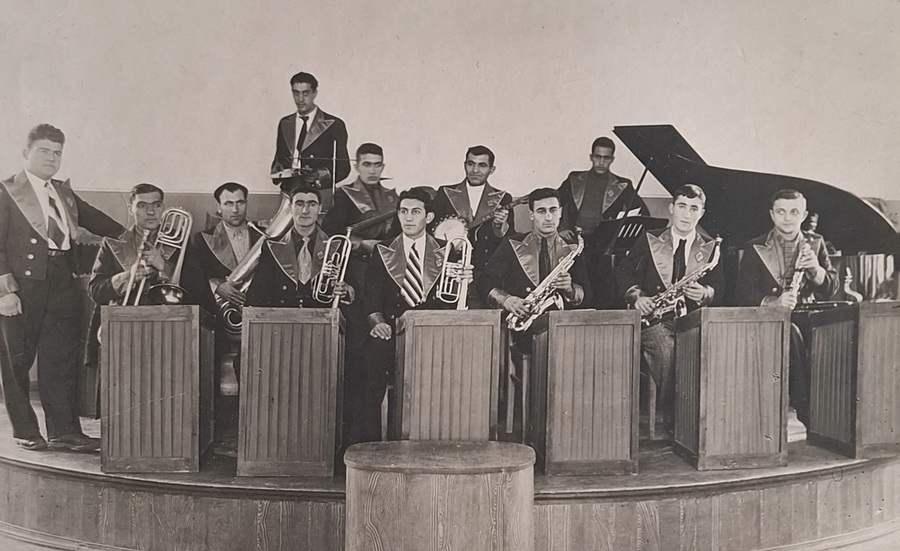
Tsolak Vardazaryan and the Armenian State Jazz Orchestra
Under the direction of Artemi Ayvazyan and Tsolak Vardazaryan, the first Armenian State Jazz Orchestra was established in 1938, initiated by the government of the Armenian Republic. This made it the first jazz orchestra in the Caucasus. The orchestra placed special emphasis on performing traditional national melodies—this was its defining difference. The ensemble presented unique arrangements of urban folklore and Armenian folk songs, alongside works by contemporary Armenian composers, which later became its signature style. The orchestra’s unique theme tune, which opened every concert, was Ayvazyan’s famous «Armenian Rhapsody.»
Despite the horrors of war, the orchestra toured hospitals and front lines, performing concerts for the Red Army and bringing joy to the exhausted public. They performed both Armenian compositions and international hits. One medic noted that she had never seen soldiers sing «Jan Yerevan» while marching to the front.
«Today he plays jazz, and tomorrow he will sell out the homeland!»
During Stalin’s rule, Western influence was taboo, and jazz was no exception. Although jazz in Armenia endured slightly less suppression during the crackdown on Western music—as it was the only orchestra not shut down by Soviet authorities—this impacted its development and name. The orchestra renamed itself the State Estrada Orchestra, making it more appealing to the proletariat tastes of the public. The core remained the same, which even allowed for a greater focus on ethnic and folkloric research.After the war, a complete ban on jazz music was imposed until Stalin’s death in March 1953. Nikita Khrushchev’s policy of de-Stalinization lifted many restrictions across the entire USSR. In the early 1960s, during what is known as the Khrushchev Thaw, there was a significant decrease in repression and censorship. Nevertheless, jazz remained a subject of contention in all Soviet republics.
Rehearsals and performances of the State Estrada Orchestra of Armenia, conducted by Konstantin Orbelyan, at the «Rossiya» Concert Hall in 1984
In 1956, Konstantin (Kotik) Orbelian took the helm of the orchestra. He was already a part of the ensemble, working as a pianist and creating his own jazz arrangements of folk songs. It was upon taking the role of director that he first recognized and implemented the principles of fusing contemporary jazz with national melodies. It was under Orbelian that Armenian jazz reached the international stage: in 1966, the orchestra made its first foreign tour as part of the Days of the Soviet Union in Czechoslovakia, and in 1975, the orchestra became the first Soviet jazz ensemble invited to the United States. They performed 25 concerts across the country, with the final one held at the Lincoln Center in New York.
K. Orbelyan — Journey to the Land of the Sun (Alexander Zakharyan, 1974)
The tradition of continuity in the orchestra remains unbroken: following Orbelian, the ensemble was led by saxophonist Armen Khusnutss, and today the director is saxophonist, composer, and arranger Davit Melkonyan. The orchestra continues its activities in modern Yerevan, regularly performing at the House of Architects, proving that the tradition established in 1938 has not ended but continues to live and evolve.
Levon Malkhasyan: A Living School of Piano
You do not need to use folk instruments to prove that you play Armenian jazz. If you were born in Armenia and possess this national melody, it will inevitably manifest in your music.
Levon Malkhasyan, known as Malkhas, is rightfully considered a living legend of Armenian jazz, whose career is inextricably linked to the development of the entire Yerevan jazz scene. In 1963, while a student at Yerevan University, he founded the city’s first small jazz band—the «Levon Malkhasyan Trio”—which included drummer Armen Tutundzhian (Chiko) and bassist Artur Abramyan. It was with this ensemble that the era of intimate acoustic jazz in Armenia began, and Malkhas himself established himself as a virtuosic pianist who merged the classical jazz tradition with national color.
His influence on the republic’s jazz scene extended beyond performance. In 1968, he organized the first republican jazz festival in Armenia, and in 1998, he became one of the main initiators and founders of the Yerevan International Jazz Festival (as part of the Jazz-Art organization he created). This festival was a true breakthrough—the first event featured ensembles from the United States, Russia, France, Slovakia, Sweden, and Georgia, and subsequently hosted world-class stars such as Herbie Hancock, Diana Bridgesouter, and Arturo Sandoval.


posters for upcoming concerts, sourced from the club’s social media.
Today, Malkhas continues to be a magnetic center for the jazz community. He is the owner and creative driving force behind the «Malkhas Jazz Club» in downtown Yerevan—an iconic venue frequented by international jazz stars. Despite his advanced age (he will turn 80 in 2025), the pianist still performs there. His artistry and organizational efforts affirm that the «old school» of piano playing is a living process, one that continues to resonate within Yerevan’s contemporary club culture and nurture new generations of musicians.
Ethno-Jazz Synthesis: Duduk, Oud, and Folk Melody
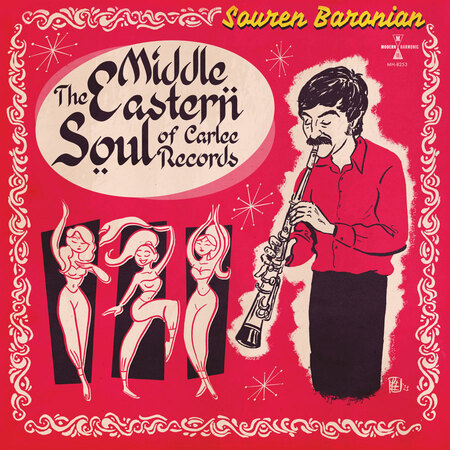
In this section of my research, I focus on how Armenian folk music organically integrated into the jazz language, becoming not merely an exotic addition but a complete foundation for a new sound. Armenian musicians in the diaspora were among the first to master this synthesis. Suren Baronyan, a master of the saxophone, clarinet, and duduk, became one of those who succeeded in merging Middle Eastern music with jazz. His works, such as the album «Middle Eastern Soul, ” demonstrated that traditional Eastern melodies can resonate within a jazz harmonic structure.