0. Navigation
1. Introduction
2. Music and Animation: First Encounters
3. A New Stage in Animation
4. Mickey-Mousing
5. Characteristic Traits of Jazz That «Work» in Animation
6. Instrumental Features of Jazz
7. Rhythmic Techniques of Jazz
8. The Cultural Code of Jazz
9. Conclusion
10. Bibliography
1. Introduction
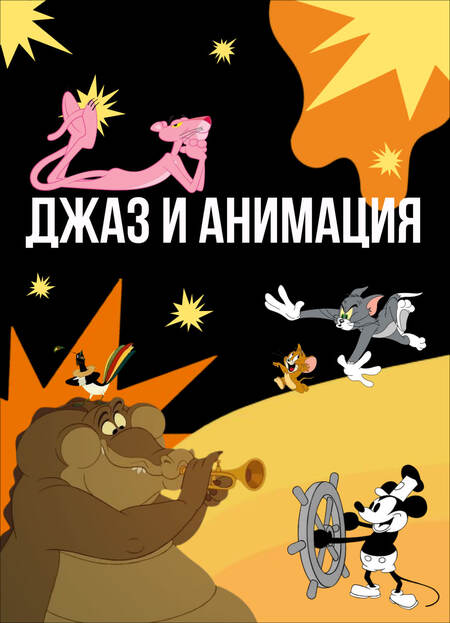
I have always been curious about how much music influences the perception in cartoons. It doesn’t just play in the background; it helps us understand a character, their mood, and even the nature of their movements. In this project, I want to explore how jazz became one of the primary tools in animation. I based my work on several well-known examples: «Mickey Mouse, ” „Pink Panther, ” „Tom and Jerry, ” „The Princess and the Frog, ” and the Soviet film „Strange Voice.“
2. Music and Animation
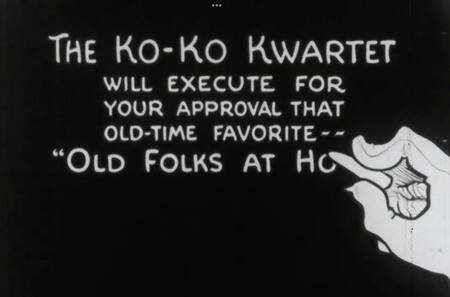
The Fleischer Studio was the first to experiment with sound and animation with its «Song Car-Tunes» series (1924–1927). Thanks to the Phonofilm technology—one of the first systems for synchronized image and sound recording on film—the studio managed to implement the «Follow the Bouncing Ball» technique, where the ball moved in time with the words set to the music—this is how the prototype for karaoke was born. However, a problem remained: the characters' movements still didn’t synchronize with the music.
3. A New Stage in Animation
Walt Disney became a true innovator. He released the cartoon «Steamboat Willie» (1928), which was the first to feature ragtime—the «mother of jazz.»
Excerpt from the cartoon «Willy the Steamboat» (1928).
Directors: Walt Disney and Ub Iwerks.
Composers: Wilfred Jackson and Bert Lewis.
At the beginning of the Mickey Mouse cartoon, he whistles the song «Steamboat Bill» by The Leighton Brothers (1910). Because of this, he is widely considered the first to incorporate a jazz motif into animation.
4. Mickeymousing
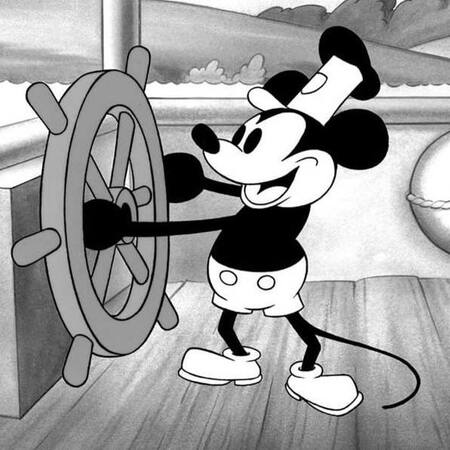
But why did «Steamboat Willie» become a genuine breakthrough in animation? Walt Disney, inspired by the work of the first sound film, «The Jazz Singer» (1927), released his work where he synchronized the characters' movements with the music. Later, Carl Stalling (a composer who collaborated with Disney for a long time) created the «Mickeymousing» system, which later became established in both animation and film. The concept is quite simple—the music literally «voices» every movement we see on screen. There are two types of synchronization: either the music adapts to the picture, or the picture adapts to the music.
A fragment from the cartoon «Willy the Steamboat» (1928).
Directors: Walt Disney and Ub Iwerks.
Composers: Wilfred Jackson and Bert Lewis.
We will analyze how miming works in the animated film «Willy the Steamboat» using a specific excerpt.
We have the character Captain Pete. He takes a bite of chewing tobacco, timing it perfectly to two beats. He then chews: each movement takes half a beat, and turning his head takes one beat. After that, he spits, and this action again spans two beats. To add more visual punch, the sound of the spit is augmented with a whistle that musically depicts the trajectory of the spit using a glissando (a musical term denoting a smooth slide from one note to another). Pete then chews and spits again. Right as the measure concludes, we hear the spit hit the bell—bang.
Next, Captain Pete laughs precisely in time with the music and repeats all the actions. But then the musical motif changes, and we are left anticipating a new, unexpected turn. This time, his next spit hits him. The glissando whistle is interrupted by a sharp slap—the spit landed directly on the Captain. His movement as he wipes the spit off is accompanied by a sharp, descending sound.
In my work, you will often see mikemousing, as this system became fundamental in the creation of animated films.
5. Characteristic Features of Jazz That «Work» in Animation
But what jazz elements «work» in animation? I have broken them down into three major categories: instrumentation, rhythm, and cultural code.
6. Instrumental Features
Let’s start with the instrumental nuances. Jazz instruments in animation have become a unique source of life for characters. With them, creators can imbue a character with personality, convey their emotions, or establish their own leitmotif. Instruments play a key role in underscoring movements, creating comedic effects, or even imitating human dialogue.
A classic jazz ensemble—composed of a brass section (trumpet, trombone, saxophone, clarinet) and a rhythm section (upright bass, piano, drums)—allows for the realization of these tasks, with each instrument possessing its own characteristic emotional tone, rhythm, and style.
6.1 Leitmotif and Characterization
The Panther’s leitmotif occupies a special place in the animated series «Pink Panther,» a theme created by Henry Mancini in 1963. Its core features a tenor saxophone, played in the original recording by Plas Johnson. Mancini initially composed the theme in the style of this musician, which is why the saxophone so perfectly captures the Panther’s languid and confident nature. However, the leitmotif would not be complete without the rhythm section: the upright bass with its «walking» bass line and the piano create that precise pulsation that gives the Panther’s movements musical meaning.Moreover, the leitmotif never sounds the same within the cartoon itself. It constantly evolves depending on what is happening on screen. In some episodes, the arrangement becomes heavier and bass-driven; in others, the tempo accelerates, new instruments are added, or the harmony shifts. Yet, despite all these transformations, the fundamental melodic structure remains unchanged.
A segment from the animated series «Pink Panther, ” episode „We Are Sticking Pink Stamps“ (1965). Director: Houlle Pratt. Composer: William LaVa.
6.2 Hero’s Emotions
In a clip from the series «Pink Vitamin» from «Pink Panther, ” the piece demonstrates how music conveys the hero’s emotions. Initially, we see an exhausted person who can barely stumble toward the counter. His fatigue is conveyed through a viscous, slowed tempo and descending tones from the brass instruments. Their heavy, „sagging“ sounds create the feeling that the hero literally has no strength to stand.
But then Panther gives this person a pill, and a sharp turning point occurs. The tempo instantly accelerates. The brass instruments recede into the background, yielding to the percussion. The music becomes audacious, rebellious, and energetic. This shift in rhythm and instrumentation (from heavy brass to chaotic percussion) illustrates how the exhausted person transforms into a maniac in a single second—he is full of energy and confidence, and now he runs to rob a bank.
Excerpt from the animated series «Pink Panther,» episode «Pink Vitamin» (1966). Director: Houlie Pratt. Composer: William Lava.
6.3 Color Application