Navigation
- From Vessel to Label
- France. The Label as a Sign of Origin
- Italy. The Label as a Reflection of Tradition
- Germany. The Label as an Information System
- Comparison. Three Regions, Three Visual Languages
- Conclusion
Concept
This visual study explores the evolution of European wine labeling—tracing the path from ancient vessel seals to contemporary labels from France, Italy, and Germany. The wine label is examined as both an information carrier and a visual signifier. The study’s focus is on the transformation of its visual language (typography, composition, iconography, and illustration) under the influence of printing technologies, legislation, and the cultural traditions of these three wine-producing regions.
The relevance of this topic stems from the fact that the label remains one of the few packaging elements where historical continuity is immediately visible.
A contemporary designer working on alcoholic packaging or the identity of a gastronomic project inevitably engages with established codes: heraldry, script and Gothic typefaces, engraved images of buildings, and quality grading systems. Understanding the origin of these codes and what each conveys to the consumer allows for their intentional use, rather than mere stylization.
The research hypothesis posits that the set of information on a label (contents, location, manufacturer, date) coalesced by the late 19th century and is universal across nations. The divergences in the visual languages of France, Italy, and Germany, however, can be explained by what each nation prioritized for quality assurance: location in France, tradition in Italy, and quantifiable information in Germany. While printing technologies—notably lithography—expanded pictorial capabilities, they did not define this underlying logic.
Research Goal: To determine how the visual language of European wine labeling has evolved and to illustrate the distinctions between three national models.
To achieve this goal, the following objectives have been set: to trace the evolution of labeling from stamps and marks on vessels and barrels to the first paper labels; to examine the French model, which is based on origin (the 1855 classification, the geographical designation system, and Mouton Rothschild labels); to examine the Italian model, which is based on tradition (Gallo Nero, the Chianti consortium, and the DOC and DOCG categories); to examine the German model, which is based on information (fraktur, Prädikat grading, and the VDP mark); and finally, to compare these three models against uniform criteria and formulate general conclusions.
Research methodology: visual and comparative analysis of labels based on criteria such as primary element, typeface role, composition, illustration, color, and legal influence, supplemented by an analysis of historical sources and museum collections. The illustration sequence has been curated so that every paragraph of text is supported by a specific image, which includes the author, year, and source.
The structure of the work mirrors the logic of the hypothesis. The first chapter describes the general origins—from the vessel to the label. Chapters two through four sequentially explore three national models: France as a sign of origin, Italy as a reflection of tradition, and Germany as an information system. The fifth chapter presents the three regions in a comparative table, and the conclusion formulates an overarching finding: the visual language of the label is determined by what a culture considers proof of quality.
The practical significance of this research is connected to the final project: a private wine club and restaurant, along with a related object—a wine cork keychain. The research findings allow the selection of one of three logic frameworks (place, tradition, or information) for the club’s identity and mandate that the typeface, composition, and sign system adhere to it. Furthermore, it provides a rationale for which label elements are appropriate to transfer to small items, such as the keychain tag.
From Vessel to Label
The label arose as a response to a practical question: what is in the container, where did it come from, and who is responsible for it? Long before paper and printing, the containers themselves carried this information, along with methods of marking them.
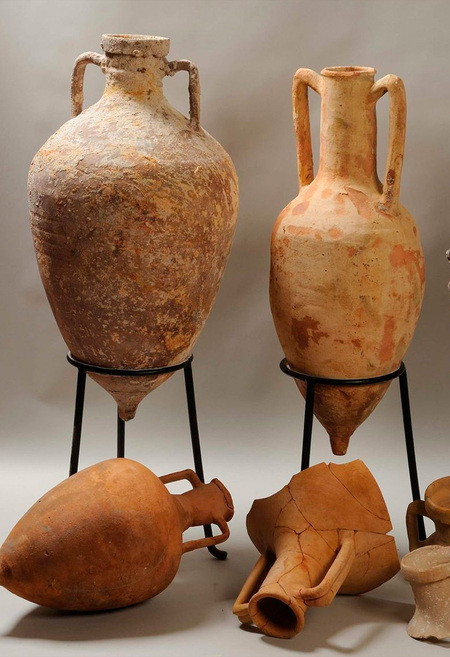
1. Author not listed. Greek wine amphora
In Ancient Greece, wine was transported in ceramic amphorae, and it was here that a system of origin markers emerged. Markings were placed on the handles and necks of the amphorae—stamps that are used today to identify the city of origin: Phasos, Rhodes, Chios, and other winemaking centers. The mark functioned as a guarantee: the buyer recognized not a brand, but a place, and it was this place that served as the primary indicator of quality. This logic would later form the basis of the French system of origin.
2. Amphora neck with a seal. Rhodes. Hellenistic Period 323–31 BCE. Philadelphia
The Romans complicated labeling. In addition to stamps on amphorae, painted inscriptions (tituli picti) appeared, indicating the contents, weight, trader’s name, and origin of the goods, and sometimes even the date. The vessel transformed into a carrier of multiple layers of information: the amphora’s shape suggested what it contained (wine, oil, fish sauce), while the inscription provided the details. This established a principle that will remain forever in the label: the general appearance conveys the category, and the text provides the specifics.
3. Paint inscriptions on Roman amphorae. Finds from Roman Britain, Roman period.
The scale of Roman markings is clearly visible in the example of the Monte Testaccio hill in Rome. It was formed from the refuse of ancient trade—that is, numerous broken amphorae, predominantly from olive oil, dating mainly to the 1st–3rd centuries CE. The inscriptions on the shards allow us to reconstruct trade routes and supplier names. For the history of wine, this example is important as evidence of a system: control over provenance and quantity was organized by merchants and the state, not left to the buyer’s memory.
4.5. Monte Testaccio, Rome. A hill composed of shards from Roman amphorae, primarily used for olive oil. 1st–3rd centuries CE.
During the Middle Ages and the early modern period, wine was primarily stored and sold in barrels. Labeling was limited to burned seals, merchant marks, and guild stamps. Buyers relied on the seller or the region, as wine did not have a separate «label» because the wine itself did not yet exist as an individual bottled product.
4. Nikolaus is pounding wooden hoops onto it. On the ground stands a tub of water, and finished hoops lie nearby. 1425.
In the seventeenth century, the vessel itself began to change. In England, the sturdy, dark, rounded-bodied bottle—the so-called «onion bottle”—emerged, and wine could finally be stored and transported conveniently in glass. Wealthy patrons and taverns commissioned bottles featuring a molded glass seal bearing the owner’s initials, coat of arms, or the year. This seal served the same function as a stamp on an amphora: it identified the bottle’s owner. The vessel itself once again carried a mark of ownership, but this time, it was on the glass.
7. «Onion» bottle, 1700, Bonhams, London
The definitive turning point arrives in the 18th century. Advances in manufacturing sturdy dark glass, the widespread use of cork, and the advent of a lying-down bottle shape made it possible to age wine in the bottle. The bottle became a standalone commodity, and it needed to be labeled. The first «labels» were tags attached to a chain or cord: starting in the 1730s in England, silver labels for decanters (bottle tickets, decanter labels) featuring the drink’s name, such as Madeira or Claret, became common. These were not advertising; they were a form of in-house navigation—the servant needed to quickly identify the contents of the decanter. Alongside these were handwritten labels made of paper and parchment.
(8) Margaret Binley. «Madeira» wine label. London, c. 1770.
Alongside the silver labels, wine merchants also used handwritten and simple printed paper labels. These were affixed to the bottle or tied to the neck, indicating the wine’s name, vintage, and the merchant’s name. Because paper is not durable, few samples have survived, and the exact dates of the first paper labels vary across sources. For this reason, literature typically states cautiously: paper labels were affixed to bottles during the 18th–19th centuries.
The 19th century proved decisive. Lithography, invented by Alois Senefelder in the late 18th century, and subsequently chromolithography (from the 1830s onward) made color printing affordable and mass-producible. Simultaneously, bottled wine transformed into a mass-market commodity, and the label acquired a new purpose—it had to not only inform but also persuade. Heraldry, images of castles and vineyards, ornamental borders, owner signatures, and medals from exhibitions appeared on them. The label became the face of the product.
(9) Wine label for Haut-Brion La Mission, 1895