Concept
Ancient Greek art undeniably played a crucial role in the development of world culture. Its influence can be traced through many centuries and peoples—from the Etruscan civilization and Ancient Rome to the present day. Sculpture is no exception, and the breakthroughs of Ancient Greek masters in realistically depicting the human form became fundamental to the subsequent evolution of this visual art form.
Ancient Greek sculpture traveled a long path—not just from the idealized and generalized figures of the Kouroi and Korai of the Archaic period—youthful athletes and beautiful young women—to the genre sculptures of Hellenism depicting everyday life scenes of ordinary people, but also from static Kouroi to realistic and dynamic representations.
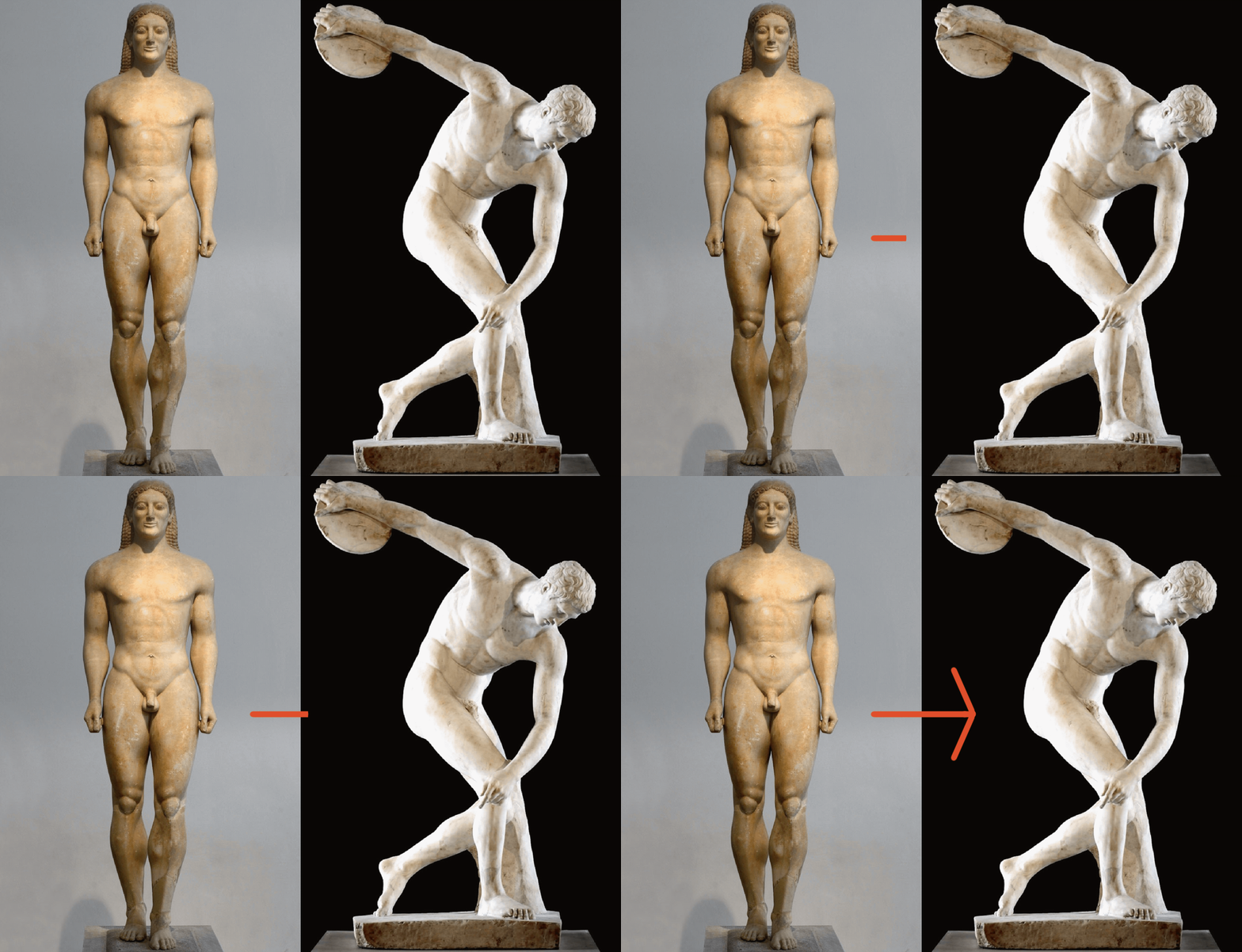
«Caryatid from Anavysos» / c. 530 BCE | Myron / «Discobolus» / c. 450 BCE
For the visual component of my research, I selected some of the most notable sculptures that reflect the trends and characteristics of various periods in Ancient Greece.
In this study, by analyzing notable sculptures from various periods, I aim to trace the trends and evolution of themes and execution techniques within this form of visual art across the centuries. Since the influence of ancient Greek sculpture on subsequent eras—whether through the adoption of fundamental principles, styles, techniques, or themes—cannot be underestimated, its development remains perpetually relevant.
Periodization of Ancient Greek Art
Art from Ancient Greece is generally divided into four main periods:
- Dark Ages (Homeric Period) — 11th–18th centuries BCE.
- Archaic Period — 7th–6th centuries BCE.
- Classical Period — 5th–4th centuries BCE. — Early Classical Period — 490–250 BCE. — High Classical Period — 450–410 BCE. — Late Classical Period — 410 BCE — 4th century BCE.
- Hellenistic Period — 4th–1st centuries BCE.Excluding the Homeric Period, whose main artifacts were made of ceramics, each of the listed sculptural periods possessed its own distinct characteristics. During each of these periods, ancient Greek sculptors achieved notable breakthroughs.
Archaic (7th–6th centuries BCE)
During the Archaic period, monumental sculpture emerged, dominated by two figures: nude athletic youths and beautiful, clothed young women, who began to be referred to as «Kuros» and «Koras» starting in the 19th century.
The kouros, as mentioned previously, is a type of archaic statue depicting the image of a nude athletic youth, yet this is by no means its only characteristic.
«Kuros from Anavisos» / c. 530 BCE
As we can see from the example in the Anavyssos course, this type of statue did not aim for individualized portrait resemblance to a specific person or to reflect the inner world of the depicted hero. The image is highly generalized and idealized; the pose is characterized by frontality and staticity, and the body by strict symmetry. The forward-thrust left leg suggests the masters' striving for greater dynamism, but this breakthrough occurred only in the subsequent period. The anatomy and proportions of the male figure are depicted accurately; the sculptor strives for realism, paying particular attention to muscle detail, thereby emphasizing the athletic and heroic quality of the figure.
The statue from Anavissos retains the «archaic smile» characteristic of the period—upturned corners of the lips while the other facial features remain impassive. This artistic device is particularly typical of statues from the Archaic period.
Like Kurosawa, Kora possesses a frontal and static quality, an unchanging, archaic half-smile, and hands often held at the sides.
«Cora in Peplos» / c. 530 BCE
The Korai in peplos demonstrate one of the main differences between the two primary Archaic figures—while the Kouroi are almost always completely nude, reflecting Greek cultural beliefs that male nudity was not sinful but rather heroic, the Korai are always clothed, adhering to social norms that deemed female nudity inappropriate.
Despite the absence of such a pronounced focus on cortical physiology as seen in the Anvisa piece, the body proportions are rendered accurately, albeit schematically. This reflects the sculptors' aspiration toward relative realism.
Early Classical (c. 490–450 BCE)
Early Classicism is a period of the burgeoning development and flourishing of Greek culture, philosophy, and art. It breaks free from the rigid confines of the Archaic period; artists sought and discovered new ways of representation, including in sculpture.
During the early classical period, there is a transition from the static frontality and schematic nature of archaic art to the harmony and dynamism of high classical art, which is most often associated with ancient Greek sculpture in the contemporary world.
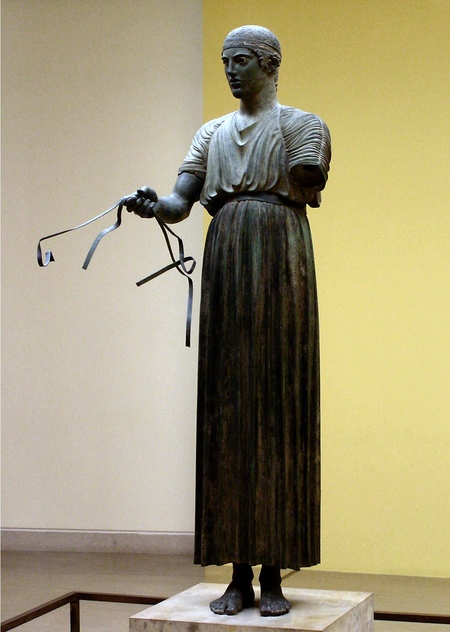
«Delphic Charioteer» / 478–474 BCE
The Delphi Charioteer is one of the most famous bronze statues of the early Classical period. Unlike later statues from the period, the pose of the depicted hero is relatively static, yet it is striking for its realism and detail, demonstrating the progress in the technique of ancient Greek sculptors. Even though the pose may not compare to later works, it features a naturalism and astonishing anatomical accuracy when contrasted with the Archaic period, and the depiction of fabric—the precision of the drapery—can be called revolutionary.
Miron / «Discobolus» / c. 450 BCE
The «Discobolus,» which is lost to us but has many well-known copies, is one of the most famous ancient statues. A primary reason for its fame is the innovation and atypical nature of its highly dynamic pose for that period. The subject depicts a youth one second before throwing a discus: the hero’s torso is twisted to the side, the right arm is drawn back, and the left rests upon the right knee. By combining the pose with detailed rendering of the idealized ancient Greek physique’s musculature, the sculptor subtly conveys the tension and effort of the young athlete, convincingly capturing a fleeting moment in bronze (from which the original was cast).
High Classicism (c. 450–410 BCE)
Polykleitos, a renowned ancient Greek sculptor, wrote a scholarly treatise detailing his mathematical calculations of the «ideal» proportions of the male body, which became a standard for many works of antiquity. Although his rule of ideal proportions was often modified in subsequent centuries, Polykleitos’s work laid important foundations for future studies of the human form.
The scientific treatise by Polycleitus has not survived to modern times, but the sculptor also embodied his ideas in his works. The bronze statue «Doryphoros» (Spear Bearer), whose original is also lost to us, is one of the most striking and recognizable examples.
Polykletos / «Doriphone» («Spearman, ” 450–440 BCE)
The basis of the canon, periodically used to this day, was the head-to-body ratio of 1:7, which is clearly visible on the statue. The early classical tendency toward realism continues in the High Classical period, becoming even more pronounced—the sculptor meticulously renders the spearman’s muscles, the features of his face, and his calm, impassive expression.