Concept
The goal of this project is to investigate the development of the female image in ancient Greek sculpture.
Reflections on the ideal of womanhood continue to occupy people’s minds in modern society. Ancient Greek art laid the foundation for the formation of various cultures. It is interesting to examine how the female image—a cornerstone of art—was conceived.
Ancient sculptors admired the beauty of the female form, but capturing it in stone required not only considerable effort and time but also an interest in the inner world of the human being.
The conceptual research involves examining the visual techniques employed in female sculptures across various historical periods of Ancient Greek art. It also studies how the inner world of women was represented by the Greeks through literary heroines, which serves as a supplement to revealing the artists' intentions.Visually, the research adheres to the chronology of artistic development in Ancient Greece.
Navigation
1. Archaic Period of Ancient Greek Art. Cora.
2. Classical Period. Ancient Greek Art.
3. Hellenistic Period.
The Archaic Period of Ancient Greek Art. Kore.
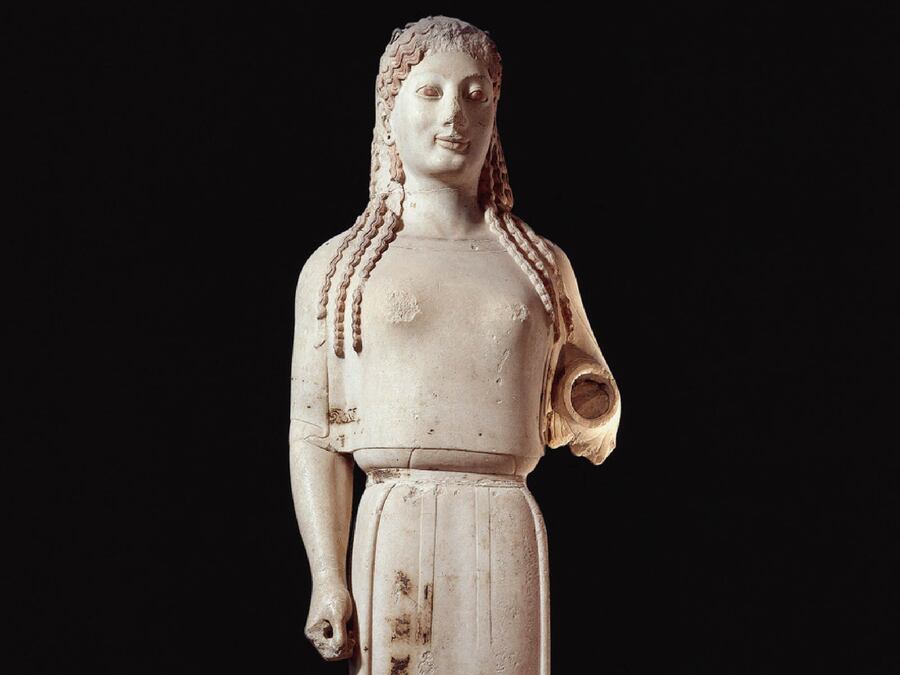
Corinthian in Peplos. c. 530 BCE. Marble. Acropolis Museum, Athens.
One of the earliest depictions of the female figure in ancient Greek art are statues known as Kore. They were presented as offerings to the goddess Athena. The statues portrayed a girl frontally, with an upright posture, in draped clothing, and with an emphasized waist.For sculpture from the Archaic period, depicting individual features of the face and body was not characteristic. The Kore are no exception—the figure’s proportions are rendered accurately, but there is no plasticity or movement. The face features the symmetrical Archaic smile.
Left. The Kore of Antenor. Sculptor Antenor. Approx. 530 BCE. Acropolis Museum. Right. Kore in Ionic chiton and himation. Approx. 520 BCE. Marble. Acropolis Museum, Athens.
Despite the general stateliness of the female form, sculptors conveyed beauty and individuality through the folds of the chiton and headwear adorned with ornamentation.Unlike the male figures, the female figures were always clothed, which suggests the sacredness of the female body to sculptors of the Archaic period. Furthermore, the female image was consistently associated with beauty and refinement; consequently, the statues are depicted with a pronounced waistline and are holding up the hem of their chiton.
The Ideal Woman of Homer
J. Flaxman. Penelope Unraveling the Cloth. Illustration to the «Odyssey.» 1805. Line engraving.
«None is pleasing to my heart: neither the supplicant seeking refuge, nor the wanderer,
Nor the herald, the servant of the people; only one is desired
by me—Odysseus; my heart demands him without cease» [5, p. 234].
The Image of Penelope. «It encapsulates the ancient Greek conception of woman—of the ideal wife. <…> Penelope was the queen of Ithaca, Odysseus’s wife, who married out of love and remained faithful to her husband in Ithaca throughout 20 years of separation, never ceasing to believe in his return despite the rumors of his death.» [12] Cloaked in an intricately embroidered chiton, with a delicate, static figure, she depicts the beautiful and faithful woman that Penelope was.
2. Classics. Ancient Greek Art.
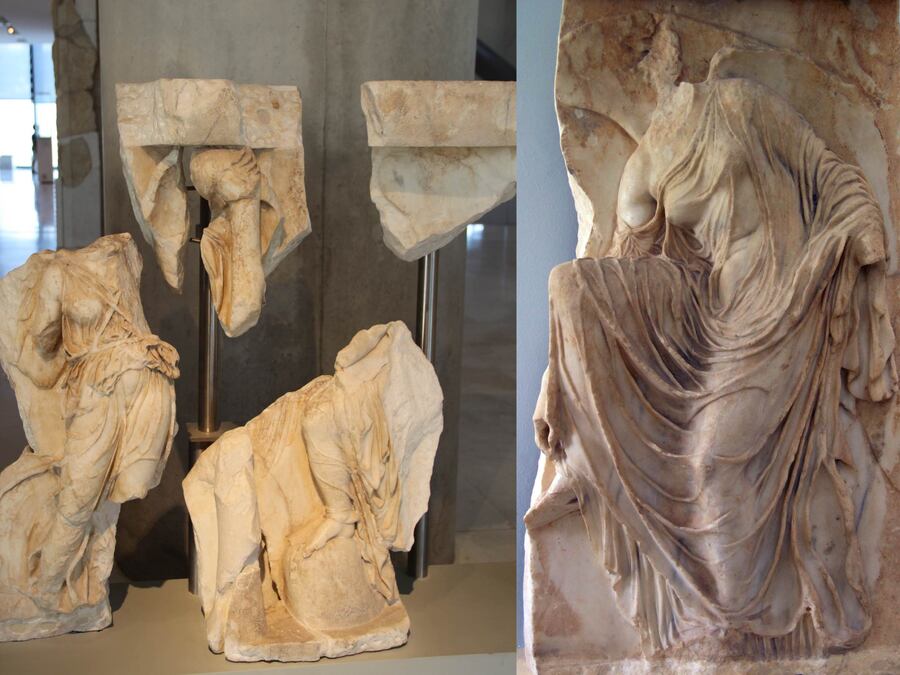
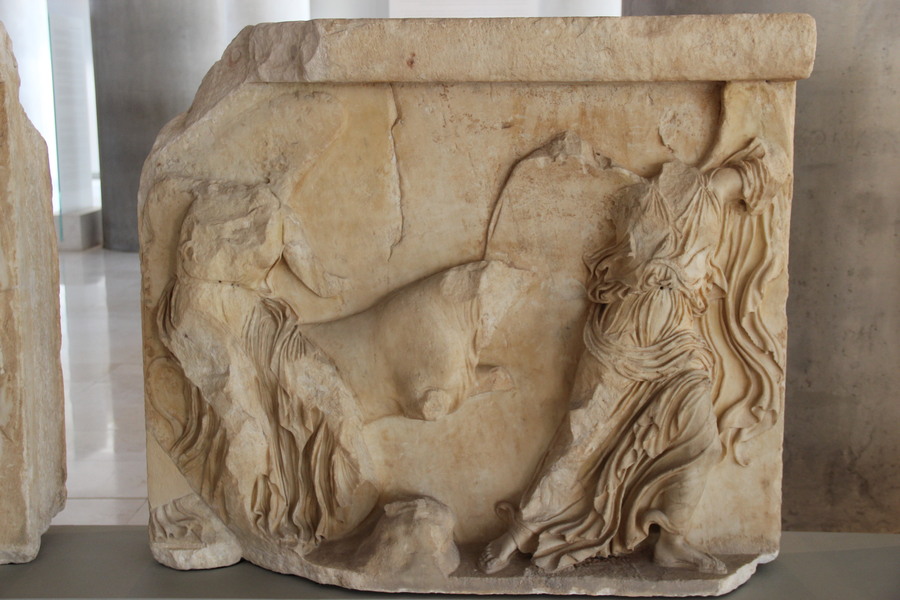
Fragments of the balustrade from the Temple of Athena Nike (Nike). Circa 410 BCE. Pentelic marble, relief sculpture. Acropolis Museum, Athens.
In the classical era, ancient Greek art undergoes significant transformation. Human figures become more dynamic and emotional.The reliefs of the Temple of Athena Nike seem to come alive. Here, the pose of the female figure is not static; her entire body is in motion, resisting the power of the bull.Particular attention is drawn to the drapery—fabrics still feature abundant folds, but these creases are no longer symmetrical. The fabric is carved in a way that conveys all the curves of the body, as if a sheer veil has enveloped the female figure.Nudity is still not possible in female sculpture. The body is exposed, yet it retains an air of mystery.
The bas-relief scene, «Two Nymphs Leading the Sacrificial Bull,» is highly emotive. It operates through the contrast between the powerful, tense body of the bull and the delicate, supple figures of the young women. The female figures remain tender and sensual, despite the circumstances.
Peony Mendsky. Nike. OK. 420 BCE. Marble. Archaeological Museum of Olympia.
In the classical era, masters of ancient Greek sculpture began employing the contrapposto technique. This allowed the marble to appear alive, giving the statues a sense of dual posture simultaneously. The first posture shows the figure standing still, while the second suggests the left foot stepping forward. This state made the body appear highly natural.
The sculptor Peony used the contrapposto technique in his work on the statue of Nike. The goddess steps forward with her left foot to meet the element, indicated by the eagle in the folds of her chiton. This creates the impression that she is frozen in place, signifying victory.
Thanks to the drapery of the chiton, the goddess appears to soar through the air, even without the wings, which have not survived.
Nike embodies an inner strength, reflected in her firm posture. The asymmetrical movement of her arms and the hem of the chiton conveys the emotionality of the scene. The fabric covers her figure, exposing her chest and clinging closely to her hips.
«…Nika Peonia carries her spirituality while wearing the chiton.» [10]
Medea
«Oh, woe! Oh, agony! Oh, agony, and you,
Powerless sobs! You, children…
Oh, may you be cursed along with
the father who bore you!
May our whole house perish!”[7]
A. Mukha. «Medea.» Renaissance Theater Poster. 1898. Color lithograph. Fragment.
The ancient Greek playwright Euripides contemplated the female image in his works. He reinterpreted already established literary heroines, such as Homer’s Helen.Like the female sculptures of the Classical era, Euripides’s heroines came to life. In the play Medea, the character of the young woman is depicted in multiple dimensions. The heroine appears as a young woman blinded by jealousy and deeply in love. Medea cannot tolerate betrayal, which ignites a passion for vengeance within her.The faces of ancient Greek female sculpture from the Classical era remain expressionless, yet the passion is evident in the movement of their bodies and drapery. The female image becomes more multifaceted and natural.
Aphrodite Knidskaya. A Revolution in Late Classicism.
Praxiteles. Aphrodite of Knidos. c. 350–340 BCE. Roman marble copy. Pio-Clementino Museum, Vatican.
During the Late Classical period, a revolution occurs in female sculpture. Praxiteles creates his most famous work, «Aphrodite of Knidos, ” a completely nude statue of the goddess. The female body loses its sacrality in representation, yet it remains so within the context. The sculpture depicts a scene before bathing, drawn from myths about Aphrodite, which constitutes a ritual of purification.Praxiteles created works that departed from established canons—a freedom of the artist and a move away from classicism are evident here. The sculptor carved gods in tranquil scenes: the muscles are relaxed, the body takes on a curved form, the legs are semi-bent, and the face conveys serenity. Thanks to this approach, Praxiteles refined the female image in sculpture. Aphrodite emerges sensual, yet not athletic, thereby conveying the figure’s natural plasticity.
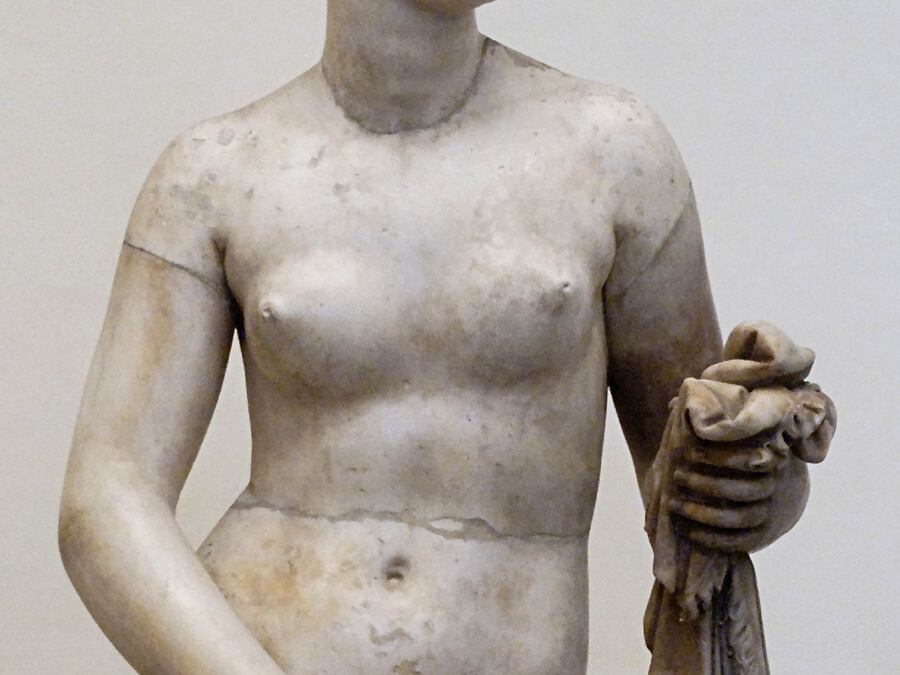
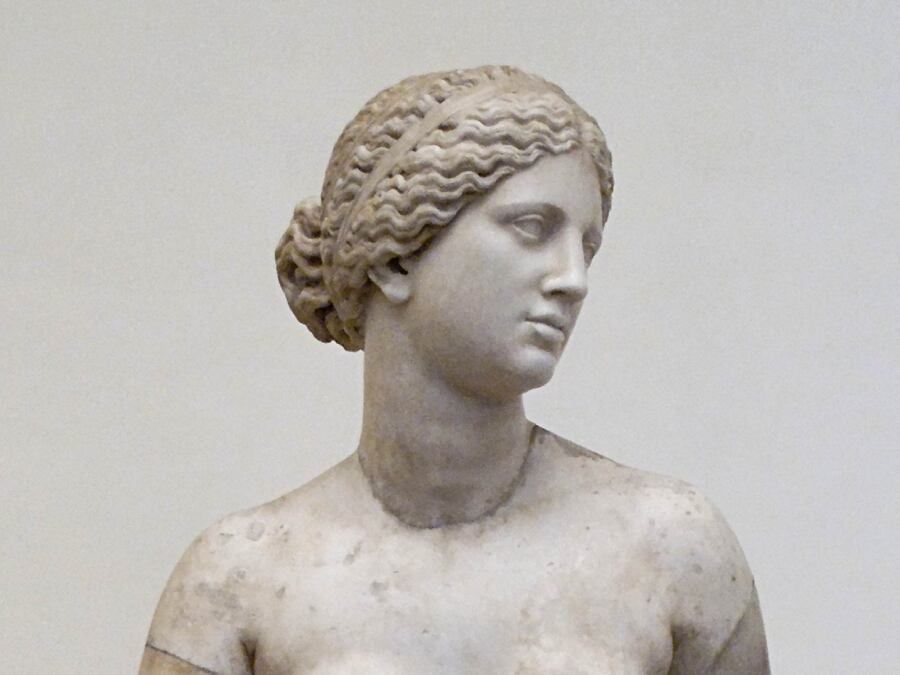
Praxiteles. Aphrodite of Knidos. c. 350 BCE. Roman copy, marble.