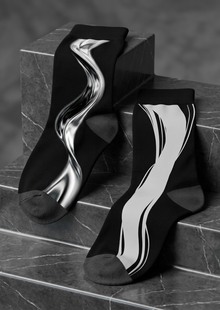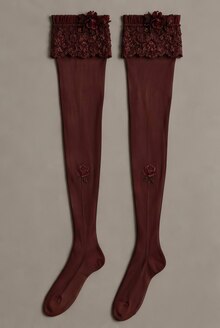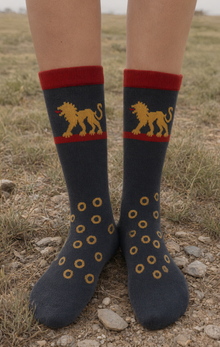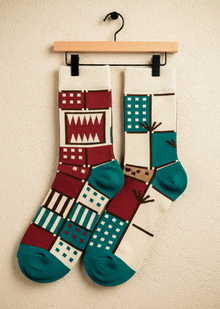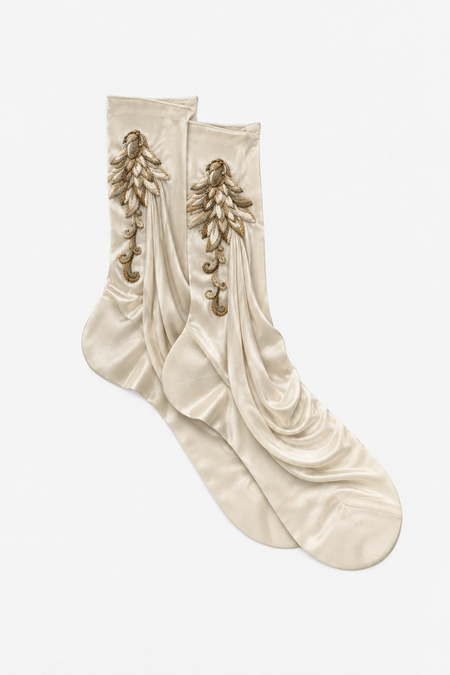
Concept
Socks created as part of a project exploring the historical reinterpretation of the female body. The fashion house Margaine-Lacroix primarily focused on lingerie, which is why the dresses from this house have a distinctly boudoir style. Seamstress Jeanne Lacroix aimed to free women from structured, unnatural shapes. Her goal was to gently sculpt the female figure using corsetry and, through the dress, to highlight the natural fluidity of the form, thus revealing the inherent beauty of the female body.
Sylphide/Tanagra replica—this historical reconstruction offers a new perspective on the female body from the early 20th century.
The key feature of the piece is the draping, which evokes the Tanagraean gown. The silk fabric gently envelops the leg, forming folds that are secured beneath the embroidery.
Visualization
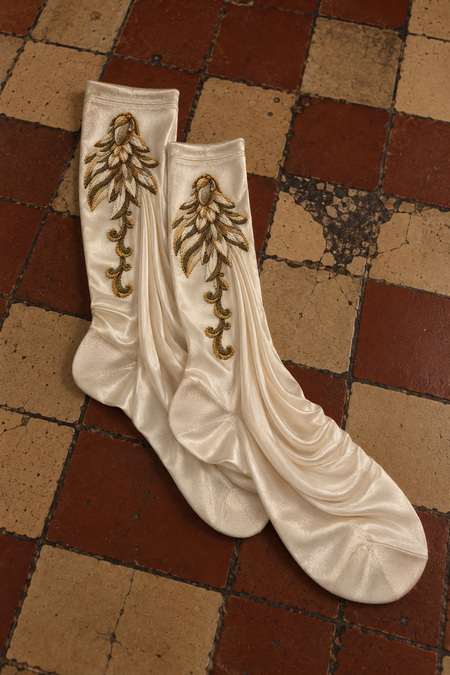
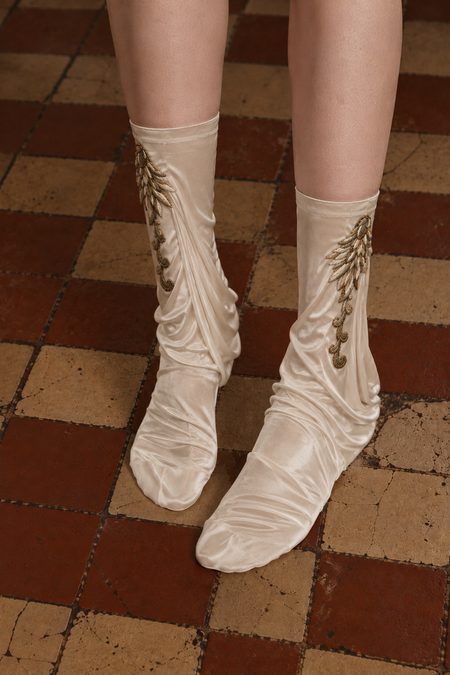
Technical Requirements
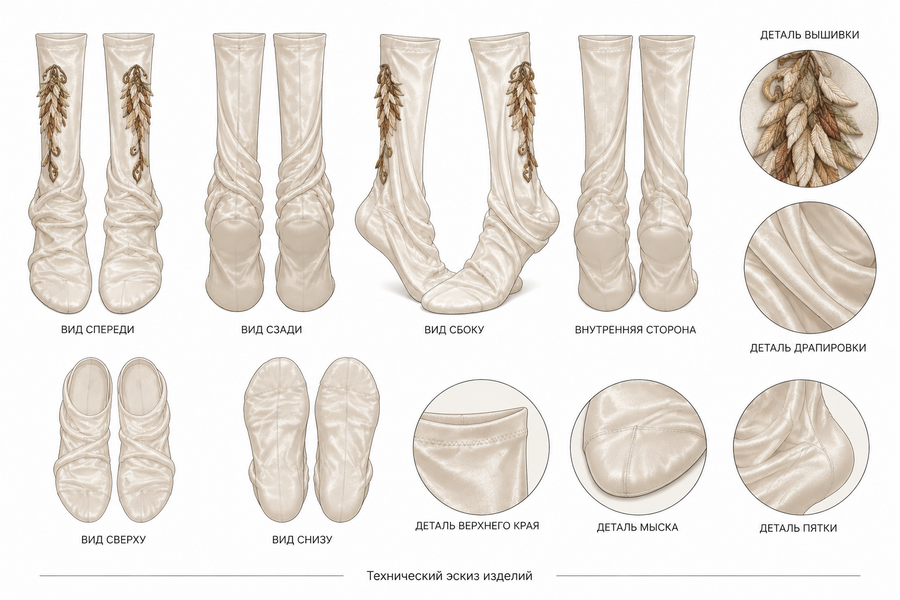
Designer socks—high silk socks featuring decorative draping and embroidery with silk threads.The size is custom-made, tailored individually based on foot measurements and the intended height of the sock. The construction allows for a close-fitting silhouette with soft draping across the calf and foot.The material is natural silk, characterized by a smooth surface, lustrous sheen, and a soft, pliable texture. The decorative embroidery is executed using silk threads. A lining is not included.The color palette combines a light ivory base with beige, brown, and gold embroidery accents.The decoration method involves hand-embroidery with silk threads, forming a voluminous botanical composition placed along the sides of the socks. The draping is created through specific design features and
Materials, manufacturing cost calculation
Production of one experimental sample of natural silk socks with draping and embroidery using silk threads — 13,500 ₽.Cost of goods for a small drop of 10 pieces — 135,000 ₽.Total budget for producing the sample and the main batch — 148,500 ₽.Estimated retail price for one pair of socks — 15,000 ₽.Total revenue from selling 10 pairs — 150,000 ₽
Production Stages
- Design Development
An original design was developed for high silk socks, based on a combination of the exquisite texture of natural silk, soft draping, and decorative embroidery. The model features high-cut socks with a close-fitting silhouette, crafted from light ivory natural silk. The main decorative element is voluminous embroidery with silk threads, forming a descending botanical composition located on the sides of the garment. The interplay of beige, brown, and golden hues creates a striking ornament that emphasizes the direction of the drape and the texture of the material. The decorative elements unite both socks into a single composition, achieving a balance between the simplicity of the form and the expressiveness of the finish.
- Pattern Making and Cutting
Socks patterns are developed taking into account the anatomical shape of the foot, the height of the garment, and the characteristics of natural silk. The main components include the front and back sections of the sock, as well as elements that shape the foot, heel, and instep. When developing the construction, attention is given to the garment’s fitted quality, the grainline direction, and the necessity of preserving the material’s soft drape. Natural silk with a smooth surface and a distinctive sheen is used for manufacturing. Cutting is performed according to the prepared patterns, factoring in seam allowances, fabric direction, and the subsequent placement of the embroidery. Particular attention is paid to the placement of the decorative composition along the sides of the socks to ensure symmetry and harmonious element integration.
- Garment Construction
The sock components are joined using fine and durable seams suitable for working with natural silk. The main sections of the garment are formed, including the foot, heel, instep, and the top cuff. During sewing, the characteristics of the silk fabric—its plasticity and ability to form soft folds—are considered. Draping is achieved through the structural design and the distribution of the fabric, creating expressive volumes around the calf and foot. The upper edge is finished with a neat seam that ensures comfortable fit. At this stage, the symmetry of the items, the quality of the piece connections, fit, and the preservation of the original sock shape are verified.
- Application of Decorative Elements
Manual embroidery using silk threads of various shades is utilized to adorn the socks, forming a