«THE HUMAN GUITAR» is a media outlet for musicians who don’t just want to watch lessons—they want to finally start playing.
The media platform isn’t trying to become just another massive library of lessons. Its purpose is to help a person figure out what to do with their guitar right now. It’s not simply about offering guitar playing lessons, but about creating a clear learning path where every piece of material addresses a specific user problem.
The project operates within the field of music education, but it utilizes the format of modern digital media: short videos, analyses, interactive exercises, challenges, and self-study materials.
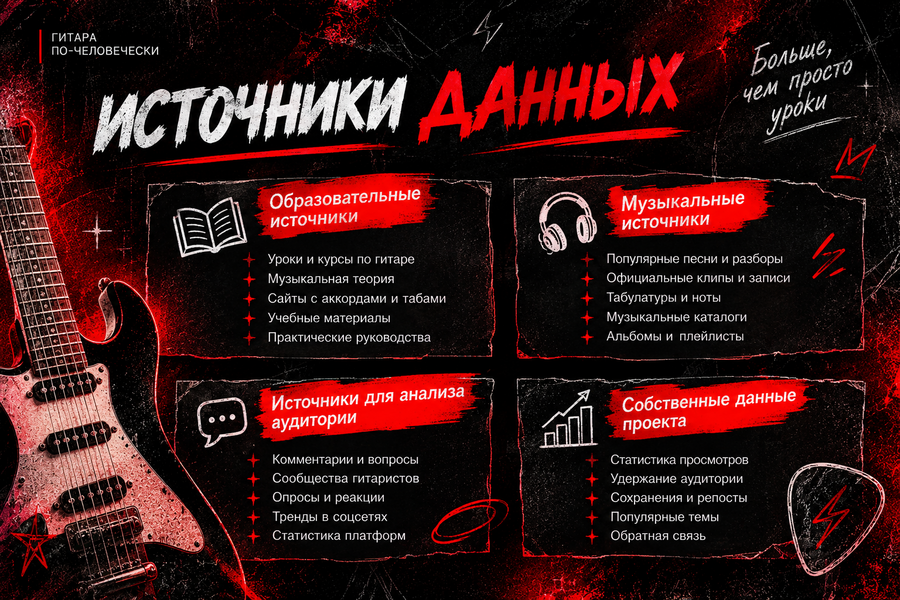
DATA SOURCES FOR MEDIA
To prepare materials, the project utilizes several groups of sources. These help in finding themes, verifying information, selecting musical examples, and understanding audience interests.
DATA SCHEMA WITH HUMAN AND MACHINE PROCESSING SEPARATION
Data handling within the project is structured around a principle of dividing tasks between automated services and human input. Machine processing aids in faster collection, sorting, and structuring of information. Human processing is responsible for verification, interpretation, content quality, and creative input.
The project workflow consists of several stages:
GUIDELINES FOR AUTOMATED SERVICES
Automation in the «GITARA PO-CHELOVECHESKI» project helps to quickly find information, systematize materials, and prepare publications. At the same time, it is important to maintain the accuracy of the musical information and the media’s unique creative approach.
Services Used
ChatGPT — information structuring, drafting, brainstorming ideas, and generating headlines.Perplexity — information retrieval and source curation for verification.YouTube Studio — analyzing views, audience retention, and engagement.Google Sheets — organizing chords, tabs, sources, and statistics.Notion / Trello — material storage, topic database management, and content planning.CapCut / DaVinci Resolve — video editing and publication design.
Guidelines for Working with Automated Services
Information Management — Utilize automation for material retrieval and organization. — Verify chords, tabs, and musical facts. — Maintain records of all sources used.Music Material Handling — Employ automatic chord generation only as a preliminary check. — Independently verify the accuracy of notes, rhythm, and sound quality. — Respect copyright for music and tablature.Text Handling — Leverage AI for drafting and editing content. — Do not publish AI-generated material without thorough review. — Maintain a simple, approachable, and clear media style.Publication Process — Use automation to prepare the content plan. — Ensure materials align with the project concept. — Proofread all text, video, captions, and links before publishing. — Maintain a consistent visual style across all media.
What cannot be fully automated
Technical Execution Review — requires musical aptitude and practical experience.Technique Explanation — it is important to demonstrate hand movements and analyze errors.Material Complexity Assessment — the level of the audience must be taken into account.Development of Personal Style — the project must retain its unique voice.
General Principle of Automation
The Machine handles information processing speed, search, and the execution of repetitive tasks. The Human is responsible for musical precision, review, clear explanation, and the final content of the publications.Automation helps make media production more efficient without replacing what is most important—the live musical experience and human interpretation.