Navigator
The Evolution of the Greek Vase from approximately 1050 BCE to the 3rd Century BCE
- Concept
- Premise and Significance
- Geometric Style
- Orientalizing Period
- Black-Figure Vase Painting
- Red-Figure Vase Painting
- White-Ground Vase Painting
- Late Classicism
- Hellenism and Gnathian Vases
- Conclusion
- Sources
1. Concept
Visual Research Concept «The Evolution of Greek Pottery: A History of the Vase» The selection of the topic, «The Evolution of Greek Pottery: A History of the Vase, ” stems from the fact that ceramics allow one to trace the development of ancient Greek art through an everyday object. The vase was used for storing food and performing rituals, and its shape, ornamentation, and painting reflected people’s ideas about beauty, nature, and mythology. Changes in pottery illustrate the development of technologies, trade connections, and the artistic language of Ancient Greece. This topic allows for the study of history through objects of material culture. Materials are selected based on the principles of historical sequence and visual clarity. The research includes samples from major stages: Minoan and Mycenaean vessels, pieces from the Geometric and Orientalizing styles, black-figure and red-figure vase painting, and pottery from the Late Classical and Hellenistic periods. Preference is given to works that clearly show the characteristics of the era: the vessel’s shape, the decoration technique, color, and the nature of the images. For each example, the title, approximate date, artist’s name (if known), and museum or collection are provided. Images are predominantly chosen from museum catalogs, where attribution and dating can be verified. What matters is not the volume of illustrations, but their ability to demonstrate change. The research is structured chronologically—from the early cultures of the Aegean world to the Hellenistic era. Within each period, examples are examined based on common features: the shape and purpose of the vessels, manufacturing and firing techniques, painting methods, ornamentation, and subject matter. This structure…
2. Premise and Significance
Greek pottery cannot be simply called household ware; it is the primary visual archive through which we can trace the state of Greek culture and its evolution. Since the monumental painting of Ancient Greece is poorly preserved, it is the decorated vases that help us trace the evolution of drawing.
Greek vases are one of the most recognizable archetypal images of ancient Greece. The designs depicted on these vases formed the basis for many modern visual motifs.
The Greeks did not invent the potter’s wheel, but they certainly perfected it.
3. Geometric Style
After the Mycenaean palaces fell, art became simplified. Vases transformed into strict geometric forms, and the human figure lost its anatomy and became streamlined.
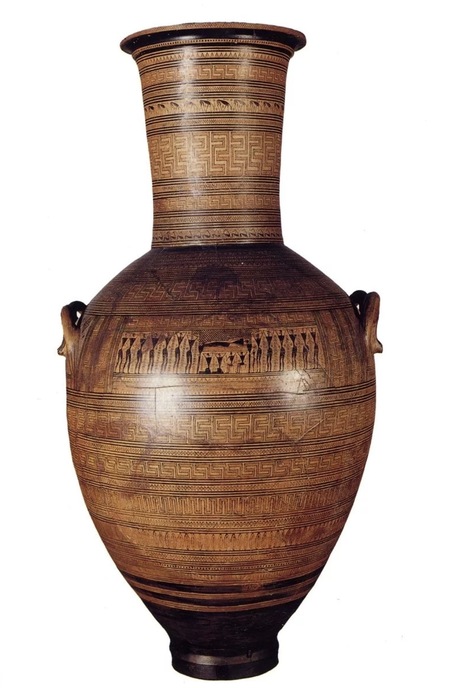
Dipylon Amphora (circa 750 BCE, Athens, National Archaeological Museum). A massive vessel (1.55 m high) used as a tomb marker. The surface is divided into rigid friezes. The figures of mourners and chariots are constructed from triangles and rectangles.
An amphora is an ancient vessel immediately recognizable by its characteristic shape: flared at the top, tapered at the bottom, with a narrow neck and two vertical handles.
Characteristic features of this period include: a fear of the void, rows of horses and warriors, displayed bodies on funerary amphorae, rhythm, and restraint.
4. Orientalizing Period
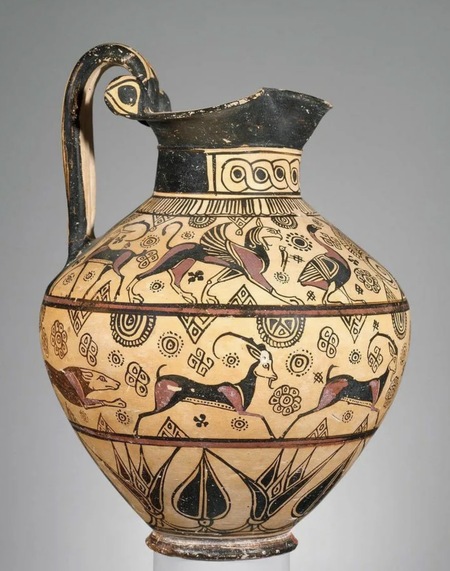
During this period, there is a return to the depiction of myths. It is also characteristic of borrowing motifs from the East (such as lions and sphinxes). Corinth becomes the main center, and later, Athens. The Greeks invented complex triple firing, which allows for a glossy black silhouette on a red clay background.
Olpa in Oriental style
This period is characterized by: black figures and details that have been incised by the chisel. Female figures begin to appear, covered in white paint, along with ornamental rosettes beneath the vase handles.
Dinos with ring handles from Etruria
5. Black-figure Vase Painting
The Eyes Cup «Dionysus» by Exekyia
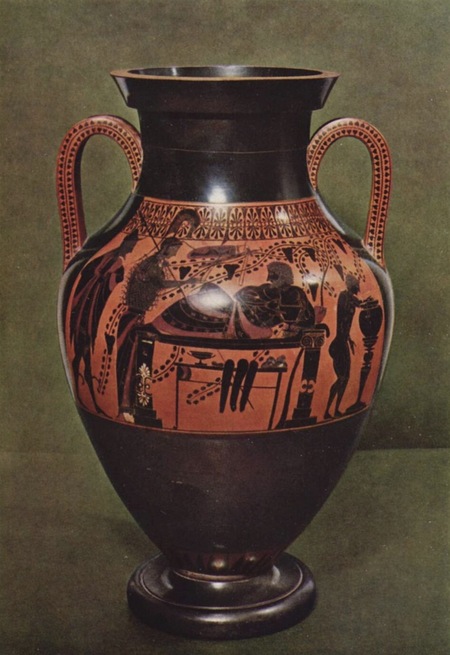
During this period, there is a return to mythological imagery. The borrowing of motifs from the East—such as lions and sphinxes—is also characteristic. Corinth becomes the main center, followed by Athens. The Greeks invented a complex triple firing, which allowed them to achieve a glossy black silhouette against a red clay background.
Black-figure Attic amphora
This period is characterized by: black figures and details incised by a chisel. Female figures appear, covered in white paint, and an ornamental rosette appears beneath the vase handles.
6. Краснофиgure Vase Painting
The technology has changed: the background is covered with black lacquer, while the figures remain the color of red clay. This allowed the artisans to eliminate the need for incising. Greek masters gained the ability to paint with a brush, as if on paper, which enabled vase painters to begin conveying perspective and emotion.