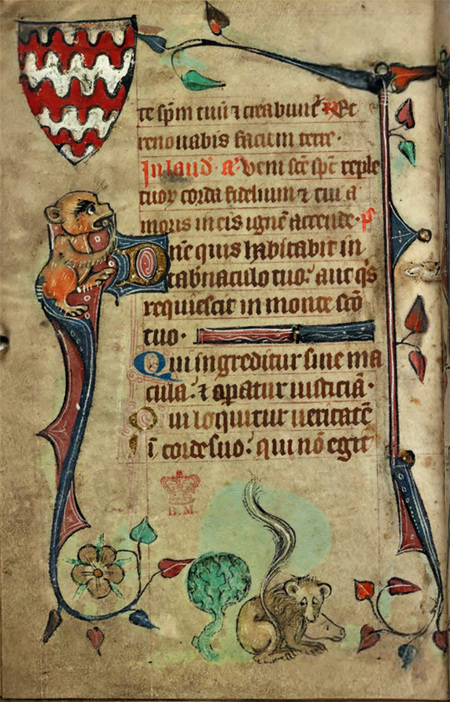
On the margins of an English timepiece from the first quarter of the 14th century, a hare goes hunting, a fox preaches to the birds, mice besiege a cat’s fortress, and a human retreats before a snail [3; 6]. It is not only the unusual nature of the scenes that is surprising—each one is easily recognizable, even though what is depicted contradicts conventional experience. The hare remains a hare, the fox remains a fox, and the snail remains a snail. What changes is how they act, whom they interact with, and what reaction they elicit from other characters.
I. Concept
This study is not about finding a singular «secret meaning» in humorous drawings, but rather about how the artist uses visual means to make an impossible situation understandable to the viewer. The primary artifact selected is Harley’s Hours of the Lord No. 6563 (library code Harley MS 6563), created around 1320–1330. Small, colored illustrations appear in the margins of most surviving leaves. Some occupy two adjacent pages; others continue across several episodes. The original pages featuring large miniatures were later lost, making the preserved book an exceptional resource for closely examining the marginal graphics.Focusing on a single artifact rather than a large selection of manuscripts allows for a closer examination of how different techniques function within one book. If one were to collect the funniest images from different centuries and countries, they could easily be grouped only by their external eccentricity. However, such a collection would tell little about how scenes are constructed. In Harley’s Hours, the characters operate within a relatively unified visual environment: some narratives fit into a small composition, while others take up a full spread or continue onto the next sheets. This provides material for comparison without requiring that every drawing be assigned the same meaning.I am interested in the tension between a recognizable form and an unexpected action. It is particularly interesting that such a reversal appears alongside serious religious scenes. The Hours depict the parable of Lazarus, the rich man, and the poor man. In this narrative, the change in the characters' positions serves as a moral lesson, not a comedic effect [1; 6]. This proximity helps to test whether the inversion is itself a form of humor or whether its meaning is determined by how and in what context it is depicted.
The hypothesis of this research is that the «confusion» effect arises when a familiar role is transferred to an unexpected character or when the usual power dynamic is reversed. However, the inversion itself does not necessarily create a comedic effect—its significance depends on the context and the plot’s development. During this study, I aim to determine how familiar representational forms generate a sense of a flipped world, and why similar artistic techniques can be employed in both comedic and didactic narratives. The analysis is based on the catalogue of the British Library and the publication by Eleanor Jackson [3; 6]. Controversial interpretations of the snail motif are examined with reference to the research of Lillian Randall and materials from the British Library [4; 7]. When interpreting marginalia, it is important to distinguish between what is depicted in the image and hypotheses regarding its historical meaning—a distinction Michael Camille addresses in his study of medieval marginal culture [5].
Navigation
I. Concept II. Role Definition III. Perceived Superiority IV. Subversion V. Reinterpretation VI. Conclusion and Bibliography
I decided to use this categorization to systematically explore different methods of creating visual contradictions in medieval marginalia. The study’s structure is built upon a progressive increase in the complexity of pictorial techniques—from individual characters and their unusual roles to more complex interactions and entire narrative sequences. This division allows one to trace how the perception of the imagery changes depending on the characters' gestures, behavior, relationships, and the development of the action. Furthermore, the sequence of sections creates a distinct dramatic arc: from an introduction to the unusual structure of the inverted world to a deeper understanding of its artistic characteristics and potential meanings.
II. Defining Roles
In a small, marginal scene, the artist does not need to detail the setting for the viewer to grasp the action. A simple object in the paws and a familiar pose suffice. On the 20r–20v plates of Harley’s Clockmaker, the hare is depicted with hunting gear, and subsequently with its prey [3; 6]. Its long ears and elongated snout maintain the animal’s recognizable features; the viewer primarily determines the human element based on the hunter’s accoutrements and the sequence of events. The paradox arises because the role of the pursuer is assigned to a creature that typically serves as the prey itself.
The Hunter Rabbit. Harley MS 6563, side 20r–20v. Unknown artist. 1320–1330.
To compare, let’s look at two scenes featuring the fox. On plates 22v–23r, it appears as a teacher addressing the dog, who is holding a book [3; 6]. The open book in the mentor’s hands, the text held by the student, and their orientation toward one another create a recognizable teaching scenario. What matters is not merely the ability of the animals to perform human actions, but the role assignment: the fox occupies the position of the knowledgeable and authoritative figure, even though in fairy tales it is more often associated with cleverness than with wisdom.
The fox teacher and the dog student. Harley MS 6563, plates 22v–23r. Unknown artist. 1320–1330.
This technique is even more evident in the scene on folios 54v–55r: the fox is delivering a sermon to birds. Its raised paw, staff, and the assembled listeners in front of it indicate a public address. The birds form an audience, and attention is focused on the figure speaking [6]. However, this familiar trope of preaching proves unreliable: on another folio of the same manuscript, the fox is depicted with a bird in its mouth. Eleanor Jackson connects these narratives to the tradition of Renard, the clever fox, and allows for a satirical reading of the image of the false mentor [6]. This is not grounds to attribute mockery of a specific spiritual figure to the miniature, but it is reason to note the contradiction between the venerable posture and the behavior of a predator.
Fox preaches to birds. Harley MS 6563, fol. 54v–55r. Unknown artist. 1320–1330
The rabbit receives the trappings of a hunter; the fox adopts the gestures of a teacher and a preacher. In all three instances, the character itself remains almost unchanged—only its role becomes alien.
III. Apparent Superiority
In scenes depicting the confrontation between humans and snails, the disruption of expectation is conveyed differently. Here, the characters don’t change through their activities; the focus shifts to the human reaction to a creature that doesn’t inherently appear threatening. On plates 62v–63r, in Harley’s Hourglass, the armed human yields to the snail [3; 6]. The artist illustrates this incongruity not so much through size, but through behavior: one might expect the human to dominate, yet they adopt the posture of the defeated party.
Man Yielding to a Snail. Harley MS 6563, l. 62v–63r. Unknown artist. 1320–1330.
To ensure this is not a feature specific to one drawing, we will compare it to a miniature from the Gorlston Psalter. On folio 162v, a person kneeling is depicted before a snail [2; 4]. In both instances, the snail remains recognizable—with its shell and familiar body shape—while the pose of the human figure lends it an improbable superiority. The second miniature confirms the repetition of the graphic formula but does not prove its singular meaning.
Figure of a man before a snail. Gorlstonskaya Psalter, Add MS 49622, fol. 162v. Unknown artist. 1310–1324.
Lillian Randall dedicated a special article to this motif, proposing a connection between the snail and the image of moneylenders; other researchers put forth different explanations, and there is no general consensus on interpreting the narrative [4; 7]. Therefore, it is more important not to guess at a hidden symbol, but to document what is visible: the snail itself does not create the threat—the reaction to it does. In the previous chapter, objects and gestures played an unusual role. Here, the human posture becomes decisive, altering the conventional balance of power.
IV. Revolution
In previous scenes, the contradiction could be noticed through a single gesture or reaction from the character. However, artists like Chasoslov Harli could develop a turning point across several pages. At that point, the viewer is no longer just recognizing an unusual situation—they have to follow its development, remember previous episodes, and wait for the resolution.
The most expressive example is the story of the cat and mouse standoff. It spans four consecutive spreads, from leaf 71v to 75r [3; 6]. Initially, the mice besiege the cat’s stronghold. The unusual nature of the narrative is evident immediately: typically, the cat chases the mouse, but here it is the mice who have organized the attack. Furthermore, the artist utilizes a recognizable military narrative scheme: the fortification, attackers, and defenders are positioned opposite each other. The reader can easily grasp what is happening, even though the participants do not conform to conventional roles.
Mice besiege the cat fortification. Harley MS 6563, fol. 71v–72r. Unknown artist. 1320–1330.
On the next spread, the dynamic shifts: now the cats assault the mice’s stronghold [6]. We are no longer looking at a standalone image featuring «mouse soldiers,» but rather a narrative of a fluctuating confrontation. The viewer remembers who was attacking previously and notices how quickly the balance of power turns.
Cats attack a mouse stronghold. Harley MS 6563, leaves 72v–73r. Unknown artist. 1320–1330.
The third spread reduces the scale: instead of two fortresses, we see the direct clash of adversaries. Attention is no longer distributed between fortifications and groups of animals, but is focused on two figures [6]. The large conflict transforms into a singular, more intense episode.
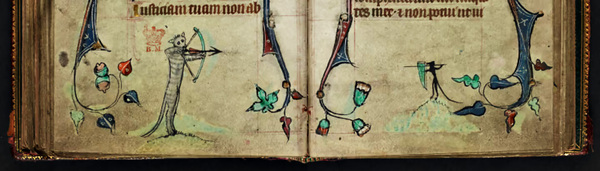
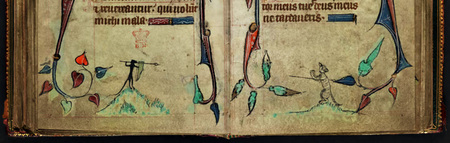
The standoff between the cat and the mouse, and the mouse’s victory. Harley MS 6563, fol. 73v–75r. Unknown artist. 1320–1330.
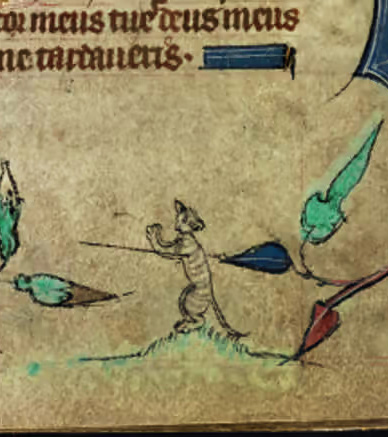
In the fourth panel, the confrontation reaches its conclusion: the mouse defeats the cat [6]. The finale forces a re-evaluation of the story’s beginning—the creature we expected to be the weak prey turns out to be the victor. This isn’t explained with words; the outcome is evident in the positioning and actions of the figures.