Spring in Moscow begins with the promise of warmth. In the courtyard of the Azerbaijani restaurant «Halva, ” tucked away in an alley near Taganka, the air still smelled of iron gates and cool, post-rain earth.
Emin was the first to arrive. That’s what he was told: if you want to stay, be there before everyone else. He was twenty-two. He was a Moscow Azerbaijani who spoke his native language as if he were asking permission to enter.
From the outside, the restaurant seemed almost inconspicuous: a sign, a warm streak of light in the window, a heavy door behind which, in winter, hung the scent of fried onions, pomegranate sauce, lamb, hot bread, and distant family conversations.
Inside, everything was a bit old-fashioned—and that was precisely why it was convincing. Dark wood tables, plain white plates devoid of modern fuss, curtains that had long absorbed the smell of smoke and spices, local lamps over each table, like small, domestic suns. Here, they weren’t trying to stage the Orient for tourists. Here, it existed—tiredly, mundanely, stubbornly—in the copperware, in the napkins, in the voices coming from the kitchen, in the sharp shouts of the chef, in the music that sometimes sounded too loud and other times dissolved into the clatter of forks.
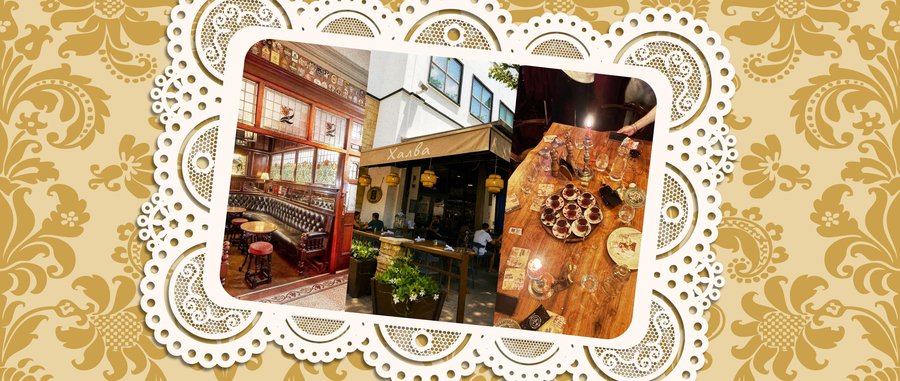
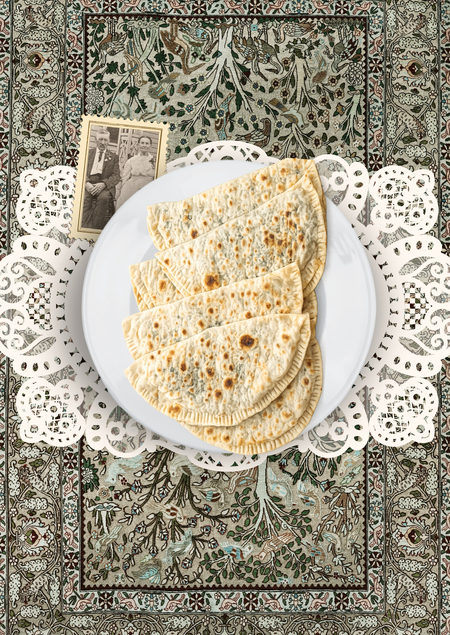
The menu could be described as broad, traditional, and recognizable—without resorting to merely listing «hits.» The guest should have the feeling of being in a genuine Azerbaijani setting, one that offers mangal, soups, pilaf, homemade dishes, and a tea table featuring armud glasses. The waitstaff at «Halva» know the menu by heart; they offer recommendations without being intrusive, and they are skilled at serving large banquets. Their manner of speaking is respectful and direct, devoid of gastronomic snobbery. When speaking with Azerbaijani guests, they converse in the local dialect, avoiding Russian unless necessary—and this is done without prior arrangement: upon arrival, a simple «Salam» is used instead of «Zdravstvuyte.»
«Halvy» was the backyard—cramped, uneven, almost secret. In the spring, the veranda was opened there. The walls still held the cold, the air smelled of damp plaster and coal, but plates, pitchers, and baskets of bread were already being set on the tables, and it seemed as if summer was about to forgive Moscow its grayness. On this veranda, people ate, argued, laughed, reconciled, toasted each other, and exchanged glances. In the latter moments, there were also words, speeches, entire plots that were not able to be spoken aloud.
The restaurant «Halva» unfolds as a distinct character. Initially, it seems like a warm, bustling, lively place with food, music, regulars, family rules, and the smell of home. But gradually, it becomes clear that beneath the coziness lie fear, addiction, power, and long-held silence. «Halva» is a home for those with nowhere else to go, and simultaneously, a trap where everyone is obligated to play a role.
Each character unfolds within the plot in their own way—for example, through the lens of personal choice: one character blindly follows the prejudices of their environment, another breaks stereotypes, and a third tries to remain neutral but is forced to take a definitive stance.
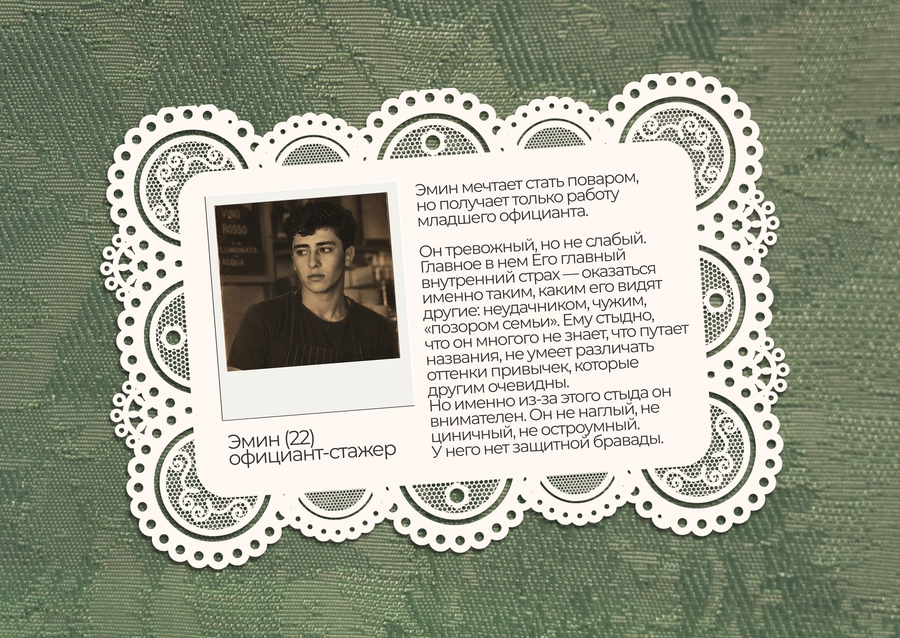
Amin unfolds as a coming-of-age hero. He enters the story as a timid, awkward boy dependent on external approval, dreaming of becoming a chef. His greatest internal fear is being exactly what others see him as—a failure, an outsider, a «family disgrace.» But in the finale, he is the only one who acts not out of pride, not out of calculation, and not out of old resentment, but from a vital human impulse to protect.
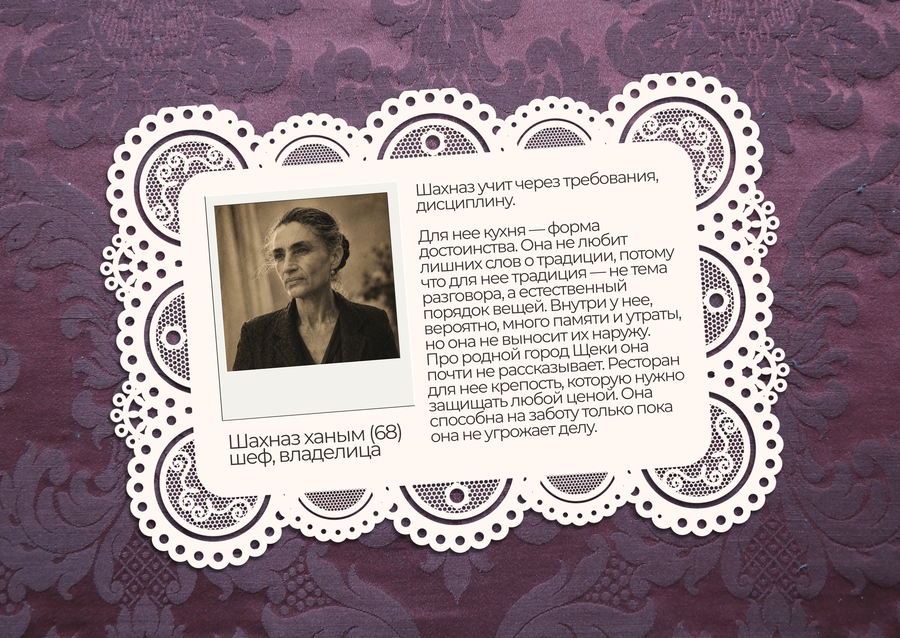
Shahnaz Khanam initially appears as a stern yet just mistress of the house—a woman burdened by fate and possessing an almost maternal authority. Gradually, her true nature is revealed: the restaurant is a fortress to her, a destiny, a venture she must protect at all costs. She is capable of care only as long as that care is not threatened. In conflict with Tatyana, Shahnaz defends people from the fear for the reputation of her enterprise, maintains control, and seeks avenues for coercion. In the finale, her coldness becomes absolute.
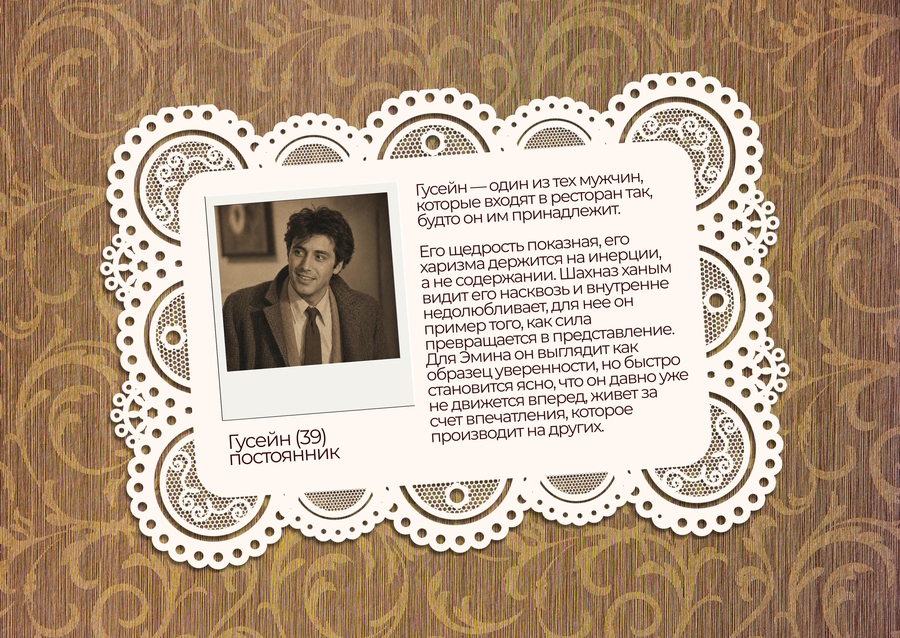
Guseyn enters the story as a flamboyant guest—generous, loud, confident, as if he knows life better than anyone. For Amin, he becomes a false mentor: speaking eloquently about dignity, strength, and masculine honor. Twice in Tatyana’s presence, his persona shatters: he betrays Amin and fuels the conflict at the restaurant, and when he senses danger, he withdraws. His character arc is built on the rift between role and actor. The villain did not emerge from him because such a role demands depth of character; one cannot sustain the cost of those words merely by mechanically repeating the correct lines.
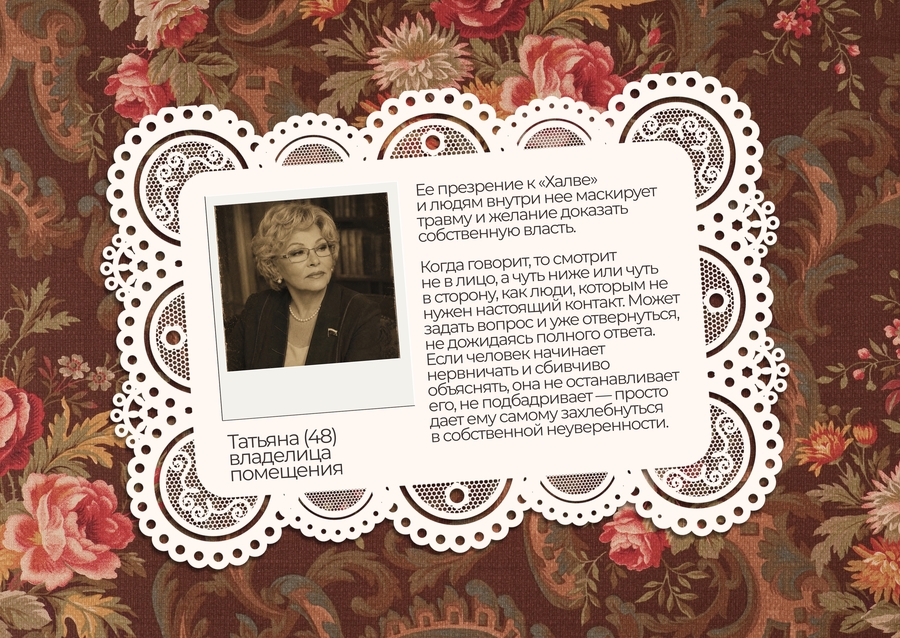
Tatyana Sergeyevna is a person whose soul is buried so deeply that it is nearly impossible to discern beneath layers of anger, contempt, and self-defense. She arrives at «Halva» as an aggressor: she humiliates, provokes, and speaks to people as if she has already stripped them of their right to dignity. Her soul has not disappeared, but it is buried under pride, resentment, fear, and years of arrogance. Having lived in a state of defense for so long, Tatyana herself has become a weapon. In the finale, what was almost permanently entombed briefly surfaces in Tatyana.
It is important to note that the narrative contains themes of xenophobia and national discord, but these themes are not its core focus—they serve only as artistic backdrop against which the true values of the story unfold.
Twenty-year-old Emin, evicted from his home after being dropped from university, takes a job as a junior waiter at the Azerbaijani restaurant «Halva» on Taganka, dreaming of becoming a chef someday. Amid the strict and cold head chef Shakhnaz Khanum, the pompous regular customer Guseyn, and the harsh property owner Tatyana Sergeevna, he tries to find his place but becomes a captive of others' resentments, national prejudice, old debts, and power struggles. His first conflict with Tatyana shatters his faith in adults, and the second turns the restaurant veranda into a battleground of open hostility. In the end, Emin demonstrates true strength for the people who could never see a human being in him.
The full story can be read at the link below.
“ — There you are, clear as day, ” she jabbed a finger in his direction. «Cowards. Standing around watching, drowning in your own mire… Damn it all.» Emin heard the word, but it didn’t immediately land. First, it was heat in his ears, then an emptiness in his chest. He watched Shahnaz Khan walk toward Tatiana. She was a restaurant threatened by a minor misunderstanding—her livelihood, the only justification for her life. A knife rested in the sleeve of her uniform; in Tatiana’s hand, there was a shard of glass. They were walking toward each other, not meeting. It was a farewell. And then he ran. Emin had never been brave, nor had he been clever. And in that moment, he didn’t become a wolf. He simply saw two women looking past him into their own memories: Tatiana, looking at the first love who had left her due to her family’s rejection; Shahnaz Khan, looking at the son she had once lost and about whom she never spoke. In their eyes, Emin wasn’t Emin; he was a foreign mass of emotion, an object of someone else’s love or hatred, a convenient vessel for someone else’s pain. He stood between them, and first, the shard of glass pierced his chest. Then, somewhere under his shoulder blade, there was the small knife that Shahnaz Khan hadn’t managed to hide from her own hand. Emin was surprised that the pain was less than the fear.
On the veranda, all that could be heard was the wine dripping from the broken bottle. Tatiana stared at her hands. Then at Emin. Then back to her hands. «Boy…» she murmured. «Boy… boy… what’s wrong with you?» She knelt beside him, wrapping her arms around his shoulders, pulling him close awkwardly, like a mother holding a newborn she feared dropping. She didn’t know his name; she had never seen the need to remember it. Now she repeated the one word that could replace them all: «Boy… boy…»
Gussein stood by the exit. Blood smeared down his lip from his nose. He wanted to take a step, but he wasn’t sure he wouldn’t get something worse than the shard in his chest. The eternal stance of a man who spent his life teaching others to hold their heads high, while only searching for somewhere to hide his own. —An ambulance, —he whispered to ease his conscience. Shahnaz Khanom looked at Emin. At the knife. At Tatiana. At Gussein. Her face was calm, as if she had been through something like this dozens of times before. —Gussein, —she said evenly. —Bring the rags and a bucket. He didn’t understand. —What? Rags. And a bucket. Shahnaz Khanom, you have to… —Do as you’re told. Tatiana lifted her eyes to meet hers—red from the ruptured capillaries. —I… I didn’t want to… Shahnaz Khanom crouched down beside her. So close that only Tatiana could hear. —Of course, you didn’t want to. There wasn’t a shred of comfort in those words. Instead, there was a lock—for Tatiana knew nothing about the knife. When she recovered, she would only remember the shard in her hand, the blood, and the boy whose name she didn’t know. Accidentally, deliberately, out of anger or fear—it didn’t matter anymore. She would no longer interfere in the affairs of «Halva.» She wouldn’t comment on the ventilation, the backyard, the brothers, or the rent. Emin lay on the cold tile floor. He suddenly thought of the kitchen. Not of death, not of his father, not of Gussein. He thought of how he hadn’t managed to ask Shahnaz Khanom to teach him how to slice onions paper-thin so they would disappear into a sauce but still leave a sweetness. He hadn’t managed to learn when chestnuts were added to plov so they wouldn’t fall apart. He hadn’t managed to become a cook. He stood up bravely between them—more bravely than he had ever managed to stand up for himself. He gave away the last of what he had to people who never saw him as a complete human being.