Essay: «The Wooden Path»
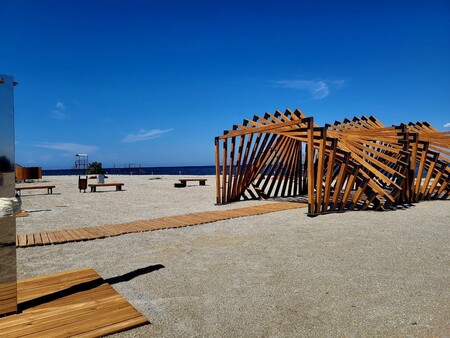
At the «Mayak» Creative Center beach, there is a corridor where it is impossible to get lost. It has no walls, no doors, and not even a real ceiling. It is constructed from wooden frames, repeated one after another. But as soon as you step inside, the ordinary view of the sea transforms into a completely different scene.
This unusual pavilion is located right on the sandy shore of the Sea of Azov. Its structure resembles a long sequence of inclined arches. Each successive arch repeats the last, creating the impression of an endless passage. When viewed from one end, the wooden frames coalesce into a single geometric shape, and the sea beyond them appears to be part of the architecture.
But the most fascinating aspect of this structure is what it lacks. There are no solid walls, so the space is constantly shifting. In the morning, rays of sunlight pass between the wooden beams, leaving long stripes of shadow on the sand. During the day, they become shorter, and closer to evening, they stretch out again, gradually altering the pattern beneath your feet.
As a result, the same pavilion never looks exactly the same. To change its appearance, you don’t need to rebuild anything—you just have to wait for a different time of day.
Such constructions are interesting because of how they direct our gaze. On an open beach, people usually look at the horizon, barely noticing the space between themselves and the sea. But the wooden frames compel you to pay attention to distance, perspective, and even your own movement. Every step changes the arrangement of the lines, and the familiar seascape gradually unfolds from a new angle.
This is precisely why the pavilion should be viewed not merely as a place for relaxation or photographs. It is a sort of experiment with space, where the primary materials are not just wood, but also light, air, and human movement.
If you find yourself at «Mayak,» try walking through this corridor unhurriedly. Stop in the middle, look at the sea through the wooden frames, and then turn around. You will see two entirely different landscapes, even though you remain in the same spot.
Sometimes, to see something new, you just have to look in a different direction.


«There are no whales in the Sea of Azov, ” Liza said, examining the wooden beams. „So why does this thing look like a whale skeleton?“

She didn’t know yet that by morning she would have to reconsider her words.
On the beach of the «Mayak» Creative Center, there was a strange construction. Dozens of wooden frames rotated relative to each other, forming a long walkway. Viewed from the side, the structure resembled the ribs of a giant animal half-buried in the sand.
Liza had come to an educational program focused on photography. For the final project, she needed to photograph something unusual on the center’s grounds. The young woman immediately chose the pavilion.
She came up with a title for her series: «The Last Whale of the Azov Sea.»
«But whales have never lived here, ” the instructor remarked upon seeing her first photographs.
„So, it will be a whale that never was.“
Liza liked how that sounded.
She spent the entire next day on the beach. She photographed the wooden beams from different angles, captured geometric shadows on the sand, and waited for the sunset when the light would make the structure look like a real skeleton.
But the longer she shot, the more she noticed a strange anomaly.
The pavilion’s shadows were not shifting exactly as they should have.
As the sun moved toward the horizon, the dark stripes on the sand gradually elongated. Yet, one of them remained motionless. It curved among the others, like a massive tail.
Liza checked the photos on her camera.
In every image, this dark trail was in a different place.
„It’s probably just how the light is hitting it, ” she decided.
And she stayed to wait until the sun was completely hidden by the sea.
As the light faded, Liza prepared to leave. She put her camera in her bag and headed toward the exit, but then heard a strange creaking sound from behind her. One of the wooden beams slowly rotated. Liza froze. Then a second one turned. Then a third.The structure seemed to come to life. The wooden frames bent slightly, one after another, reminiscent of the spine of a massive animal.The shadow no longer resembled the pavilion’s shape. Before Liza lay the silhouette of a giant whale. You could discern the broad head, the fins, and a long tail extending toward the water.Suddenly, the shadow began to move. The enormous whale slowly swam across the sand toward the sea, even though there was no source of light around capable of casting such a silhouette. Liza watched the dark creature cross the beach. Reaching the water, it stopped.On the shallow seabed lay a small gray animal. Its body was smooth, its head was round, and a small triangular fin was visible on its back.Part of its body was tangled in an old fishing net. The animal tried to free itself, but its movements only tightened the ropes. Liza recognized it from photos she had once seen online—it was an azovka—a small cetacean that lives in the Azov Sea.It turned out the professor was mistaken; whales were indeed here. They were just not like the ones she had imagined.