Темы преддипломного визуального исследования
Цукумогами/ город как декорации/ предмет без функции
Visual Research Topic 1:
«The Image of Tsukumogami in Traditional and Contemporary Japanese Visual Culture»
Research Concept
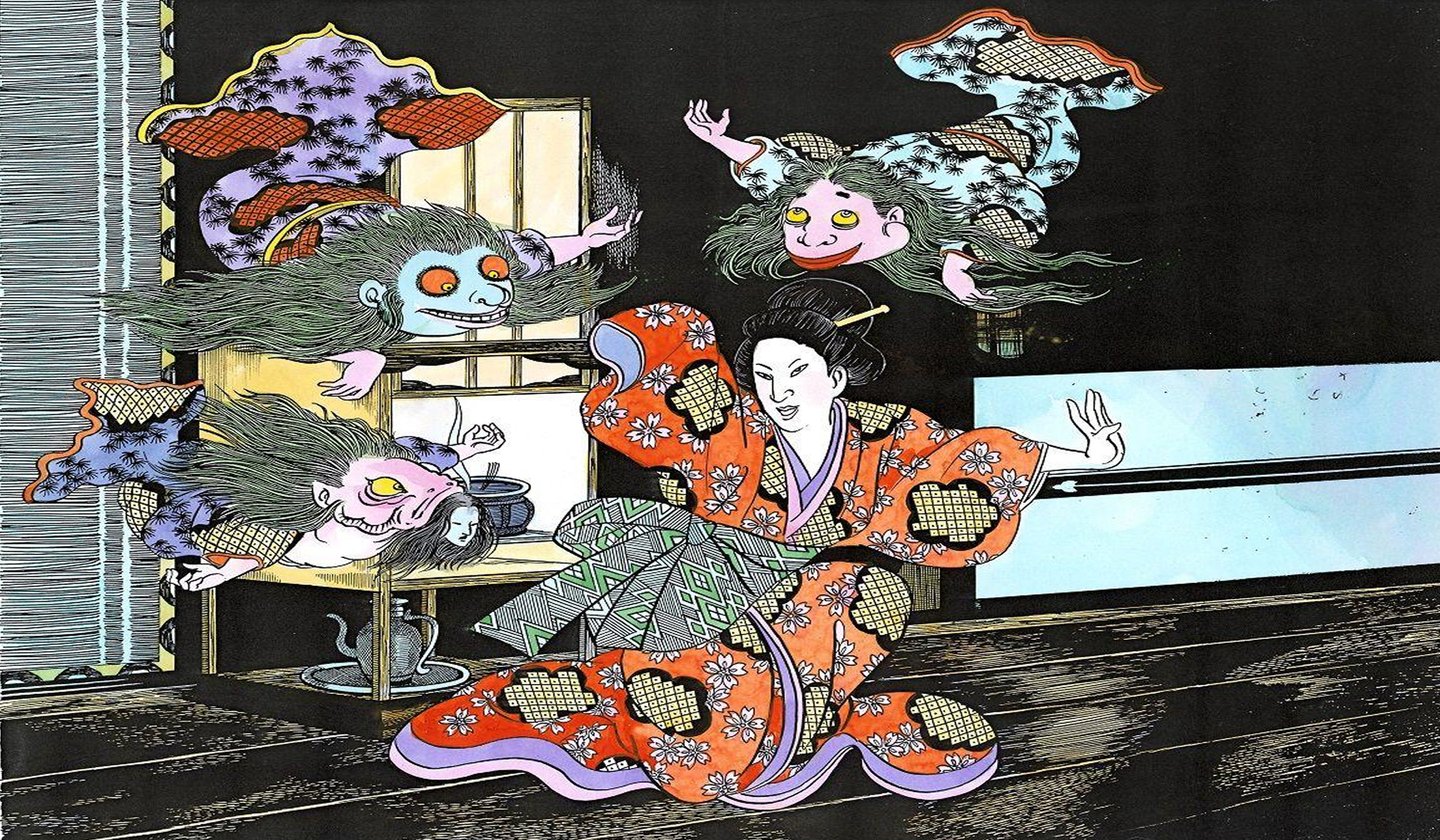
The visual study is dedicated to the image of the Tsukumogami—supernatural beings from Japanese folklore that emerge from old, everyday objects. It examines methods for visually transforming inanimate objects into living creatures, the specifics of their anthropomorphic depiction, and the characteristic forms of interaction between the material and organic worlds. The study traces the evolution of the Tsukumogami motif in Japanese art—from traditional illustrated scrolls and Edo-period woodblock prints to contemporary graphics, anime, and manga.
Visual Research Index
Chapter 1. Tsukumogami in Japanese Folklore and Traditional Art
Tsukumogami in Japanese mythological tradition.
Legends of inanimate everyday objects coming to life.
«Tsukumogami Emaki»: historical depictions of animated objects.
Tales of nocturnal processions of animated objects — Hyakki Yagyō.
Images of household items transformed into supernatural beings.
Visual characteristics of early tsukumogami depictions.
Chapter 2. Morphology and Anthropomorphism: Transforming Objects into Living Beings
Animated umbrellas, lanterns, and lighting fixtures.
Animated dishware, kettles, and kitchen utensils.
Musical instruments with human characteristics.
Clothing, footwear, and textiles as fantastic characters.
Objects featuring human faces, eyes, mouths, and limbs.
Hybrid forms: combining object construction with organic anatomy.
Distortion of proportions and disruption of the object’s familiar structure.
Chapter 3. Tsukumogami and Yokai in Edo Period Japanese Graphic Arts (1603–1868)
Toriyama Sekien: Illustrated Catalogs of Japanese Yokai.
The Gazu Hyakki Yagyō Collection (1776).
The Konjaku Hyakki Shūi Collection (1781).
The Hyakki Tsurezure Bukuro Collection (1784).
Traditional Japanese prints and illustrations of supernatural beings.
Graphic elements: contour, detail, composition, and decorative quality.
A comparison of traditional depictions of tsukumogami with other yokai categories.
Chapter 4. Tsukumogami in 20th and 21st Century Japanese Popular Culture
Images of Animated Objects in Japanese Manga.
Tsukumogami in Contemporary Animation.
«Tsukumogami Kashimashi» (2018): A Modern Interpretation of Traditional Spirits.
Yokai Imagery in the Anime «Mononoke» (2007).
Character Design in Japanese Video Games.
Reimagining the Anatomy and Appearance of Fantastic Creatures.
Modern Color Schemes and Stylization of Traditional Characters.
Chapter 5. Animated Objects in Contemporary Illustration and Design
Anthropomorphic Household Objects in Modern Illustration.
Characters Constructed from a Combination of Organic and Mechanical Forms.
Sculptures and Art Objects in the Form of Living Things.
Objects with Hypertrophied Anatomy.
Hybrid Creatures on the Boundary of Human, Animal, and Object.
Contemporary Interpretation of Japanese Yokai Aesthetics.
Experimental Character and Fantasy Form Design.
Visual Research Topic 2:
«The Image of the Artificial Urban Environment in American Cinema and Photography of the 1970s–1990s»
Research Concept
The visual study focuses on the image of the artificial urban environment in late 20th-century American visual culture. It examines urban spaces, interiors, and architectural objects that possess a pronounced theatricality and cinematic quality. Special attention is paid to the aesthetics of American motels, casinos, roadside cafes, neon signs, and desolate landscapes—elements that form a space on the boundary between reality and fiction. The research explores how architecture, color, light, and composition transform real locations into something resembling cinematic sets.
Visual Research Outline
American Urban Aesthetics of the 1970s–1980s.
Architecture of motels, casinos, and roadside spaces.
Artificial interiors and the theatricality of the urban environment.
The cinematic image of the American city.
Empty spaces and the aesthetics of liminality.
Staged reality in American photography.
Visual Research Topic 3:
«The Transformation of the Utilitarian Object into an Artistic Work in 20th and 21st Century Art and Design»
Research Concept
The visual study focuses on the transformation of familiar everyday objects that lose their original functional purpose and acquire independent artistic significance. Using Surrealism, Dadaism, Conceptual Art, and Radical Design as examples, the work examines methods for rethinking utilitarian objects through changes in form, scale, material, and context of use.
Visual Research Table of Contents
Dadaism and the readymade: the object beyond its conventional function (1910s–1920s).
Surrealism and the transformation of everyday objects (1920s–1940s).
The object in conceptual art (1960s–1980s).
Radical design and the aesthetic of non-functionality (1960s–1980s).
Sculptural furniture and experimental object design (1990s–2020s)