Concept and Central Theme of the Work
Is it possible to train a small LoRA model on 15 paintings by Aivazovsky in such a way that it reproduces not individual plots, but the characteristic principles of his artistic language—his handling of light, atmosphere, color, water, sky, and space—and applies them to images not present in the training set?
Why Aivazovsky?
The creative work of Ivan Konstantinovich Aivazovsky was selected as the object of study. His works are interesting for experimentation with a generative model due to the persistence of visual techniques recurring across different compositions. Despite the variation in subjects, common principles of image construction can be observed in his paintings: the significant role of the sky and horizon, the contrast of light and shadow, complex atmospheric perspective, expressive handling of reflections on water, the dramatic state of the natural environment, and a characteristic system of warm and cool color relationships.
Therefore, training the model was viewed not as an attempt to force the neural network to copy specific paintings, but as an experiment to discover and transfer recurring visual patterns.
Why 15 images
The training sample consisted of 15 pieces. The small size of the dataset was intentional: the experiment was designed to demonstrate how effectively LoRA can extract consistent visual patterns from a limited number of examples. Furthermore, the images were selected to ensure the sample included diverse sea conditions, lighting, times of day, and compositions.
When assembling the dataset, the primary objective was to prevent excessive uniformity in the images. If all images represented only one type of seascape, the model might associate a specific token not so much with the style as with a concrete content element—for instance, ships or the sea itself. Therefore, the selection included works featuring varying water conditions, lighting, time of day, and compositional character.
Examples of the artist’s work and some of the source materials in the dataset.


Generation Results
In Aivozvsky style, a fisherman in a calm
In Aivozvsky style, the harbor at sunset
In Aivozovsky style, cannon on the rock
What is his painting style and visual aesthetic?
Ivan Aivazovsky’s painting is characterized by a distinctive academic approach to marine themes and a set of consistent artistic features.
One of the key characteristics is the effect of internal luminosity within the waves, achieved by delicately rendering the transparency of seawater and the passage of sunlight or moonlight through it.
Dramatic lighting plays a significant role, relying on contrasting light accents—such as reflections on the water’s surface, sunset glow, or the cool light of the moon.
Particular attention is paid to conveying the movement of the marine element, which is evident in the detailed depiction of various sea states—from calm surfaces to powerful storm waves with rendered foam.
Furthermore, the compositions often carry a romantic quality and possess a sense of grandeur, frequently exploring the theme of humanity’s confrontation with natural forces.
We continue to generate
In Aivozvsky style, a guest in the stormy sea
Source Images:
Source Images:
The dataset was created using 15 artworks by the artist, which are either in the public domain or hold a CC0 license.
Generation results in the original, «classic» style, as well as with other themes
In Aivozvsky’s style: Ship in the Storm
In Aivazovsky style, a ship in a starry night
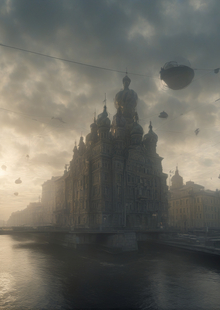
To verify that the model has assimilated stylistic traits rather than merely the content of the source samples, some generations were performed on themes absent from the training dataset. Thus, the sea and ships were excluded from certain prompts. The resulting outputs allow us to observe which characteristics of the original visual language persist when transposed onto a fundamentally different image object.
Prompt: A majestic mountain landscape at sunset
Prompt: A medieval city at night
Prompt: A dense ancient forest during a violent thunderstorm
A vast desert immediately after a violent sandstorm
Education
The Stable Diffusion XL (SDXL) Base 1.0 model was selected for training. DreamBooth LoRA was employed as the fine-tuning method. This approach allows us to adapt an existing generative model to a specific visual style without retraining the entire model from scratch.The training dataset consisted of 15 square images of Ivan Aivazovsky’s paintings. The selection included works depicting diverse sea states and atmospheres: calm and stormy scenes, ships, sunsets and sunrises, nocturnal lighting, dramatic clouds, and high-contrast illumination. This diversity was essential so that the model learned recurring features of the artistic language rather than specific subject matter.