Topic Selection
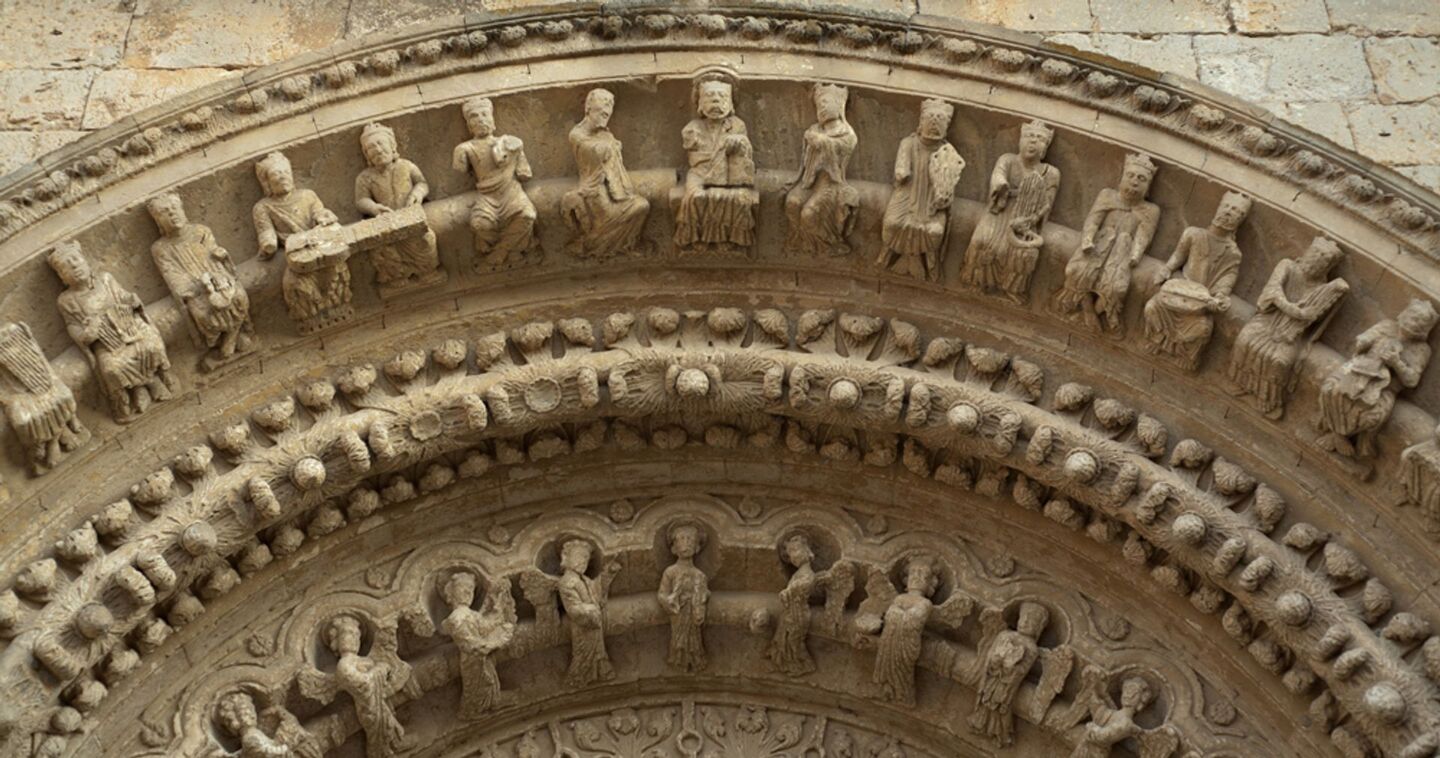
I find it interesting that in the modern world, we tend to see decorations as mere set dressing, yet a millennium ago, they played entirely different roles. Studying architectural composition and the relationship between the exterior sculptures of cathedrals tells us a great deal about the medieval world.
Principles for Selecting Material for Visual Research
Material selection was based on the artistic and architectural historical significance of Gothic cathedrals, as well as the representativeness of the sculpture displayed upon them. Primary attention was given to the sculptural decoration of facades, portals, tympana, archivolts, and other architectural elements. When choosing subjects, the preservation status of the sculptures and their stylistic features were taken into account.
Principle of Research Categorization
The research material is organized chronologically—from the earliest Gothic cathedrals to the later ones. This sequence allows one to trace the evolution of Gothic sculpture and identify changes in plastic language and compositional solutions. The chronological breakdown also enables a comparison of the characteristics of sculptural decoration across different periods of Gothic art development.
Principle of Selecting and Analyzing Textual Sources
The selection of textual sources was based on their scholarly significance. The foundation of the source base comprised comprehensive works on the history of Gothic art, architecture, and sculpture, as well as studies that reveal the interconnectedness of artistic processes, religious worldviews, and medieval social life. Specifically, the works of R. Thomán, «Gothic. Architecture. Sculpture. Painting» (2000), J. Duby, «The Time of Cathedrals. Art and Society in the 10th–15th Centuries» (2002), and R. Reht, «Belief and Sight: Art of the Twelfth–Fifteenth Century Cathedrals» (2014), were utilized. Analyzing these publications allowed for an examination of the sculptural decoration of cathedrals from the perspectives of its stylistic, iconographic, and symbolic features, as well as tracking its development within its historical and cultural context.
Hypothesis
The sculptural decoration of the Gothic cathedral was built upon the principle of introducing people to Christian philosophy.
Concept
The sculptural decoration of medieval cathedrals is not merely ornamentation, as it may appear at first glance. Every sculpture, relief, and minor detail could have carried specific meaning for the consciousness of the people of that era and their understanding of the world. The arrangement of images was part of an overarching design: the cathedral was perceived as a special space where, through architecture and art, people were taught about God, the order of the world, good and evil, life, and death. Because the population was largely illiterate, this visual system served as a model of the cosmos in place of sacred scripture. Thus, as one approached the cathedral, they gradually became acquainted with the Christian worldview—moving from earthly life, sin, and human weaknesses, to sacred images, heavenly order, and divine majesty. The cathedral functioned as a kind of visual text, communicating Christian faith through something understandable to anyone. The central entrance symbolized a passage from the everyday world into the sacred space. For this reason, the most significant religious narratives—the Last Judgment, Christ in Glory, the Ascension, and other biblical scenes—were placed above the portals in the tympana. Such images served as reminders of divine greatness, human responsibility for one’s actions, and the possibility of salvation. They fulfilled both an instructive and a cautionary function. Along the sides of the entrance, on columns and vertical supports, figures of prophets, apostles, and saints were positioned. They seemed to accompany the person as they entered the cathedral, representing the history of Christianity and forming a system of spiritual guidance. Gothic architecture strove toward the heavens, so the sculptural decoration also contributed to the feeling of movement toward the divine. Consequently, a person’s gaze would gradually rise from the entrance to the top of the building, which was symbolically perceived as a striving from earthly life toward the Divine. Gargoyles and chimeras played a distinct role, mostly situated on the external projections and upper sections of the cathedral. Their fantastic and often frightening images created a contrast with the harmonious religious space. They could be associated with the dangers of the outside world, chaos, and evil—from which the cathedral itself offered salvation. Moreover, gargoyles had a practical function: they served as waterspouts, protecting the walls from rainwater.
Saint-Denis Basilica (French: La basilique Saint-Denis), 1122–1281
тройной портал
тройной архивольт
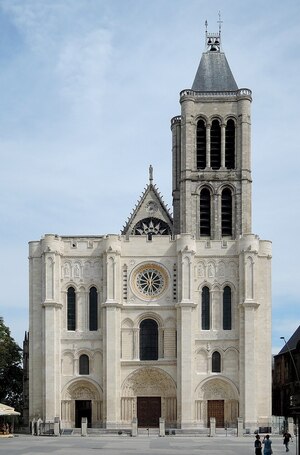
The Saint-Denis church portal, blessed by three clergy simultaneously, is tripartite. It symbolizes the Trinity, an image which also appears on the central portal.
main portal
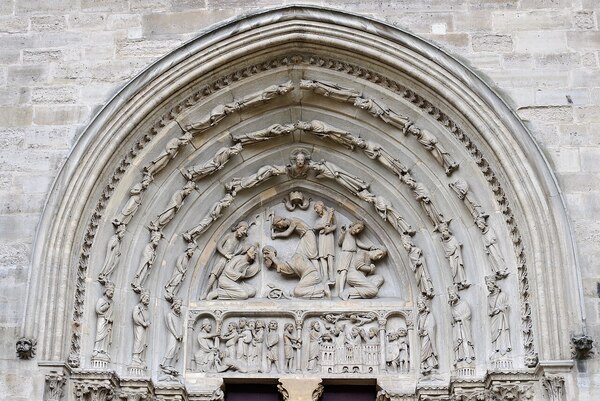
The Last Judgment is depicted in the central tympanum of the Saint-Denis portal. At the center are the prudent and imprudent maidens—that is, humanity—shown at the moment of choice between frivolity and awaiting the coming of Christ. Christ himself is shown with his arms raised, as on the cross, and alongside Him are the instruments of the Passion. The Last Judgment is presented not as the horror of the end times, but as the actual path to salvation, because all of this is situated above the main entrance to the cathedral.
North Portal
The columns here are shaped like Old Testament kings, queens, and prophets. They are the bloodline ancestors of Christ. This connects the biblical rulers to modern French monarchs, presenting them as direct heirs to the ancient rulers. In this way, royal power was imbued not only with secular but also with sacred legitimacy.
Chartres Cathedral of Our Lady (French: La cathédrale Notre-Dame de Chartres), 1194–1260
west facade, «Royal Gates»
Three entrances, the «Royal Gates, ” are connected by lintels at the same height. This connection is further emphasized by the decoration of twenty-four column capitals on the door jambs, which form a continuous series of scenes from the life of Christ. The images on the tympana of the side portals almost mirror each other, but the central tympanum clearly dominates due to its more imposing size. The main idea of the west façade is the story of humanity’s salvation through Christ. The three portals represent different stages of Christian history: the incarnation of Christ, his ascension, and his return at the end of time.
central portal
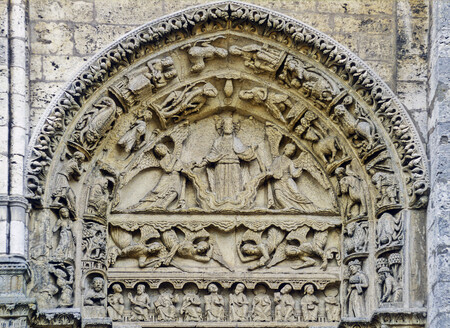
At the center of the tympanum, Christ is depicted on a throne, enclosed within a mandorla—an almond shape symbolizing divine nature. On either side of him are the symbols of the four Evangelists. Beneath him are the twelve Apostles, and within the archivolts are the twenty-four Elders of the Apocalypse. Christ is presented as the ruler of the universe and the supreme judge, a concept emphasized by the scale of his figure.
левый портал
правый портал
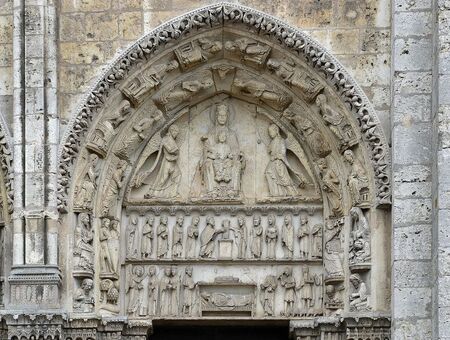
The left tympanum depicts the Ascension of Christ. He rises to heaven accompanied by angels. The archivolts are adorned with scenes of agricultural labor corresponding to the twelve months of the year. These images connect the religious narrative with everyday human life and the cyclical movement of time. Human labor, the changing of seasons, and the structure of the cosmos are part of a unified divine order.The center of the right tympanum features the Virgin Mary with the infant Christ enthroned. Mary here serves not only as Jesus’s mother but also as a symbol of the Church, through which divine wisdom enters the human world. The archivolts contain depictions of the seven liberal arts and ancient philosophers. This underscores the significance of human knowledge and its connection to divine wisdom.
северный портал
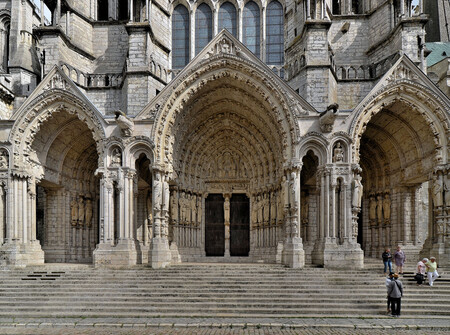
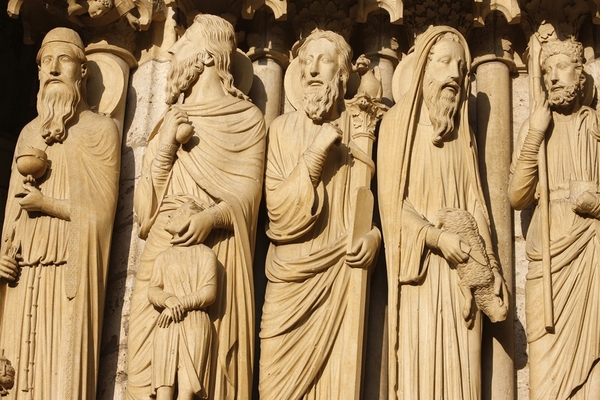
The Northern Portal is primarily devoted to the Old Testament, the Virgin Mary, and events preceding the birth of Christ. Equally important is the fact that sculptors begin to render individual character traits, emotions, and temperaments in their figures. More complex human personalities can be observed. For instance, the expressions on the faces of the prophets become more emotional, and their poses more natural. Naturalism and individuality begin to emerge within the Gothic style. It is precisely this naturalness that brings the ordinary person closer to an understanding of the divine order.
Strasbourg Cathedral (French: La cathédrale Notre-Dame de Strasbourg), 1015–1439, Erwin von Steinbach