Introduction
For this project, I utilized the Letterboxd Movies Dataset, which is available on the Kaggle platform. It was compiled using data from Letterboxd—a social network for film enthusiasts where users log the movies they have watched, rate them, and add tags and genres.
I was interested in analyzing these specific data because Letterboxd is not the «official» film history or the opinion of critics—it is the perspective of ordinary viewers from around the world. Such a source allows one to see how cinema is perceived by people today, rather than just how it is established in academic canon. Furthermore, in international discussions, Russian films often remain on the periphery. I felt it was important to see how Russian cinema measures up against the global landscape: what themes and genres prevail in it, how it is evaluated, and how its structure differs.
I used five different types of charts to visualize the data:
1. Pie chart—to clearly show the proportion of Russian cinema within the dataset compared to global cinema.
2. Distribution histogram—to see how user ratings are distributed.
3. Bar chart—to compare the popularity of specific genres in world and domestic cinema.
4. Horizontal bar chart—to conveniently compare the frequency of film themes.
5. Line chart—to track how the average film rating has changed over time.
The visual language of the graphs was based on the signature typography and color palette of the Letterboxd service.

Final Schedules
Before creating the charts, I needed to complete a data preprocessing stage. First, I took the main movies dataset and sequentially joined it with related tables (countries, genres, and themes) using the film identifier. Since one film can belong to multiple countries, genres, and themes, I aggregated these values into lists. After that, I added a binary column, is_russia, which indicates whether the film belongs to Russian cinema, simplifying the comparison between Russian and global cinema in subsequent charts.
What percentage of data is Russian cinema?


Schedule No. 1 and its code
Russian cinema constitutes a very small fraction of the dataset—about 1%—while the overwhelming majority of films belong to world cinema. I will take this into account during further comparative analysis, as the Russian sample is significantly smaller and less representative.
How are the rankings for world and Russian cinema distributed?


Schedule No. 2 and its code
The rating distributions for Russian and international cinema share a similar form and close modes, concentrated in the 3.0–3.5 range. However, the distribution for international cinema is characterized by greater dispersion and a more pronounced right tail, indicating a higher number of films that received high ratings. The distribution for Russian cinema is more tightly clustered around the mean, exhibiting less rating variability.
What genres are most popular in world and Russian cinema?
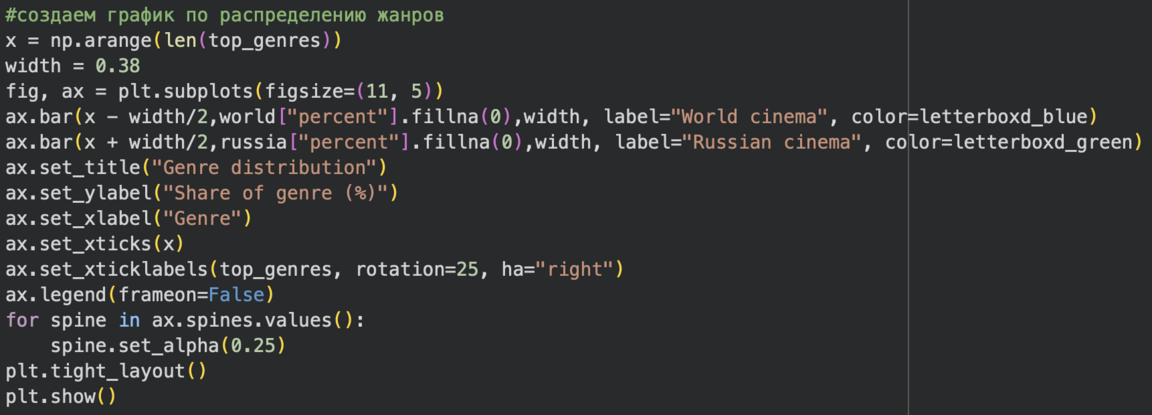
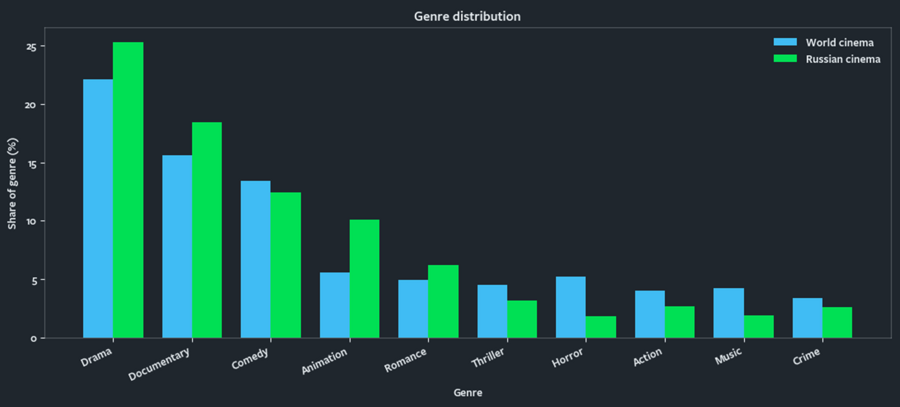
Schedule No. 3 and its code
Genre distributions in Russian and world cinema demonstrate a similar structure, yet they differ in the relative frequencies of specific genres. Russian cinema features a higher proportion of drama, documentary, and animation, while world cinema presents comparatively more horror, thriller, action, and crime.
What themes are most frequently explored in global and Russian cinema?
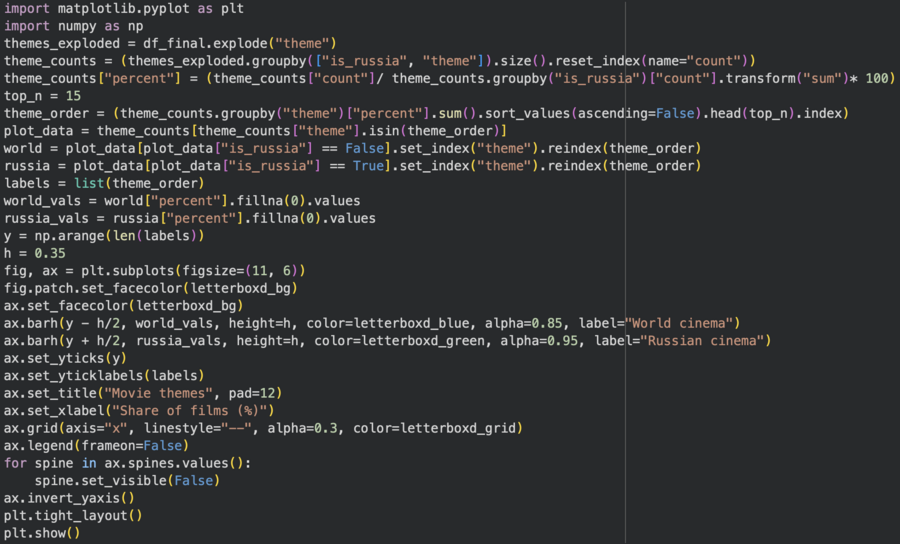
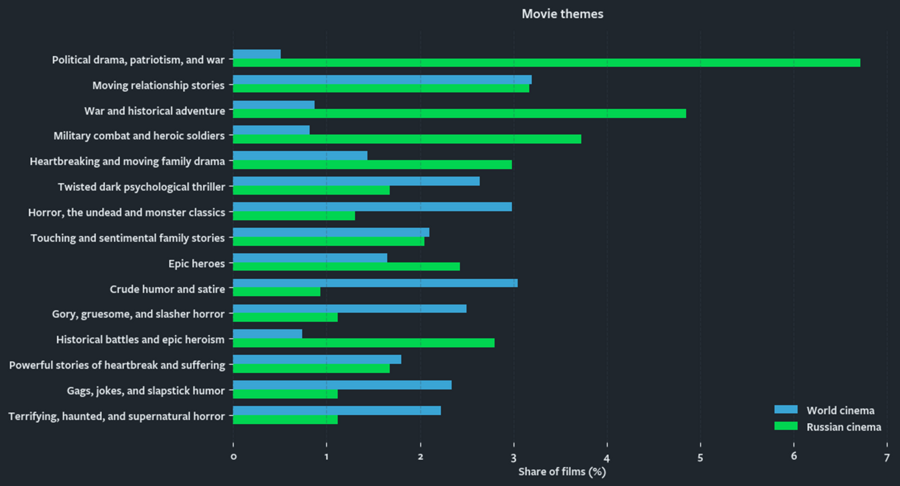
Schedule #4 and its code
In the Russian sample, there is a significantly higher concentration of themes related to politics, war, patriotism, and historical heroism. World cinema, however, features a more even distribution of horror, black comedy, and psychological thrillers, suggesting greater thematic diversification. Overall, the distributions have different «profiles,» reflecting variances in cultural and narrative priorities.
How have the average film ratings in the world and Russia changed over the past century?
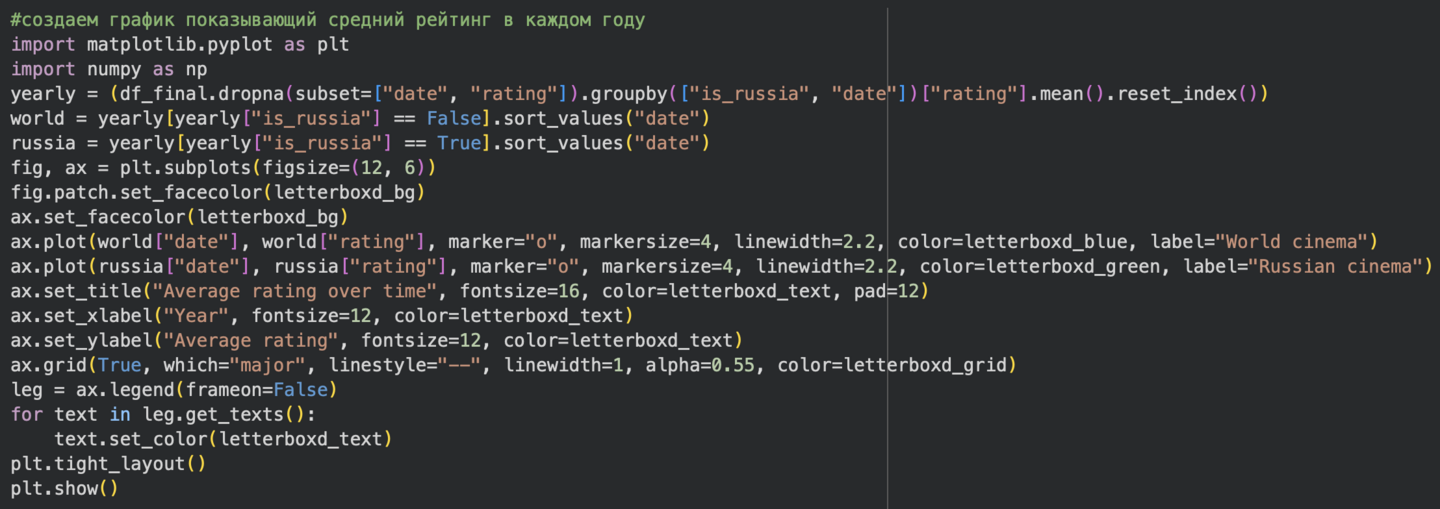

Schedule #5 and its code
In the 20th and 21st centuries, average ratings of world and Russian cinema show varied dynamics: global cinema, after sharply low scores, recovers toward the end of the 21st century and levels off to relatively stable figures, whereas Russian cinema is characterized by sharp fluctuations in specific periods. The flat trend for Russian cinema in the 20th century is due to the small selection of films in the dataset; therefore, averaging leads to the smoothing of variations.
Conclusion
Analysis of Letterboxd data reveals that Russian cinema constitutes a small percentage of the overall film pool, which affects the robustness of statistical conclusions, especially for earlier periods. Generally, the rating distributions for Russian and international cinema are similar in shape, although world cinema demonstrates greater variability and more pronounced «tails» in high ratings.
The genre and thematic structure of Russian cinema is skewed toward historical, military, and dramatic narratives, whereas world cinema exhibits greater genre diversification. The trend in average ratings over time reflects not only changes in film production but also inherent limitations in the data itself—a critical factor to consider when interpreting the results.
Description of Generative Model Application
GPT-5.2 was used to enhance the visual appearance of the charts.