SUBTALE — The Blind Spot
An interactive longread about the hidden meanings of English in film and television.
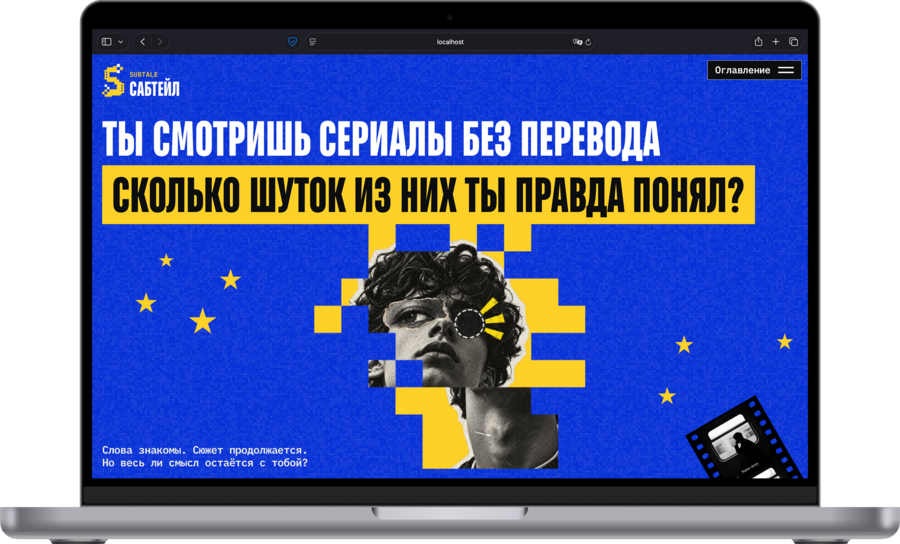
You know all the words. But does all the meaning remain with you?
The viewer understands the original dialogue and follows the plot, but might miss idioms, puns, and cultural references. It is impossible to look up an explanation for a joke if you didn’t even notice it was there.
SUBTALE helps bridge this gap: from a personal experiment in perception to an exploration of language and scene analysis.
01 / The Blind Spot as a Metaphor
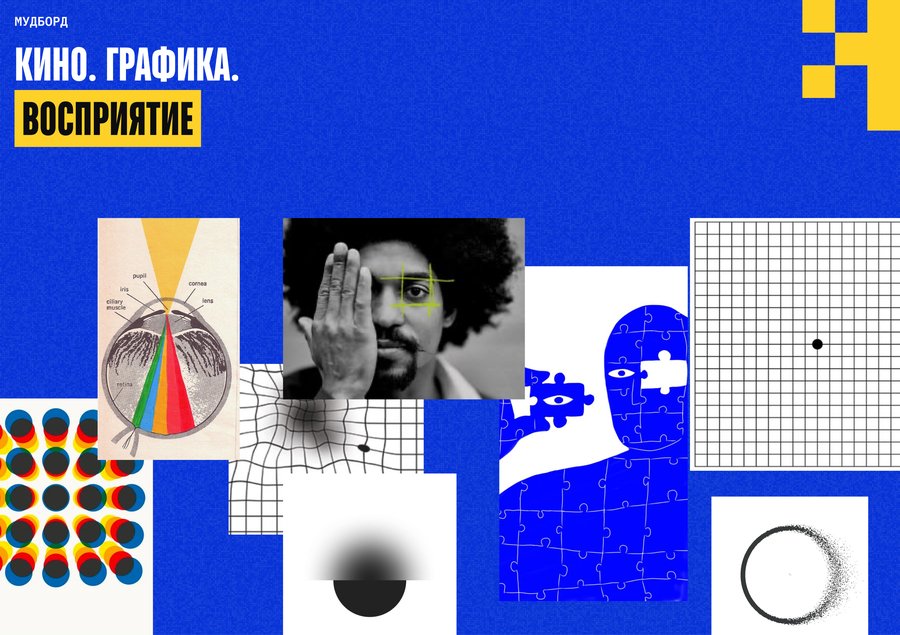
The eye has a blind spot: the brain fills in what we cannot see. In language, familiar words can also create the illusion of complete understanding.
This parallel shapes both the history and the graphics of the project. Images fragment, disappear, and reassemble—much like meaning, which becomes apparent only in context.
02 / Visual Language
03 / First—the personal experiment
Electric blue establishes the research space, yellow highlights the discovered meaning, and near-black evokes the cinema hall. The narrow, accidental TT Bluescreens functions as the poster title; IBM Plex Mono serves as a quote or subtitle.
The collages connect cinema, printed texture, and pixel fragmentation. The technique of «losing» the image supports the theme of the unnoticed.
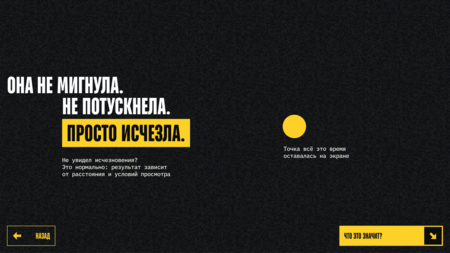
The story begins with testing one’s own blind spot. The reader follows the instructions and observes the point disappear. Only then is the physiological experience connected to the perception of language.
Long-form article route: experiment $\rightarrow$ explanation of the metaphor $\rightarrow$ four types of hidden meanings $\rightarrow$ film analysis $\rightarrow$ the habit of noticing context.

04 / Four Ways to Miss the Point
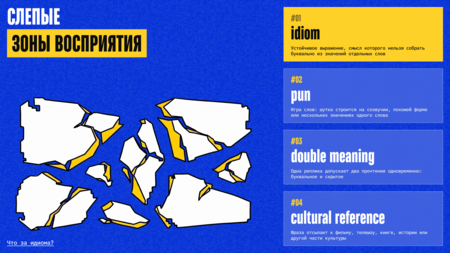
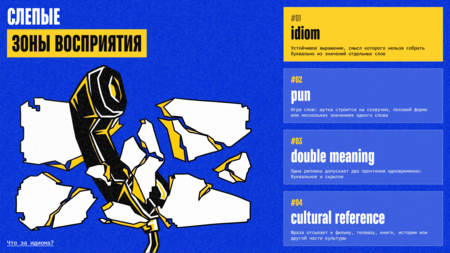
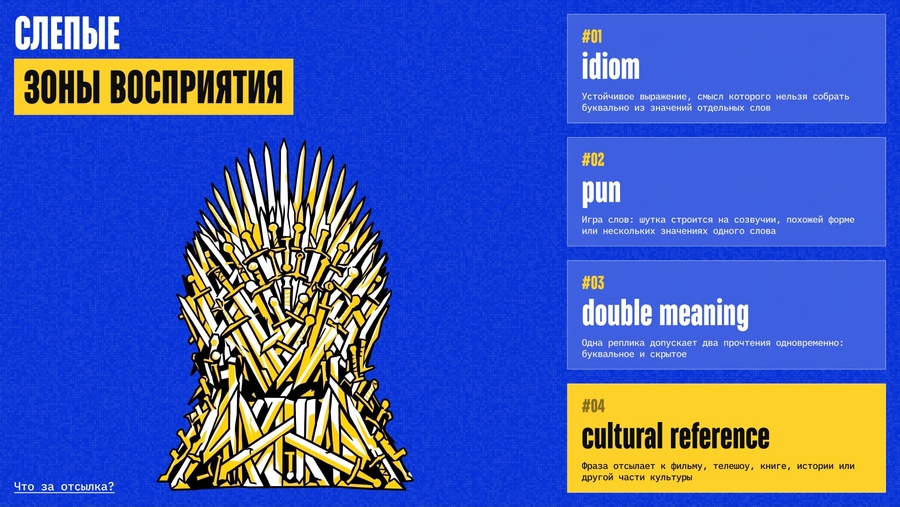
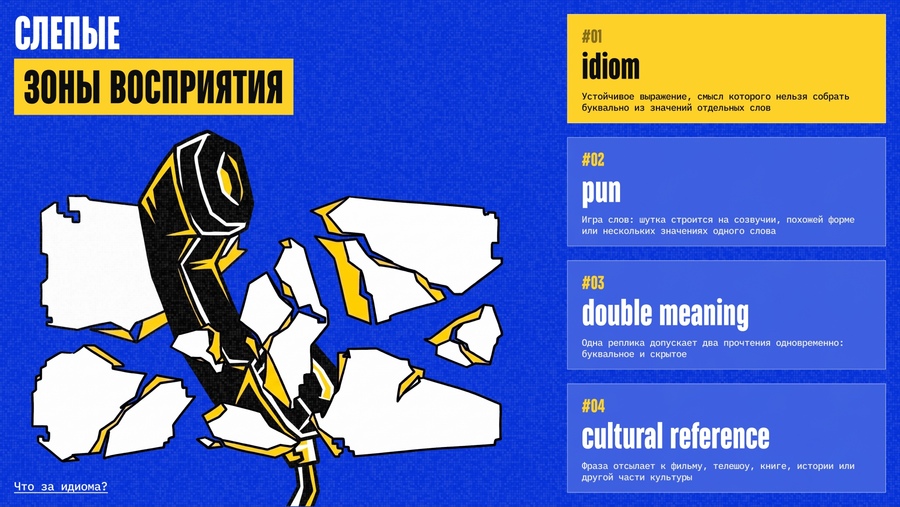
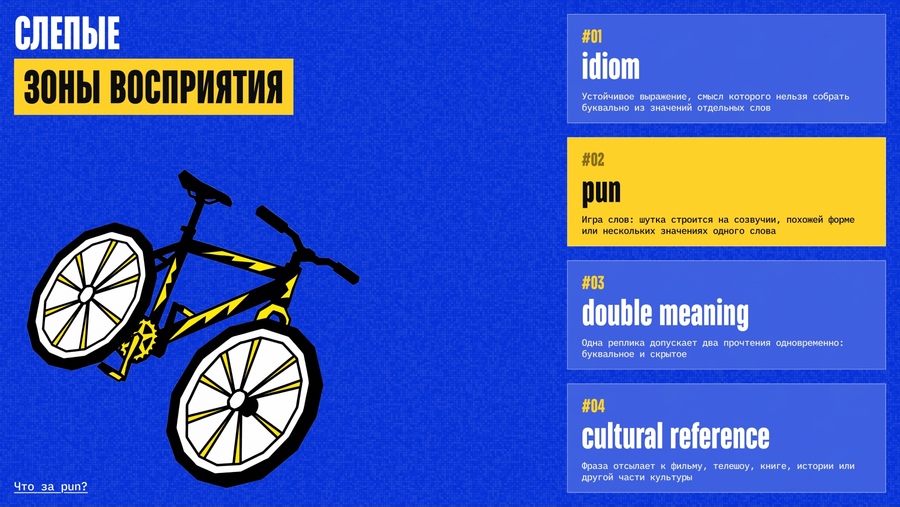
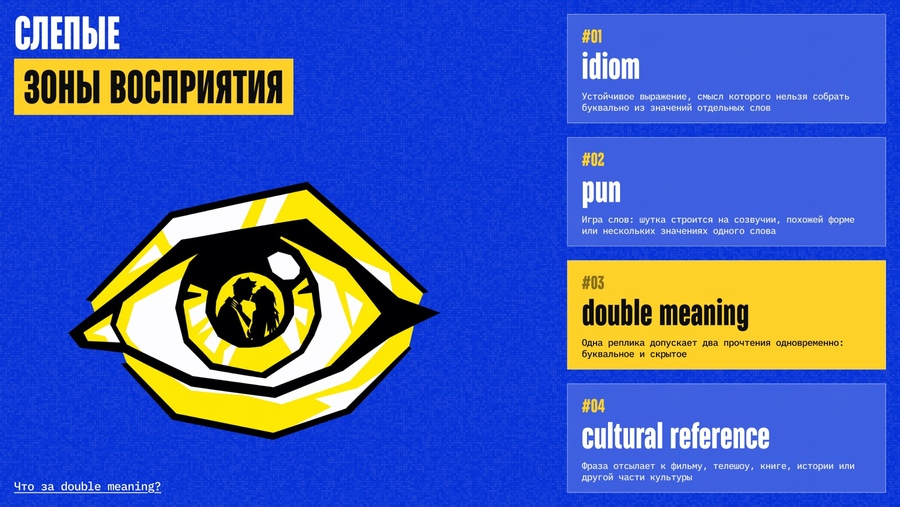
Idiom, pun, double entendre, and cultural reference—these are four blind spots in perception. In the interactive section, the reader selects a category to reveal a second layer of the illustration. Changing the image makes the mechanism understandable without a long lecture: the literal image gives way to the intended meaning of the phrase. On the two screens below are the two states of the idiom «break the ice.»
05 / From Replication to Film Analysis
Five scenes demonstrate how hidden meaning functions in spoken language: Airplane! , Back to the Future Part II, Austin Powers, Sherlock, and The Shining. For instance, in Airplane! , the near rhyme between «surely» and «Shirley» transforms a serious line into a pun. In Sherlock, the code word «SHERlocked» links the action to the character’s name. The scene, the line, and the context combine to form a single explanation.
Open the longread, complete the experiment, and return to familiar scenes with a new question: what lies between the lines?