Concept
In art, light is usually perceived as a backdrop—something that merely helps the viewer see the painting or statue. However, in the Gothic cathedrals of the 12th–14th centuries, light became the primary building material. Passing through high, colored windows, it stained the gray stone and completely transformed the interior space. Seven centuries later, contemporary artists creating light installations (light art) returned to this same technique, constructing space from pure light.
The central research question is: How do Gothic architects and contemporary artists transform immaterial light into a physically tangible element of architecture?
Despite differences in technology and meaning, visual techniques remain common: the contrast between darkness and colored patches, directed beams, and the complete immersion of the viewer into color.
Chapter 1. Light in Gothic Cathedrals of the 12th–13th Centuries
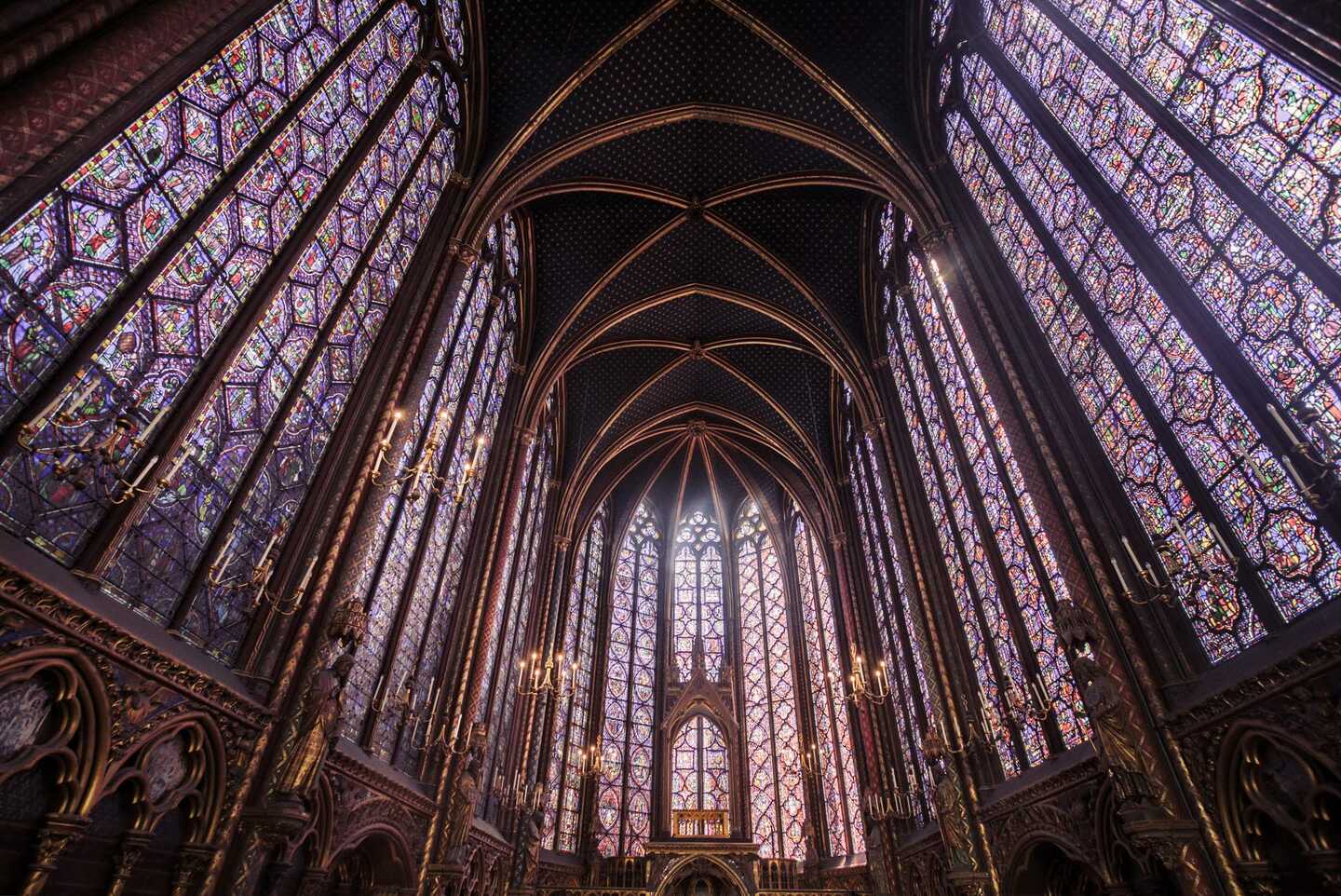
Let’s begin with the Sainte-Chapelle in Paris. Here, the Gothic idea of working with light is taken to its maximum: the heavy stone walls are barely visible. Instead, huge 15-meter-high windows circle the space. Sunlight passes through the stained glass and literally floods the entire hall with blue and red, causing the stone inside to lose its perceived weight.
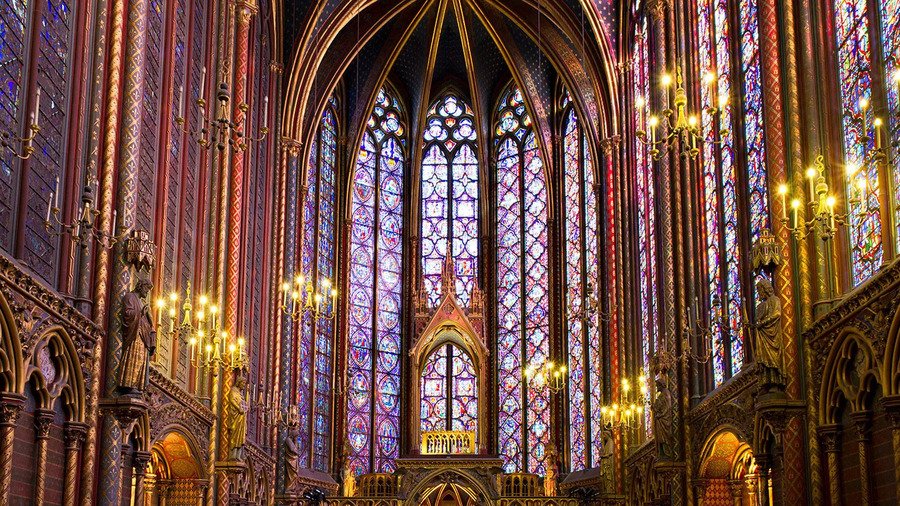
St. Chapelle Chapel, Paris, 1242–1248. Apse of the Upper Chapel
The slender columns are barely visible here, so the room feels like a single, cohesive colored space. Furthermore, the lighting constantly transforms the interior: in the morning, everything inside is cool and blue, while at sunset, it turns bright red and gold.
Light functions differently in the Cathedral of Chartres: much of the heavy, dark stone remains. This creates a stark contrast, as sunbeams filter through the famous blue stained glass, casting brilliant, colored patches onto the gray columns and ceiling.
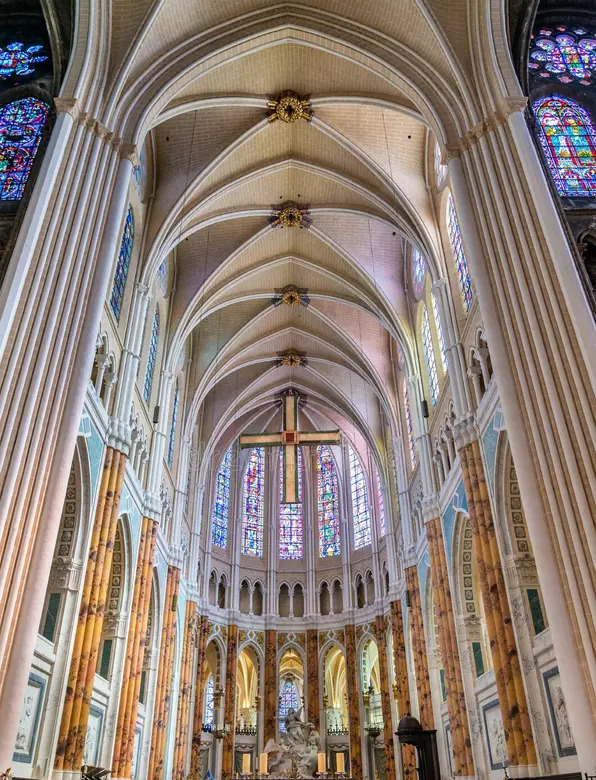
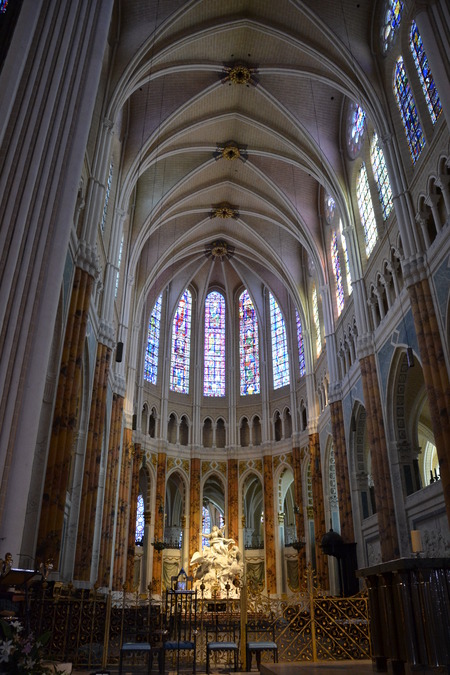
Chartres Cathedral, Chartres, 1194–1220. Vault and Choir
In feeling, the Chartres Cathedral is very similar to Sainte-Chapelle: the colored windows overhead set the mood for the entire hall in the same way. Only here the stone walls and columns are still more noticeable and heavier, but the colored light still mitigates the feeling of oppressive stone.
In Notre-Dame Cathedral, the enormous circular rose windows on either side of the nave play the leading role. The sun streams through them, bathing the vaults in contrasting light: cool blue on one side and warm red on the other.
Notre-Dame Cathedral, Paris, 12th–13th centuries. North and south rose windows.
In this shot, you can clearly see from below how two distinct rose windows cast cold and warm light within a single hall. The stone ceiling acts as a screen, and the heavy vaults appear much higher and lighter because of the hues cast upon it.
A Summary of Gothic Architecture from the 12th–13th Centuries
In Gothic cathedrals, light ceased to be merely a way to illuminate a dark space. Thanks to the vast windows, it began to function as a complete structural element, visually alleviating the weight of the stone walls and vaults.
Color and Atmosphere
Filtering through the colored glass, the sunbeams tint the air itself and cast bright patches onto the columns. Because of this, the interior is constantly shifting throughout the day: in the morning, the hall becomes cool and blue, and by evening, it is flooded with warm red and gold light.
For a person inside, this light creates a feeling of complete immersion; the gaze stops clinging to the boundaries of cold walls, and attention is immediately drawn upward to the source of the radiance. Functionally, the cathedral operates as a massive chromatic environment.
Ultimately, medieval architects learned to manipulate the viewer’s emotions through pure color and the contrast of shadow and light. Seven centuries later, contemporary artists will return to this same technique—but instead of stone and sunlight, they will use neon, LEDs, and exhibition spaces.
Chapter 2. Light in Contemporary Installations: The Architecture of Pure Color
In the second half of the 20th and early 21st centuries, artists of light installations moved away from paintings, paints, and sculptures. Utilizing neon and LEDs, they began constructing space from pure light, much like Gothic architects, but without stone or religious narratives.
The most renowned master of this art form is American James Turrell. In his famous Ganzfeld installation series, he fills enclosed rooms with a uniform blue, pink, or violet light so intensely that the room’s corners and boundaries disappear—the viewer seems to plunge into an infinite, colored mist.
James Turrell, «Aural» (Ganzfeld Series), 2018. Jewish Museum, Berlin.
James Tarrell, «Aural» (Ganzfeld series), 2018. Jewish Museum, Berlin.
If you gaze at this light for too long, your eyes lose the ability to distinguish where the floor ends and the walls begin. The corners of the room seem to vanish, making people feel as if they are not in an enclosed space, but rather inside a dense, tangible cloud of color.
It feels exactly like the Parisian Sainte-Chapelle, only without the stone or the stained glass. In both places, light functions as the primary wall, and the smooth transition of colors from green to violet completely shifts the atmosphere of the room, just like a sunset in a Gothic cathedral.
Another approach to colored light is used by the Danish-Icelandic artist Olafur Eliasson. In his installation «Your rainbow panorama,» he constructed a massive circular corridor of colored glass on the museum’s roof, allowing the viewer to literally walk through all the colors of the rainbow.
Olafur Eliasson, «Your rainbow panorama,» 2006–2011. ARoS Art Museum, Aarhus