CONCEPT
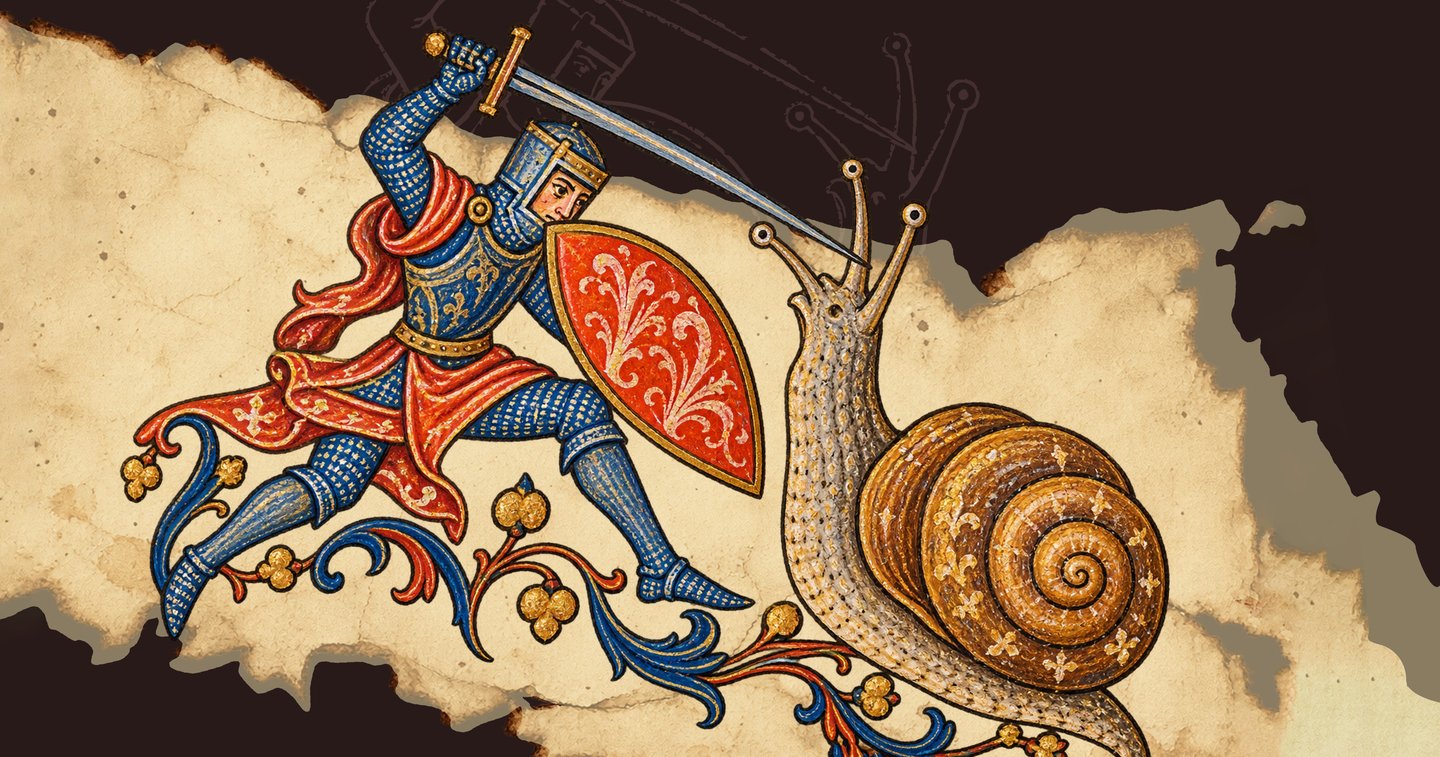
A medieval manuscript is traditionally perceived as a space of rigorous order. A sacred text holds a central position within it, yet as soon as the viewer’s eye shifts from the center of the page to its periphery, a completely different, paradoxical world unfolds: knights battle giant snails, and rabbits hunt people. These illustrations were long considered random doodles by bored scribes or meaningless flights of fancy—but is that really the case?
TOPIC SELECTION
The choice of topic relates to the reinterpretation of heritage in design. Today, marginalia is viewed not as mere incidental decoration, but as a complex, independent sign system that allows for the reconstruction of the «unofficial» culture of the Middle Ages. Studying these images provides unique access to the fears, hopes, humor, and social contradictions of people from that era—elements that found no direct reflection in canonical texts. Furthermore, the visual language of marginalia reveals a surprising similarity to contemporary internet culture, making their study particularly compelling for a designer.
RELEVANCE AND GOALS
Digitized collections allow viewers to examine book illustrations outside the context of the binding, page sequences, and surrounding text. An isolated fragment can then be utilized for a new annotation, composition, or interactive narrative. Therefore, it is important to distinguish between the historical function of an image and the conceptual role assigned to it by a contemporary creator. The goal of this research is to identify which visual characteristics of marginalia persist when transferred to a different medium, and how their functions and modes of viewer interaction evolve.
How does the function and perception of medieval imagery change when it is transferred to a modern meme, editorial design, clothing, and digital game?
WORKING HYPOTHESIS
The reuse of marginalia supports a expressive gesture, an unusual combination of forms, and a subversion of conventional roles. When the carrier changes, these characteristics can persist, while the image’s function is defined by a new caption, composition, and the available user action. Therefore, the recognizability of the motif is compatible with a shift in its meaning.
PRINCIPLE OF VISUAL MATERIAL SELECTION
For this research, I utilized books, museum catalogs, art historical publications, encyclopedic materials, and reference resources. The historical core consists of Jeanne d'Évre’s Book of Hours, the Gorleston Psalter, Harley MS 6563 Book of Hours, and a fragment of the Smithfield Decretals [1–3]. The images selected allow the viewer to observe the positioning of figures on the page, the interaction between characters, or the transposition of human action onto an animal.
The contemporary corpus includes a library publication, a university exhibition of memes, the KB project, the cover of Weird Medieval Guys, a Scribal Work Shop t-shirt, and Inkulinati [4–10]. This is a targeted selection illustrating various modes of application, not a statistical survey of all contemporary culture.
RESEARCH METHODOLOGY
Comparative visual analysis is employed. Initially, the carrier, scale, framing, gesture, and the image’s relationship to the text are examined. Then, the historical motif is juxtaposed with its contemporary application based on four parameters: what is preserved in the form, what has changed in the context, what function the image serves, and what the viewer can do. Juxtaposing identical motifs is not equated with proof of direct copying of a specific plate. Catalog information, creators' statements, and authorial interpretations are considered separately.
PRINCIPLES FOR SELECTING TEXTUAL SOURCES
The attribution of manuscripts relies on The Met museum catalog and British Library publications [1; 2; 4]. Emily Chartrand’s research is used to discuss the knight and the snail, emphasizing how interpretation is dependent on the specific context [3]. Contemporary projects are examined according to the pages of libraries, university exhibitions, publishers, manufacturers, and developers [5–10].
GUIDELINE PRINCIPLES AND SCOPE
The material is organized according to changes in the status and function of the image: the manuscript field, visual conflict, new signature, new medium, and guided action. This sequence allows for specific operations concerning the image to be compared. It does not describe the continuous evolution of all marginalia from the Middle Ages to the internet.
Miniatures, late reader drawings, and contemporary memes are designated separately. The KB illustration is included as a comparative example of the broader culture of medieval memes. The result is an author’s table of changes, not an attempt to restore a singular original meaning for every motif.
WHAT ARE MARGINALS AND HOW DID THEY APPEAR
Изображение за пределами основного текста
The medieval page possesses its own architecture. The text occupies the center, symbolizing divine order. Margins surround it, forming the periphery. It is on this periphery that artists begin to create images that are sometimes practically unrelated to the book’s content. This space becomes a territory of freedom, where the sacred meets the profane [1].
«Psalter of Lattrell,» c. 1325–1340. British Library, London (Add. MS 42130) [1]
Marginalia can supplement the text, argue with it, parody it, or exist completely on its own. There are three terms: Marginalia—a general term for images and notes in the margins. Drolleries—humorous, fantastic, and grotesque images, often unrelated to the text. Bas-de-page—narrative illustrations at the bottom of a page that can form independent story cycles [2].
Examples of marginalia, drolleries, and footnotes from 13th–14th century manuscripts [2]
FIELD AS PART OF A MANUSCRIPT
Почему смысл зависит от страницы
Jean Pucelle. The Horarium of Jeanne d’Evreux. c. 1324–1328. The Met, 54.1.2, fol. 15v–16r. Public Domain. [3]
On one hand, marginalia was often perceived as an interruption. The scribe or reader might leave notes, questions, or even criticism in the margins—sometimes these were just random scribbles, and sometimes they were significant observations that aided in better understanding the text or expressing confusion. On the other hand, within the monastic environment, these «freehand» notes were treated with more care: they were not immediately erased, and were sometimes even preserved intentionally because they reflected a living thought—a dialogue with the text.
In Jeanne d’Evreux’s Book of Hours, small figures coexist with religious scenes and prayer texts. The scale indicates levels of reading. Since the Book of Hours served as a personal prayer book, the margins should be considered as part of the book’s design [3].
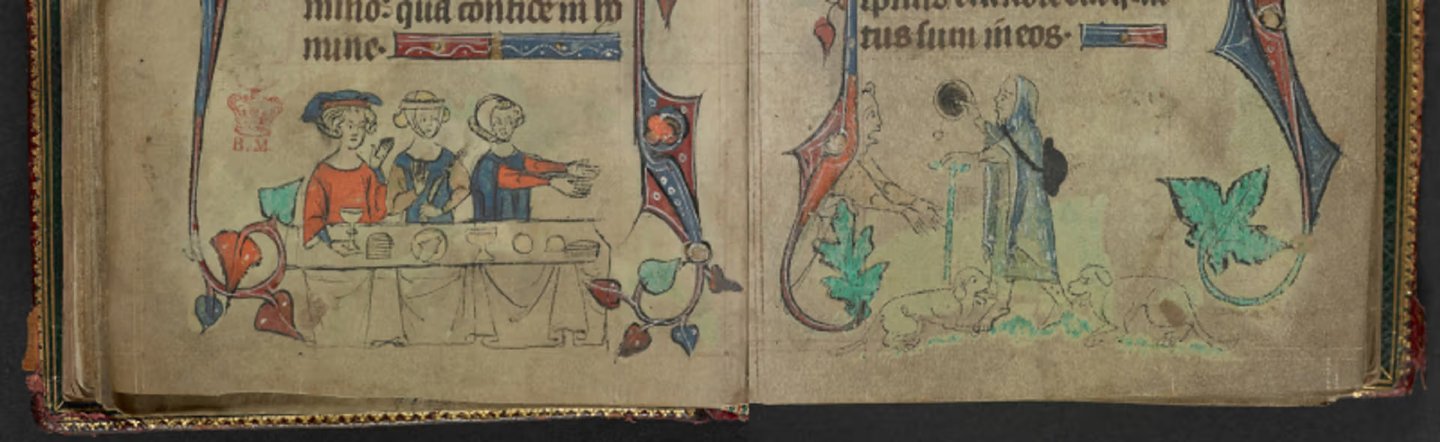
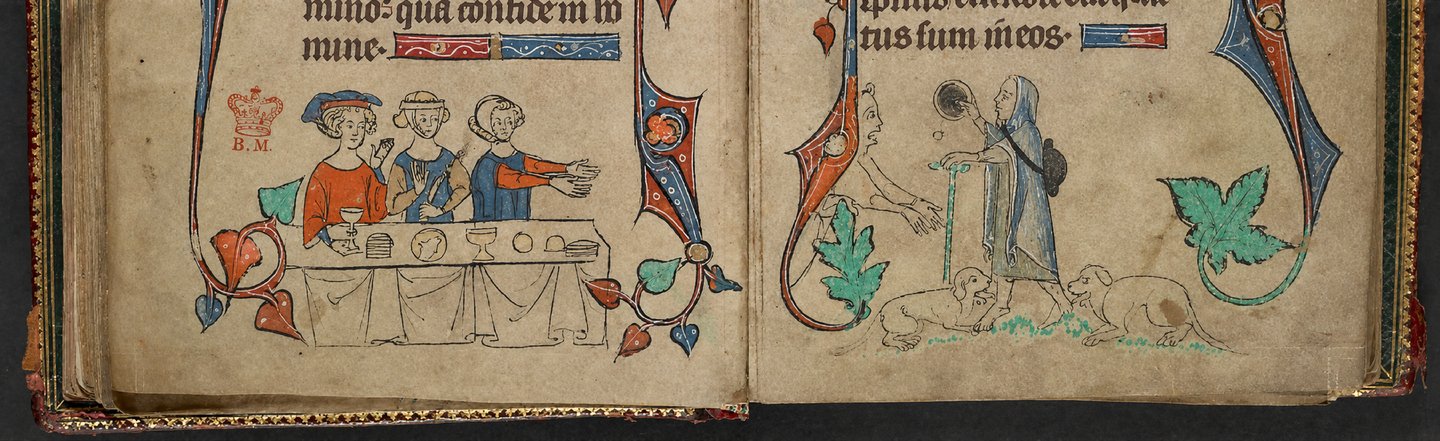
(1) AI-enhanced photograph for quality improvement
(2) Original / Rich Man’s Feast and Poor Lazarus. Hours School, England, circa 1320–1330, fol. 10v–11r. British Library, Harley MS 6563. Fragment of the opening spread in [4]
The fields adorn the page, develop the narrative, allow for moralizing, and incorporate comic play. The scene of the rich man and Lazarus in Harley MS 6563 illustrates why not all marginalia should be considered mere jokes [4]. They also served as valuable illustrations.
WHAT ALLOWS TO TRANSFER THE IMAGE
Unknown artist. Knight and Snail. Gorlstown Psalter, 1310–1324. Folio 193v. British Library, Add MS 49622 [5]