Navigator
Research Concept The Origin of the Idea of the Female Support Figure The Erechtheion: Six Girls Instead of Columns The Body as Structure: Legs, Torso, and Weight Distribution Hairstyles and Clothing: Details That Enhance the Architecture Beauty Without Depicting Effort What the Ancient Source Tells Us: The Vitruvius Version Conclusion Bibliography
Research Concept
When I look at ancient architecture, I usually first notice the columns—they establish the building’s rhythm and create a sense of stability. But at some point, I became interested in how, in Greek architecture, the column was sometimes replaced by a human figure. This figure was not merely decoration; it was a sculpture integrated into the architectural composition. I find the choice of a female figure as a support particularly unusual. To me, a girl in long robes appears pliable and even fragile, yet despite this, her head bears a heavy load in the form of a stone roof. This juxtaposition—the contrast between the living body and the strict architectural function when looking at the column—became the starting point for my research.
The main question I want an answer to is: how did the Greek masters transform the female figure into an architectural load-bearing element while preserving its beauty and expressiveness?
My initial hypothesis is that the caryatid is not simply a human-figure column. The sculptor utilized the posture, the folds of the drapery, the hairstyle, and the head termination form so that the human body is perceived simultaneously as the image of a young woman and as an integral part of the architecture.
As the primary example for my research, I have chosen the caryatid of the South Porch of the Erechtheion on the Acropolis. I am also referencing earlier examples of female figures in architecture, Vitruvius’s text, and the museum descriptions of the sculptures themselves. In my research, I will compare not only the overall appearance but also specific details: the positioning of the legs, the tilt of the torso, the vertical folds of the drapery, the hair, and the headpiece.
I divided my research into several chapters to gradually explore how the female figure became integrated into architecture. I begin by examining earlier examples of figurative representation to understand the emergence of the Caryatids of the Erechtheion, then I analyze the portico itself and the placement of sculptures within it.
In the following chapters, I examine the posture of the legs and torso in greater detail. I am interested in why the figures appear stable, even when their poses are not entirely symmetrical. I will also separately discuss clothing, hairstyles, and capitals because these details not only adorn the sculptures but also help connect the human body with architecture. Afterward, I will investigate why the caryatids appear so serene and show no sign of strain, despite the weight of the roof they support. Furthermore, I refer to the text by Vitruvius mentioned above to examine one of the ancient theories regarding the origin of their name.
In conclusion, I want to show that the caryatid is not merely an architectural support cast in the form of a female figure, but a specific artistic image in which sculpture and architecture are closely intertwined. In my view, it is this combination that allows us to better understand how ancient Greek masters merged the aesthetic expressiveness of the human body with its structural role in architecture.
Chapter 1. The Origin of the Idea for the Female Support Figure
«Treasury of the Syphnians in Delphi.» Female figures in architectural decoration. Circa 525 BCE, Archaic Period.
Caryatids did not suddenly appear in Ancient Greece. Researcher Ione Milonas Shir, in the article «Maidens in Greek Architecture: The Origin of the Caryatids, ” examines early examples of female figures used in place of columns, including the Treasury of the Sibyans at Delphi. She writes that in several early structures, „standing female figures“ were used instead of columns—meaning these figures evolved into a distinct type of architectural support (my translation).
The caryatid is not originally related solely to facade ornamentation. Its scale, placement, and verticality are subservient to the architecture; unlike a standard column, it immediately captures attention as a human form.
Reconstructed map of the Siphonus treasury
Looking at the treasury, one gets the impression that the architecture was intended to be less impersonal. The column establishes order, and the figure of the woman seems to inject something alive into it. She remains part of the facade’s rhythm, but the viewer begins to perceive her as a distinct element. The Shir article is dedicated to the origin of the type and shows that the history of female support figures is more complex.
Chapter 2. The Erechtheion: Six Maidens Instead of Columns
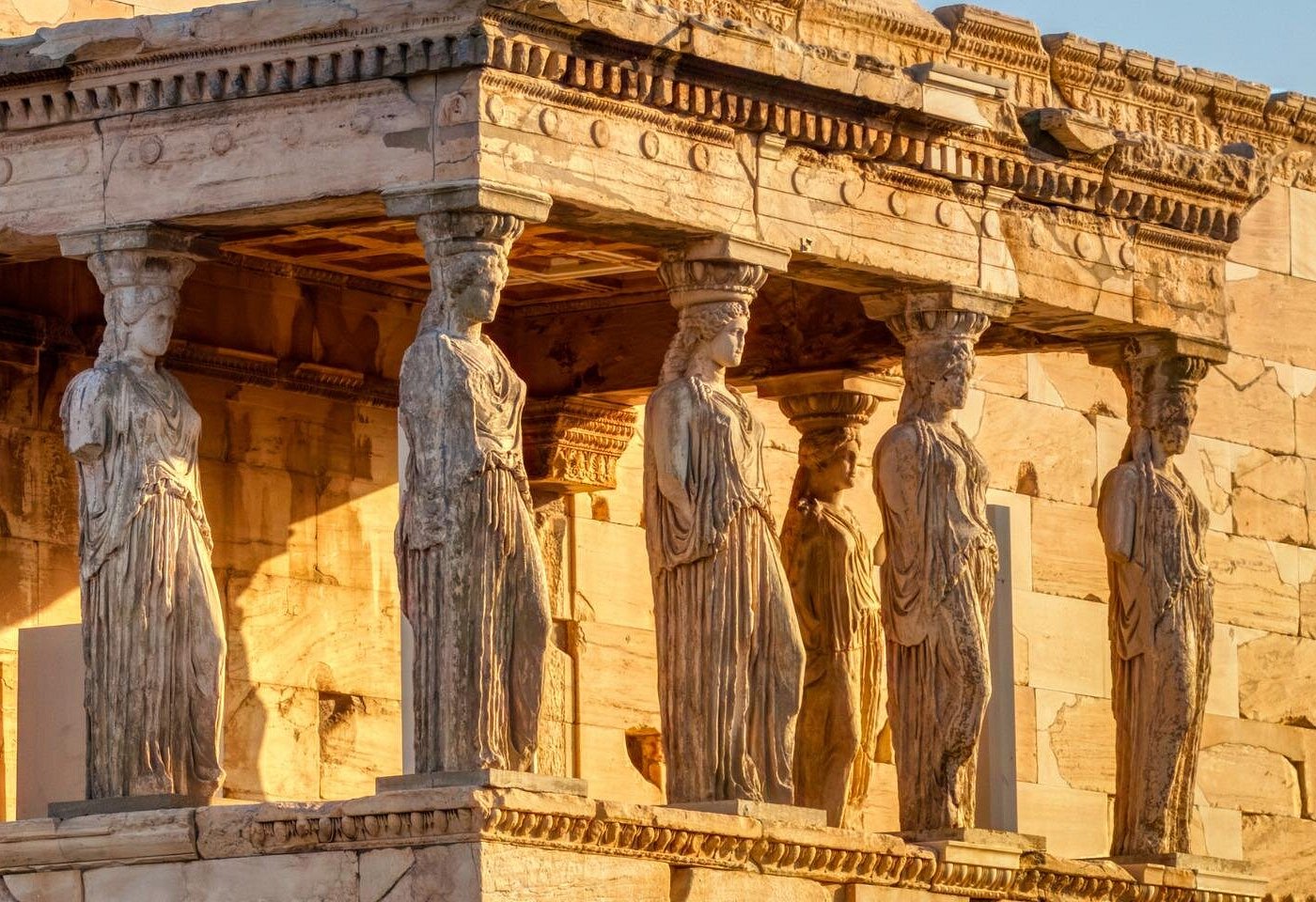
South Porch Caryatid of the Erechtheion, Acropolis of Athens. Circa 420–415 BCE.
Attach Card
The most famous example of the southern porch of the Erechtheion. It is supported by six female figures placed in place of conventional columns. The Acropolis Museum notes that they date to the Classical period, circa 420–415 BCE. They stand approximately 2.3 meters tall and are made of Pentelic marble.
Interestingly, in the temple’s construction inscriptions, these figures were called korai, meaning young women. The name «Caryatids» was adopted later. The museum also notes that five originals are held in the Acropolis Museum, while one figure is in the British Museum; the monument itself features replicas.
Southern Caryatid Porch, Erechtheion, Acropolis of Athens. Circa 420–415 BCE.
Attach card
The Caryatids are not arranged in a single plane like a standard line of columns; instead, they stand on a low base organized in the shape of the letter P. According to the Acropolis Museum, they were oriented toward the processional route of the Panathenaic festival. This suggests that their composition is connected not only to the structure of the portico but also to the movement of people around the Acropolis.
From a distance, the figures can indeed be perceived as specialized columns. However, upon closer inspection, it becomes apparent that each one possesses its own posture and plasticity.
They repeat, but they don’t look completely identical. For me, this is what makes the portico so interesting: the architectural rhythm is maintained, but instead of impersonal supports, we see six human figures.
Chapter 3. The Body as Construction: Legs, Torso, and Weight Distribution
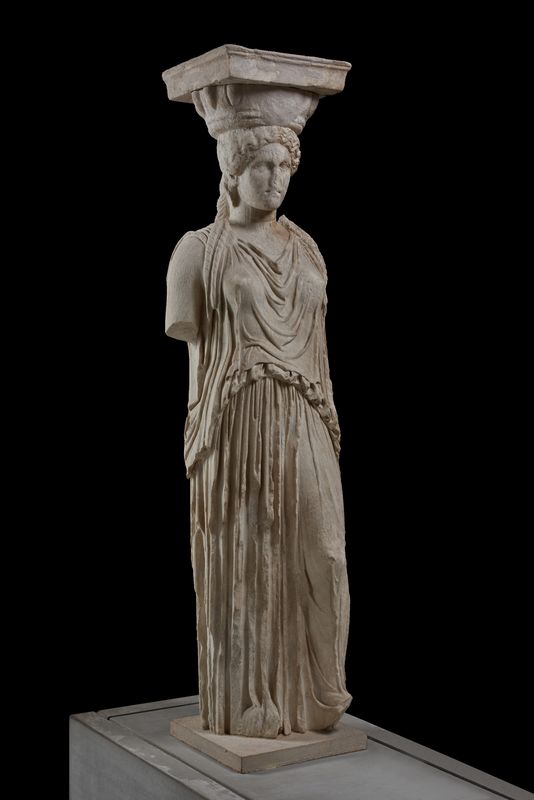
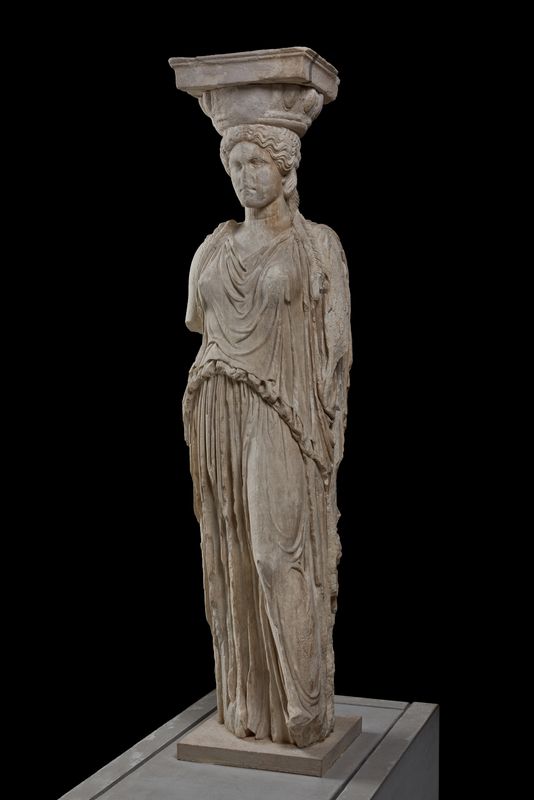
Kora A 420–415 BCE
If one examines a single figure closely, it is apparent that it is not standing straight. The museum description for Cora A states that she leans on her right leg, while gently bending and advancing her left leg forward. This posture creates a natural curve in the body without compromising its overall verticality. The supporting leg conveys a sense of stability, while the free leg adds movement; as a result, the figure does not appear static—it retains a human plasticity, even though its function is related to architecture.
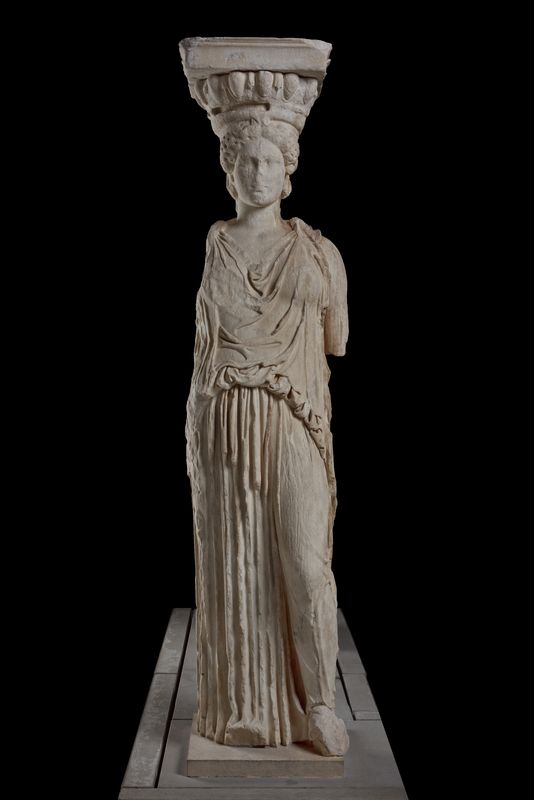
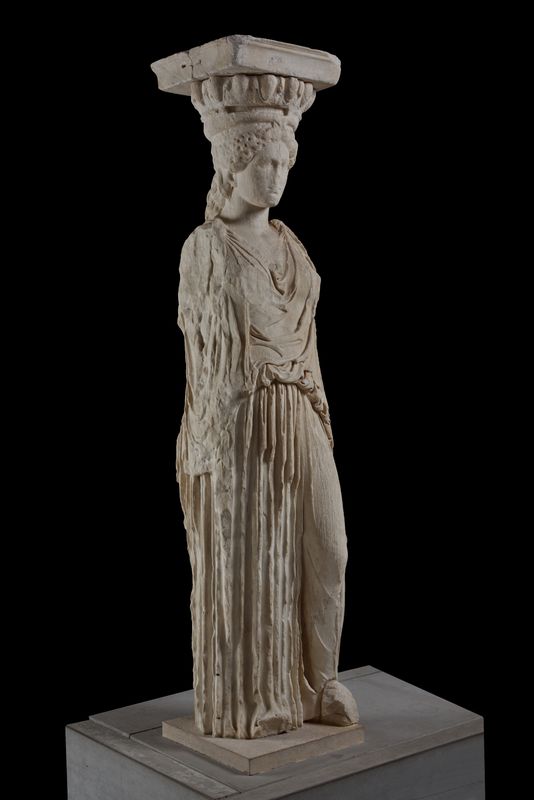
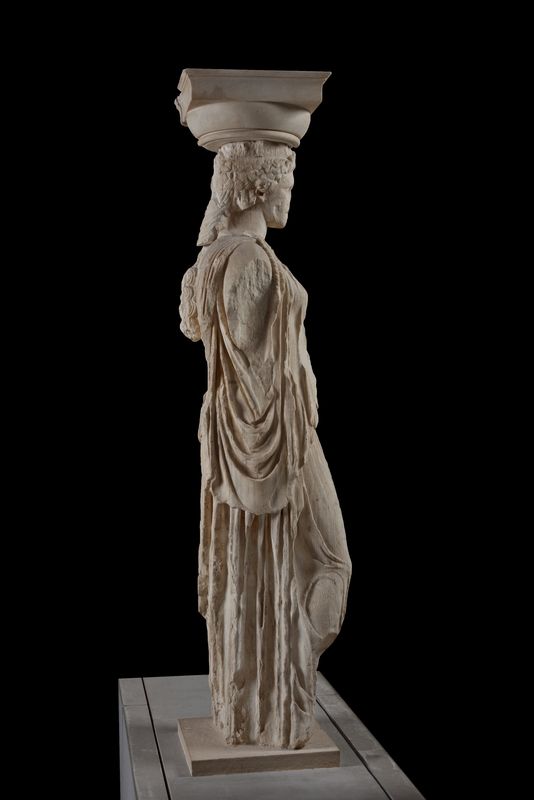
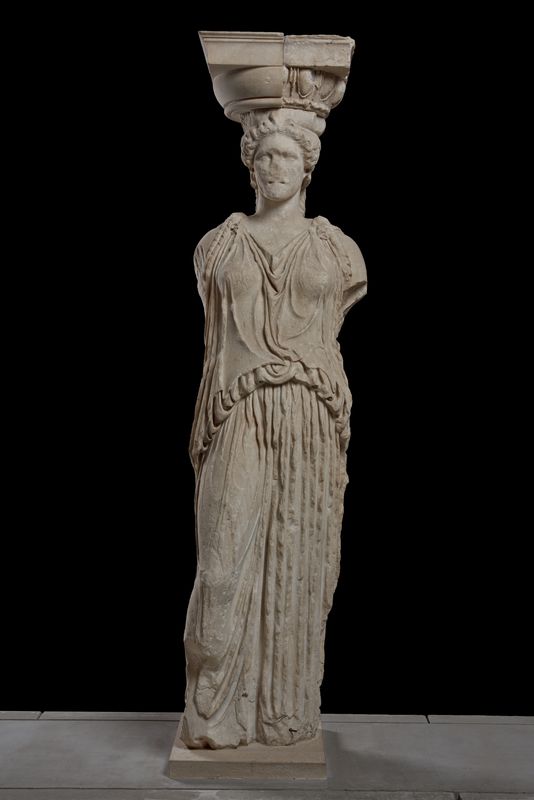
The Acropolis Museum describes other pose variations; for instance, in Cora B, weight is placed on the firmly planted right leg, while the slightly bent left leg and shoulder tilt create a crossed movement.
Cortex D 420–415 BCE
In Kory D, the proportions are more elongated and the body’s movement is more pronounced.