INDEX
- Concept
- Art Before the Epidemic
- The Birth of a New Visual Language
- Death as the Central Figure in Art
- The Image of Global Disaster
- The Dramatism and Theatricalization of Death
- Preserving Memory of the Disaster
- Social Satire
- The Legacy of Plague in Contemporary Visual Culture
- Conclusion
- Bibliography
- Image Sources
CONCEPT
«From religious motifs to imagery from contemporary pop culture»: How the depiction of death in visual arts transformed and evolved under the influence of the plague epidemic that swept across Europe in the 14th century.
The Black Death epidemic, which swept across almost all of Europe and the Middle East in 1347, was a significant historical event that claimed tens of millions of lives. Such events leave a profound mark on people’s lives, culture, traditions, and art—and this pandemic was no exception. Under the influence of the Black Death, human perception of death and the value of life transformed, leading to various changes in the narratives and figures depicted in art. The consequences of this event have been repeatedly captured in works of art that either illustrate the events of that time or were created by their eyewitnesses.
The subject of my research is the iconography of death, examined through works of visual art. Under the influence of the plague epidemic, this image repeatedly transformed, evolved, and acquired new features and characteristics. This representation was influenced not only by the epidemic itself but also by religion, daily life, public sentiment, personal experiences and fears, and the individual’s reevaluation of the value of life. I chose this specific theme for my visual research because many images that we associate with the theme of death today—which emerged under the influence of certain historical events—have become deeply entrenched in contemporary mass culture (for example, the image of the plague doctor or the image of the skeleton). I became curious about which of these images migrated into pop culture since the «Black Death.»
RESEARCH HYPOTHESIS
My hypothesis is that the XIV-century plague significantly contributed to the reinterpretation and subsequent evolution of the image of death. Because of this event, new interpretations of old imagery emerged, newly created symbols spread, and visual art became a means of reflecting collective tragedy and the attempts to comprehend it.
KEY RESEARCH QUESTION
How exactly did the perception of death change under the influence of the 14th-century plague epidemics?
The question is framed to facilitate the identification of specific artistic motifs present in the artwork of that period that underwent certain transformations, to determine whether the plague acted as a «catalyst» for these changes, and to trace the sequence and logic of their evolution during the project’s development.
MATERIAL SELECTION PRINCIPLES FOR VISUAL RESEARCH
The criteria for selecting visual materials are quite straightforward: they must fall within specific chronological parameters and depict the motif of death on some piece of visual art. The sources for my research were diverse articles and studies covering the influence of the «Black Death» epidemic on medieval art.Another significant consideration when searching for suitable resources for my visual study involved materials that covered medieval art broadly, in order to examine artworks predating the plague epidemic. Reference to certain religious texts also played an important role in analyzing the relevant iconography.
THE IMAGE OF DEATH BEFORE THE PANDEMIC
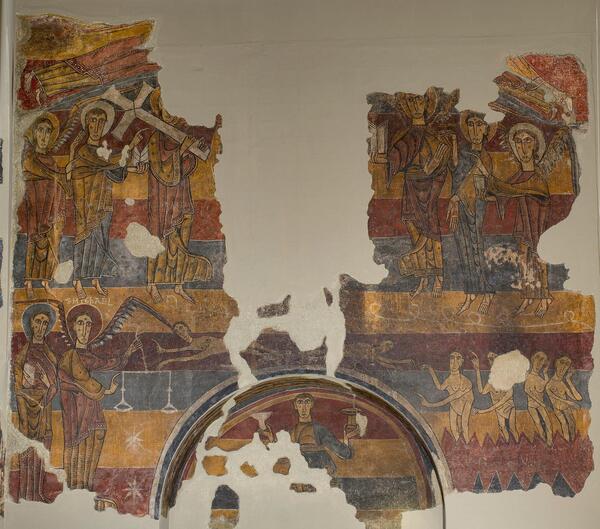
Фреска «Страшный суд». ок. 1123
Мозайка «Страшный суд». ок 1100-1200
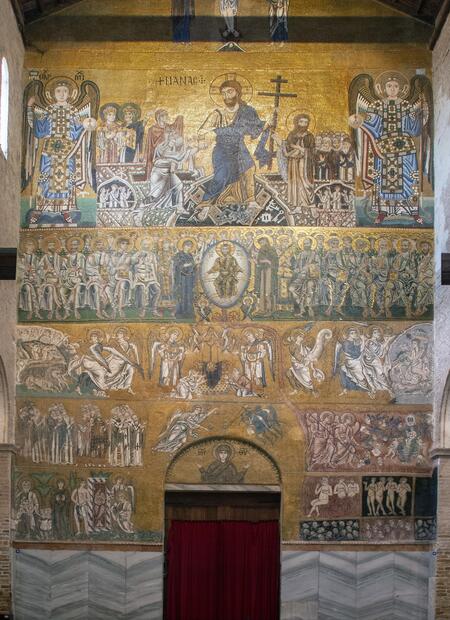
In early Christian and medieval art, death was perceived as part of the divine order. It was closely tied to the religious worldview of the time. On these visual arts subjects, death is represented through figures of the deceased who now stand before the afterlife judgment. Thus, the image of demise was depicted not as a natural biological process resulting in a person ceasing to exist, but as a transition to the afterlife, where the soul’s ultimate destiny is determined.
Miniature: «The Four Horsemen of the Apocalypse from the Apocalypse of St. Sever.» Folio 108v–109r. c. 1050
In Christian iconography, the image of a catastrophe that destroys humanity existed long before the plague emerged as an independent figure in art. A particularly popular theme for depicting devastation was the Four Horsemen of the Apocalypse from the Book of Revelation: Conquest, War, Famine, and Death.It is important to note that the figure of the first horseman, who symbolizes conquest and victory («and he came out to conquer»), will be associated with the image of the plague in later interpretations and popular culture, but this disease is not mentioned in the original text.
1347–1353: THE BLACK DEATH. THE BIRTH OF A NEW VISUAL LANGUAGE
Pieter Bruegel the Elder. Miniature «The Residents of Tournai Bury the Plague Victims, ” 1353.
In the mid-14th century, the plague swept across Europe. The scale of the catastrophe was so immense that death ceased to be an abstract concept—it burst beyond religious symbolism and became a brutal reality. Despite this, religious painting did not disappear; on the contrary, it became one of the primary means by which both creators and society processed the magnitude of the pandemic. One of the central motifs became the interpretation of the plague epidemic as divine punishment. The visual metaphor of Death, depicted as a woman shooting arrows at humanity, gained particular widespread popularity. This image of arrows can be interpreted as the swift spread of the disease and the suddenness of death.
Fresco: «The Black Death.» c. 1355
The emergence of protective imagery—icons defending people against plague—is a natural phenomenon during pandemics. It is important to note that during the «Black Death» epidemic, depictions of certain saints gained particular significance, as people turned to them for protection from the affliction. Saint Sebastian and Saint Roch (Rocco) played a key role in this.
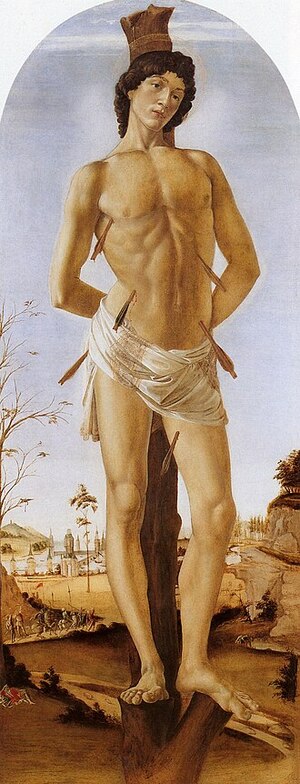
Saint Sebastian was traditionally depicted as a youth tied to a pole and pierced by arrows. During the pandemic, his image gained widespread popularity among those seeking deliverance from the plague. This was influenced by the comparison of the plague to arrows, a fate closely associated with the Roman legionary: it is believed that Sebastian was condemned to death by arrows for refusing to renounce Christ, yet these wounds did not kill him. Through the saint’s survival, believers found hope for recovery.
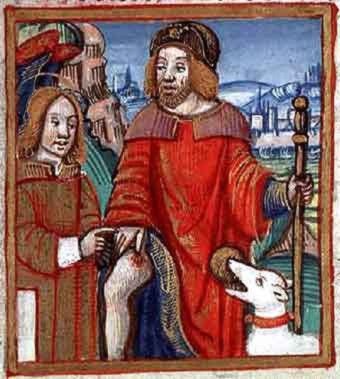
Saint Roch’s connection to the plague was more direct than Saint Sebastian’s: according to his life story, he not only contracted the illness himself but also helped the sick. He is usually depicted as a pilgrim with a dog and a walking staff.
Сандро Боттичелли. «Святой Себастьян». 1474
Миниатюра, изображающая святого Роха
DEATH AS A PRIMARY ARTISTIC SUBJECT
Vincent van Catasta. Fresco «Dance of Death.» 1474
The next stage forms the visual language that is most often associated with medieval epidemics in our time.
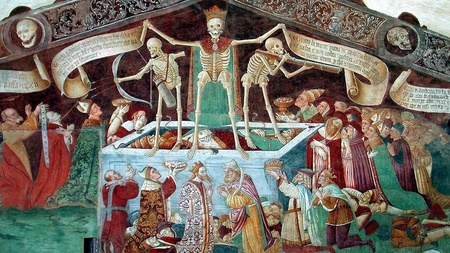
One of the most striking images of death is the Danse Macabre. This motif is easily recognizable: a skeleton or Death itself leads representatives from all social strata. The core idea of the Danse Macabre is that social inequality exists only during people’s lives, whereas before death, everyone is equal. Death mocks those who believe in their superiority.
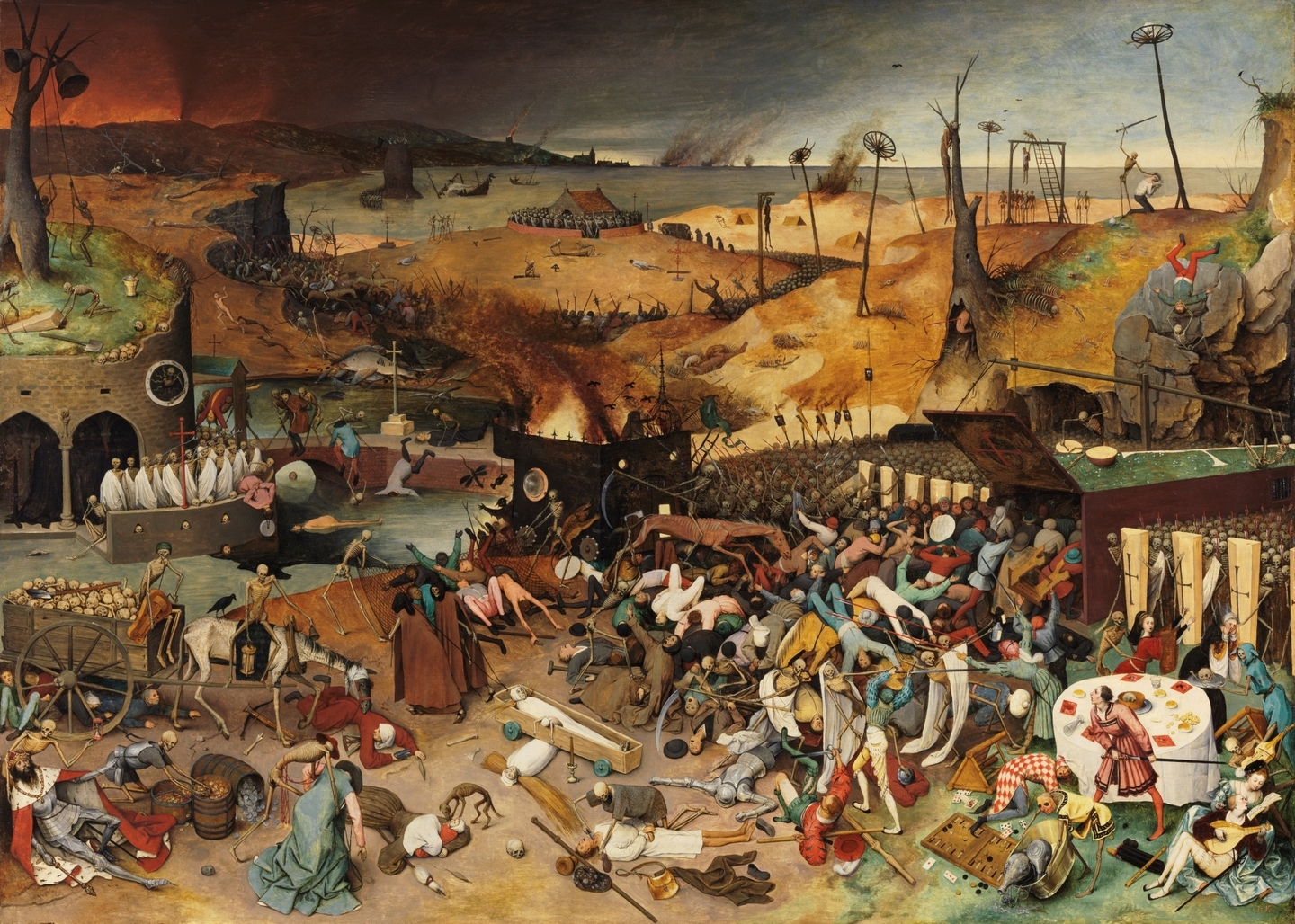
Another significant image is the Triumph of Death. If in the previous case Death interacts with individual people, the Triumph of Death strikes the entire society. Death stops being a companion and becomes a conqueror. Here, the image of demise is shown as a massive catastrophe engulfing the entire civilization: people completely lose control over their world—their orders, foundations, and laws crumble under the onslaught of the plague.
Pieter Bruegel the Elder, «The Triumph of Death.» 1562
Following the plague epidemic, the skeleton motif gains popularity, but it ceases to be solely a signifier of a deceased person; instead, it becomes an independent character—Death acquires a body and a distinct persona. During this period, a figure emerges that would later inhabit caricature, theater, literature, poster art, and mass culture.