1. CONCEPT
Miroslav Shashek entered the history of global book graphics as the creator of the iconic illustrated guidebook series, «This…» (1959–1974), which united eighteen volumes dedicated to major cities and countries worldwide [1]. As art historian Martin Solsby notes, his fundamental architectural training, received at the Prague Technical University, directly shaped the structural clarity, sense of scale, and poster-like conciseness of his book graphics [2].
Shashek’s methodology was built upon direct observation of the urban environment: during his travels, he created hundreds of rapid sketches from life, documenting the characteristic silhouettes and behavior of pedestrians in notebooks [3]. These lively sketches were later subjected to rigorous graphic selection and transformed into stylized iconographic symbols representative of mid-20th-century aesthetics.
Studying his approach reveals the precise visual mechanisms by which the illustrator is able to convey a person’s profession, social status, and cultural code using minimal graphical means, thereby avoiding an overload of detail.
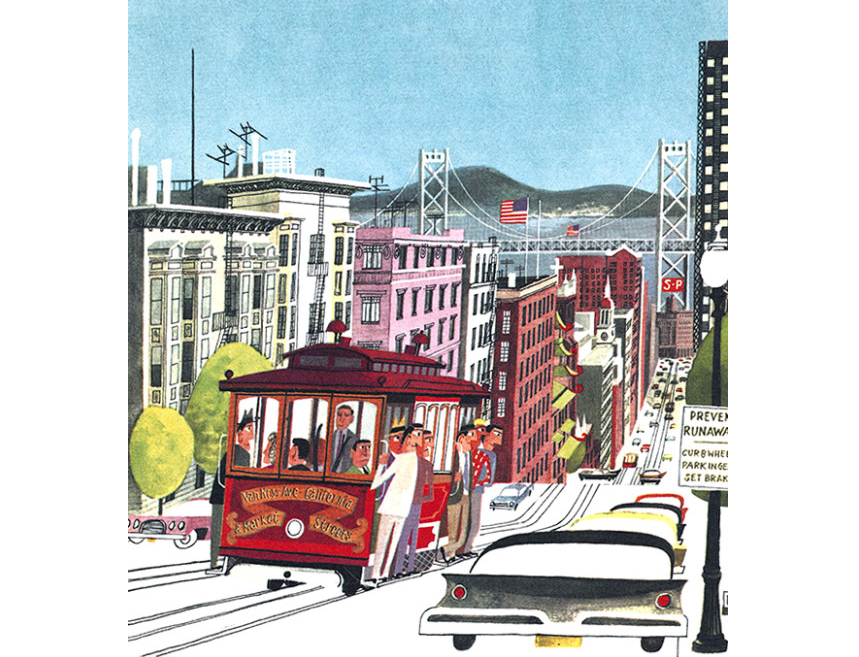
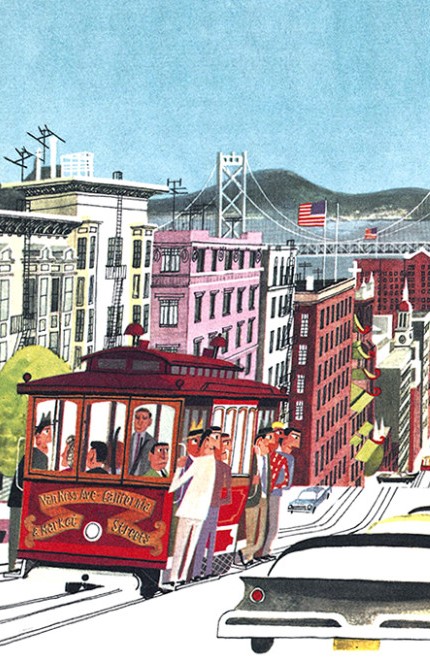
Chess Pieces by M. Shashek. California Street (from the book «This is San Francisco»). 1962.
Visual material selection was based on the criterion of expressive human typology. The selection included both close-up individual characters and characteristic groups of city dwellers representing the recognizable cultural character of a specific city.
INDEX
- Concept
- Silhouette Geometry
- Cultural Code and National Character
- Form and Emotion: The Language of Gestures Without Facial Expression
- Crowd Rhythm and Group Scenes
- Conclusion
The research base consists of monographs on the archives and creative methods of Miroslav Šašek, as well as scholarly articles concerning the composition of book illustration and the stylistics of the mid-20th century.
The central question of the study is how Šašek achieves instant recognizability of national archetypes using graphic means while employing extremely minimalist anatomy.
The hypothesis is that the characters in the «It Is…» guides are constructed according to the laws of pictograms: the artist reduces the figure to simple geometric modules but hyperbolizes a single cultural marker (costume silhouette, color accent, or characteristic gesture), thus transforming the person into a concise symbol of the city.
2. SILHOUETTE GEOMETRY
One of the key characteristics of Shashek’s graphic language is the deliberate rejection of academic anatomy and chiaroscuro modeling. The artist reduces the human figure to basic geometric modules—rectangles, trapezoids, ovals, and thin structural lines—which brings the book character closer to a navigational icon.

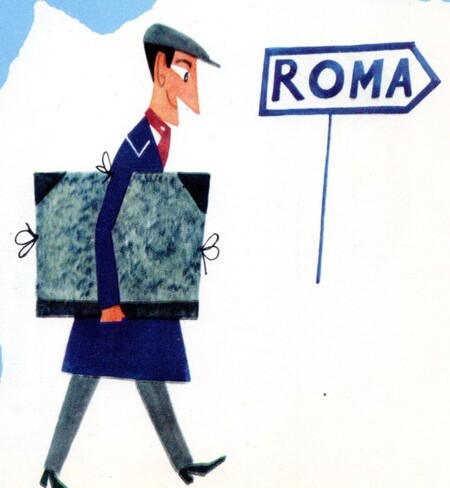
[1] Shashek M. Illustration from the book «This is London» (self-portrait of the artist with a portfolio). 1959. [2] • Shashek M. Illustration from the book «This is Rome» (self-portrait of the artist with a portfolio). 1960.
M. Shashes. Vending Machines (illustration from the book «This Is New York»). 1960.
A comparison of self-portraits from the books «This London» (1959) and «This Rome» (1960) reveals the graphic module method: Shapes employs a single geometric scheme of a walking figure (triangular profile, rectangular folder, sharp stride angle), changing only the costume and color to match the city’s atmosphere. In the scene with New York vending machines («This New York, ” 1960), this technique is scaled up into a catalog of typologies: the rectangular blocks of the machines set the rhythm against which the simplified geometric silhouettes of six different city dwellers rhyme.
M. Shashek, Bird Market (illustration from the book «This is Paris»). 1959.
The composition is structured as a strict modular grid of rectangular cells, into which concise geometric silhouettes of buyers and sellers are inscribed.
[1] • Shashek M. Student on a Bicycle (Illustration from the book «This is London»). 1959. [2] • Shashek M. Waiter and Café Patron (Illustration from the book «This is Paris»). 1959. [3] Shashek M. Boy on a Donkey (Illustration from the book «This is Greece»). 1966.
However, Shashek’s geometricization does not dehumanize the characters; rather, it establishes their fundamental characteristics through proportion. Strict vertical rectangles and elongated lines are used to create images of reserved or ceremonial characters.
3. CULTURAL CODE AND NATIONAL COLOR
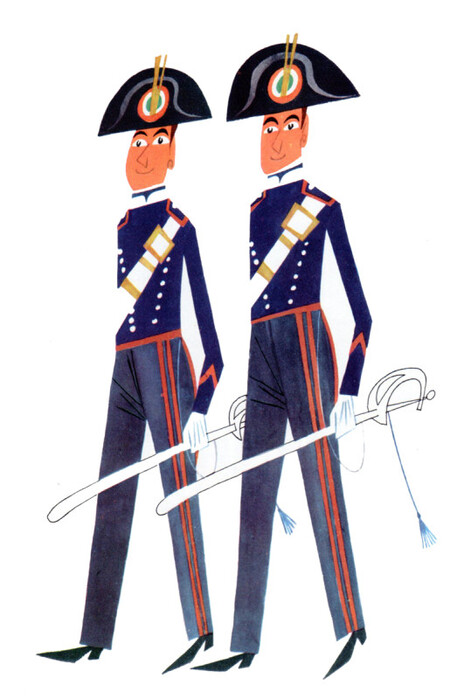
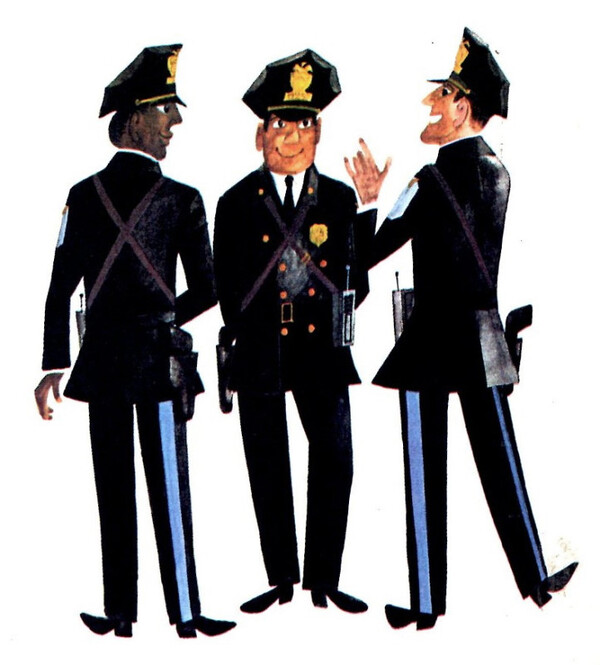
[1] Shashek M. Carabiners (illustration from the book «This is Rome»). 1960. [2] • Shashek M. Police Officers (illustration from the book «This is Washington»). 1969.
As noted by the compilers of the Thematic Review of the Russian State Children’s Library, the guides of Shashek possess a special charm due to their ability to subtly highlight and gently hyperbolize the characteristic traits of residents from various countries—from Parisian booksellers to Roman carabineers [4].
For a character to be unmistakably identified as a resident of a specific city, the artist accentuates a single cultural marker: a characteristic headwear, a piece of uniform, or an object attribute.
M. Shashek. Mitey-Mini bus by D.C. Transit (illustration from the book «This Is Washington»). 1969.
The atmosphere of late 1960s Washington is conveyed through recognizable markers of the American urban environment: the signature white-and-red Mitey-Mini van and the strict business attire of the passengers. The classic suit of a civil servant with a folder, the elegant hat with a fur trim on the woman on the bench, and the reserved expectation are read as a visual symbol of the official, measured rhythm of the American capital.
[1] Shashek M. Mailbox (illustration from the book «This is London»). 1959. [2] Shashek M. Chelsea Retiree (illustration from the book «This is London»). 1959. [3] Shashek M. Schoolgirls (illustration from the book «This is London»). 1959.
This section unites iconic London symbols—from the scarlet post box and the uniform of a Royal Hospital pensioner in Chelsea to the strict plaid uniform of British schoolchildren. The local color and recognizable cut of the costume transform each character into a concise visual signifier of their country.
Chess pieces. London on a tray (illustration from the book «This is London»). 1959.
From Mass Scene to Poster Symbol
M. Shashchek. Cattle Auction in Amarillo (Illustration from the book «This is Texas»). 1967.
At the Amarillo auction («This Is Texas, ” 1967), the regional character is conveyed through the repeating rhythm of light cowboy hats, plaid shirts, and neckerchiefs, unifying the crowd into a single cultural milieu.
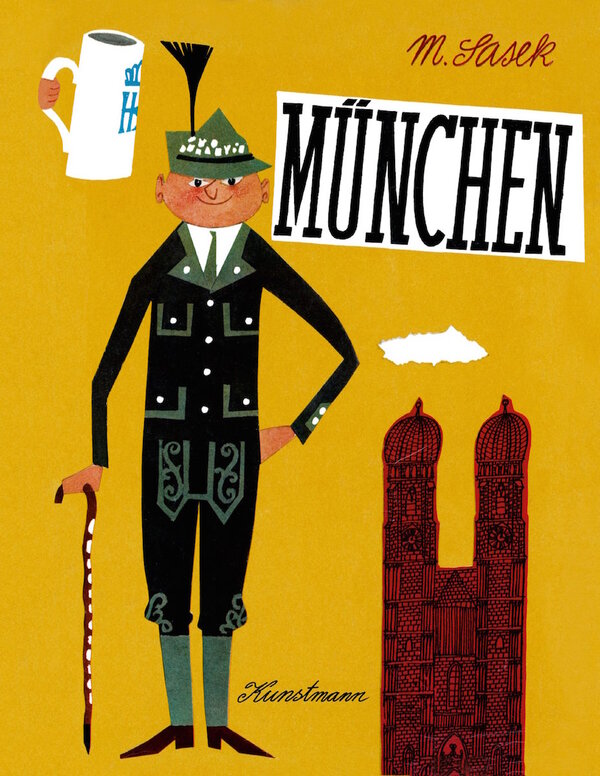
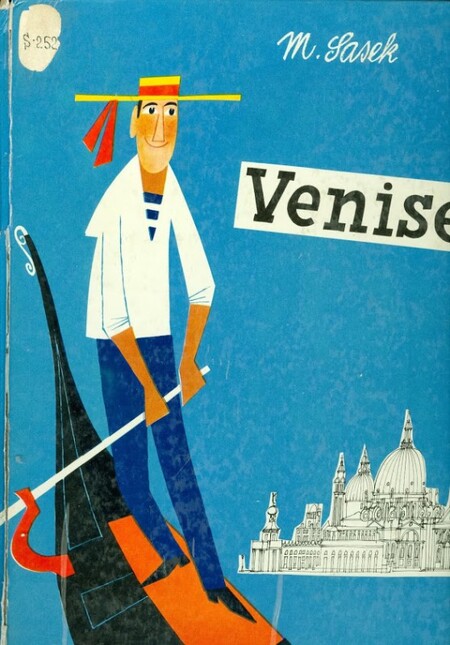
[1] Shashek M. Book cover for «It is Munich» (German edition «München»). 1961. [2] Shashek M. Book cover for «It is Venice» (French edition «Venise»). 1961.
The covers of the guidebooks «This is Munich» (1961) and «This is Venice» (1961) elevate this technique to the formula of the poster: a Bavarian man in traditional costume with a mug of beer and a Venetian gondolier in a straw hat become the main visual symbols of their cities, standing alongside the iconic silhouettes of local architecture.
4. PLASTICITY AND EMOTION: GESTURE LANGUAGE WITHOUT FACIAL EXPRESSION