«The Triumph of Concrete and Humanism»

«House-Ship» on Tulskaya Street, Moscow, Russia, 1970–1986
Topics
— Introduction — Historical Context — Visual Elements of Brutalism — Sociocultural Interpretations — Contemporary Perception of Brutalism — Conclusion — Sources
Introduction
In the 20th century, Brutalism gained particular significance within the context of Soviet architecture, leaving a noticeable mark on the appearance of many cities and settlements throughout the former Soviet Union. This period, stretching approximately from 1950 to 1970, was characterized by rapid industrial development and the realization of grand projects involving the construction of public and administrative buildings, residential complexes, and other infrastructure.
The emergence of Brutalism in the USSR was driven by a number of factors and prerequisites, similar to other countries where this architectural style also gained widespread adoption. We will examine the main ones.
Industrialization and the Establishment of Social Equity A need arose to provide housing for low-income populations, which gave rise to the idea of mass construction, implying the use of inexpensive yet durable materials. The function determined the structural form, and Brutalism perfectly met these requirements.
Ideological Aspect This style absorbed the ideological principles of the Soviet government, such as the concentrated development of public structures, and the ambition to create a new urban appearance that reflected the progressive spirit of the new era.
Following New Architectural Trends Globally, Brutalism was part of the International Style and the broader trend toward experimentation in architecture during the second half of the 20th century. Its uniqueness and approach to material usage captured the attention of architects worldwide, particularly in the USSR.
Professional Communities Across the cities of the Soviet sphere, there were active architectural schools and institutes where new architectural movements were discussed. These communities played a crucial role in disseminating and popularizing Brutalism among local architects and designers.
The visual component plays a vital role in understanding and interpreting Brutalism. Presenting architectural objects and their details through imagery allows one not only to assess their aesthetic value but also to conduct a deep analysis of their sociocultural significance, their impact on the urban environment, and the historical context of their emergence.
This is precisely why this research turns to the visual analysis of this style to identify its characteristics and various trends, as well as to diagnose its influence on the shaping of the urban environment and public space during the Soviet period. The study will examine various aspects of Soviet Brutalism, ranging from its historical foundation to contemporary perspectives on its perception.
Historical Context
Lomonosov Moscow State University
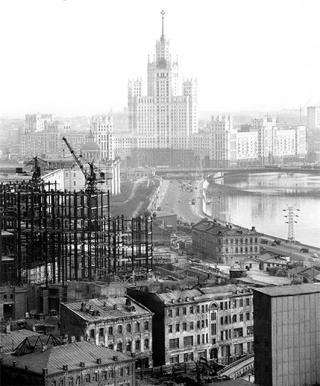
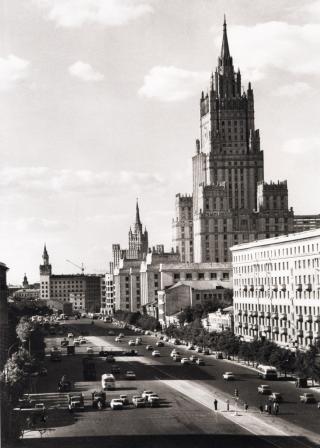
Residential Building on Kotelnicheskaya Embankment / Ministry of Foreign Affairs Building on Smolenskaya Square
During the Brutalism period (1950–1980), the USSR experienced a series of significant events and transformations in both domestic and foreign policy. The death of I.V. Stalin and the subsequent «Thaw» period (1953–1964) were the first major shifts. This era is generally characterized by substantial improvements in living standards and marked a flourishing of cultural life and science. Another, albeit more unique phenomenon, that strongly influenced the formation of Brutalism within this historical context was the Space Race, which spurred technological progress across all facets of society. The «Khrushchev Renaissance» became a primary driver of housing advancement, specifically through the introduction of standardized residential construction as a distinct architectural element.
First Khrushchyovka in Moscow at 16 Grimau St.
The «Stalinist» brick buildings constructed from the 1930s to the early 1950s according to individual projects did not solve the housing problem. While they were built with high quality, the process was slow, and they assumed communal living for residents or separate apartments for a specific segment of the population. The beautiful architectural elements of the buildings significantly slowed down the construction process and consequently increased their cost. Architects and builders were presented with a difficult challenge: to mass-produce quickly erected, small-footprint homes with separate apartments at a low unit cost.

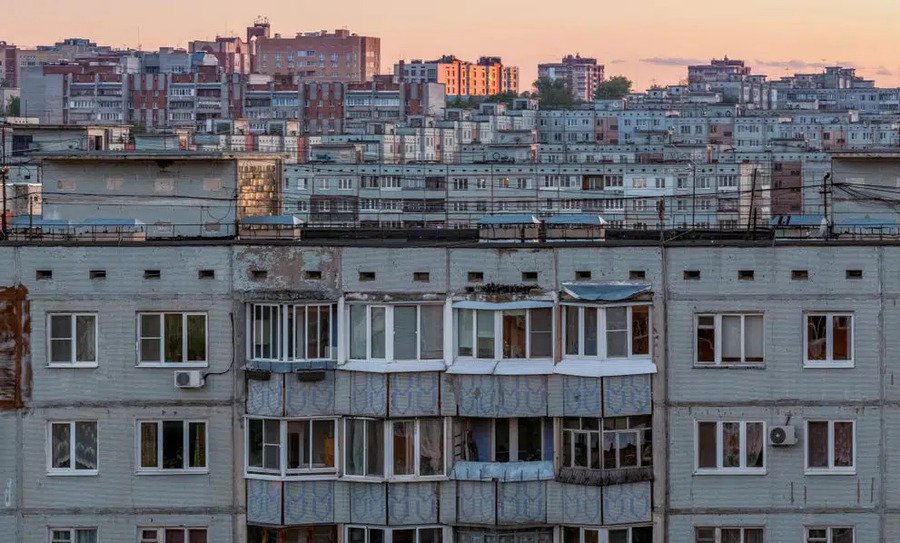
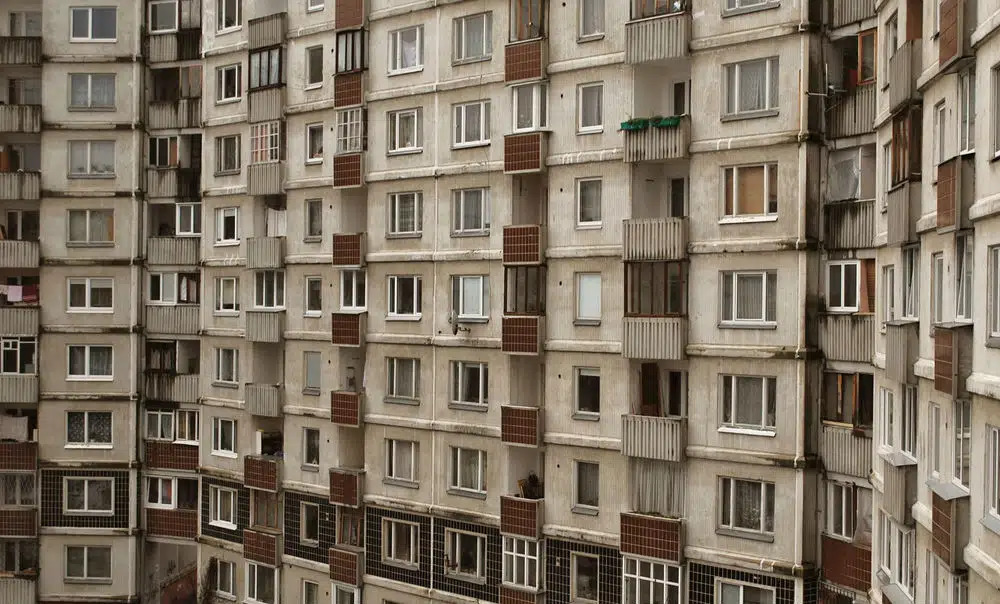
Examples of typical homes from the stagnation period
Next, we will turn to perhaps one of the key components that allowed Brutalism to settle in the city streets of the Soviet bloc: the Brezhnev era and stagnation (1964–1982). After Leonid Brezhnev came to power in 1964, the country entered a period of cultural and economic decline. During this time, mass construction of closed residential districts and public buildings continued actively. The resulting shortage of resources forced architects and urban planners to seek more economical and rapid methods of realizing projects, which directly led them to the widespread use of concrete and metal structures.
At the stage of historical context, one can draw the following conclusion: the active construction and the drive to create mass housing encountered several economic difficulties caused by changes in government. Brutalism, with its industrial materials and monumental forms, became an effective way to realize construction ambitions amid limited resources.
Visual Elements of Brutalism
To begin, let’s examine the main characteristic features of this style. The first thing to note is its massiveness and monumentality. Buildings in this style typically feature massive, rough forms, lending them an extremely imposing, even somewhat intimidating appearance that evokes an overwhelming sense of superiority and power.
Dnipropetrovsk Hotel, Ukraine, opened in 1968 (built in 1964).
The «Dnipro» Hotel is located in the city of Dnipro on Sycheslavsky Embankment. It is one of the city’s symbols and a striking example of 1960s Brutalist architectural trends, characterized by massive forms, geometric lines, and the use of concrete structures. Built on the site of former sawmills, the hotel attracts attention with its monumentality and power. Its building rises above the surrounding development, appearing imposing due to its massive structure. It exhibits pronounced Brutalist characteristics, including the use of industrial materials and rough textures.
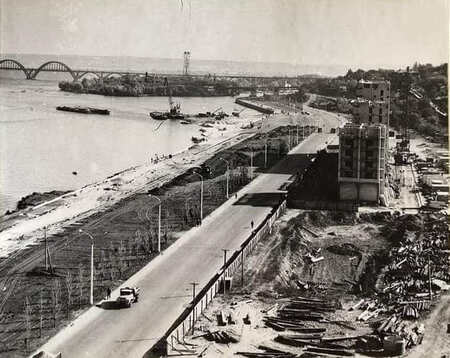
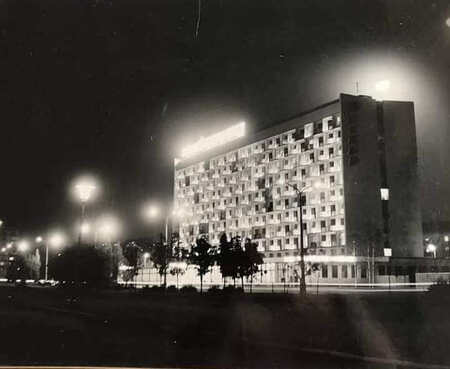
Building process/Final view of the hotel
This hotel was once considered the pinnacle of Soviet fashion and a new standard of service. Its cozy rooms for tourists, modern restaurant, conference hall, dedicated laundry facility, and contemporary kitchen with a large refrigerated storage area made it the city’s hallmark. Furthermore, some rooms were equipped with telephones, which was considered unheard-of luxury at the time, and the rooms featured beautiful views of the river.
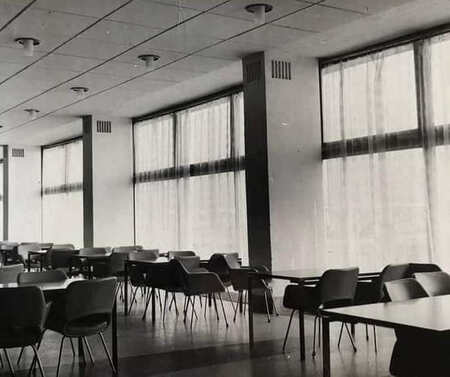
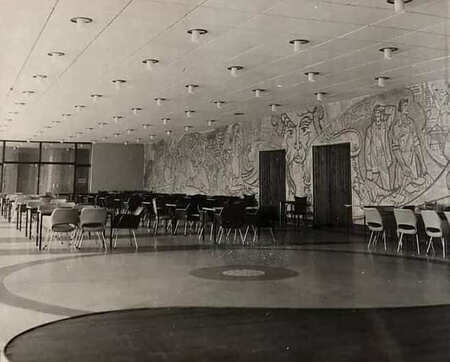
hotel interior design
Brutalism developed across the entire Soviet Union without exception. Examples of massive and monumental buildings can also be found in Georgia.
Engineering Building of the Ministry of Highways of the Georgian SSR, Tbilisi, Georgia, 1975.
The Ministry of Automobile Roads building in Tbilisi (also known as the «House of Road Construction Engineers») is a striking example of Soviet and Brutalist architecture. Completed in 1975, it represents a bold and highly expressive architectural complex. Characterized by typical Brutalist traits, the Ministry of Automobile Roads features massive forms and a monumental character. It stands out from the surrounding buildings due to its non-orthogonal geometric shape and high concrete walls.
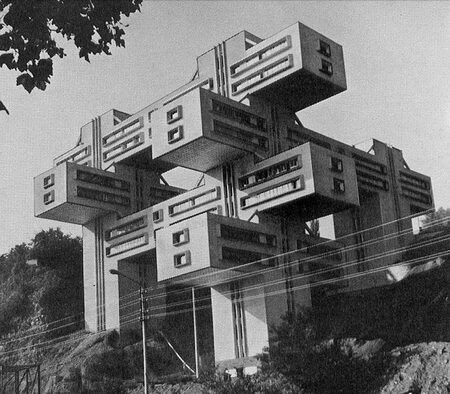
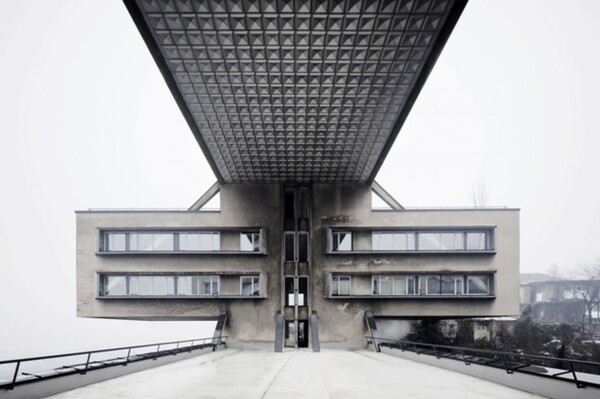
Road Engineering House, Architects G. Chakhava and Z. Djalgania, Eng. T. Thilava and A. Kimberg
The exceptional nature of this project was apparent even before its inception: when the ministry of road construction building was being designed, Chakhava himself was the Minister of Road Construction. This means that he was simultaneously fulfilling his own commission—acting as both the client and the lead architect.
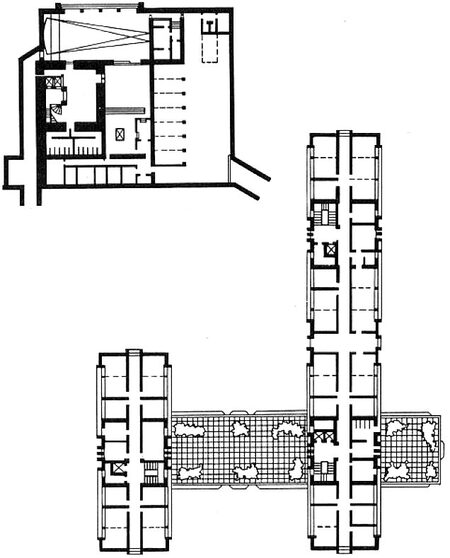
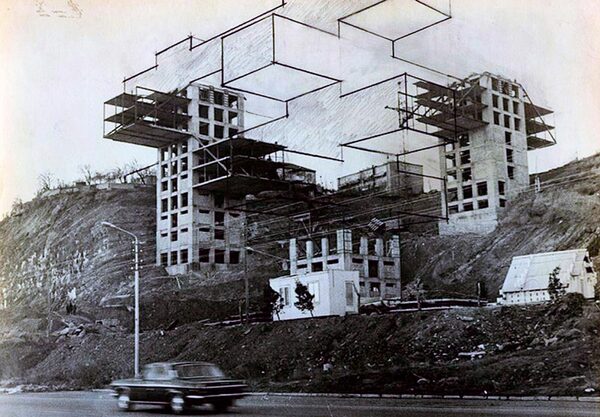
Building Plan / Initial Construction Phase