Introduction
Technologies that have become part of our daily reality were recently confined to the realm of science fiction. Much of what we use every day—from e-readers to neural networks—was foreseen by writers of the last century. Science fiction predicts not only technical breakthroughs but also how humans will interact with technology. Personal devices hold a special place within these visions—objects designed for individual use and the expansion of human capabilities. The goal of this study is to identify the main directions in the evolution of the form, functions, and usage scenarios of personal technologies in 20th and 21st-century science fiction.
The research hypothesis posits that literature shows a trend shifting from specialized material devices to multifunctional integrated systems. Alongside this change, the role of the human transforms—moving from an active user of a singular instrument to an integrated part of the technological environment.
Miniaturization of Computing and Communication Technologies
In the first half of the 20th century, the development of computing technology and radio communication formed a new perception of technological progress. Machines that actually occupied entire rooms in works of science fiction were reduced to the size of items suitable for individual use, becoming a convenient, personal tool.
Lens
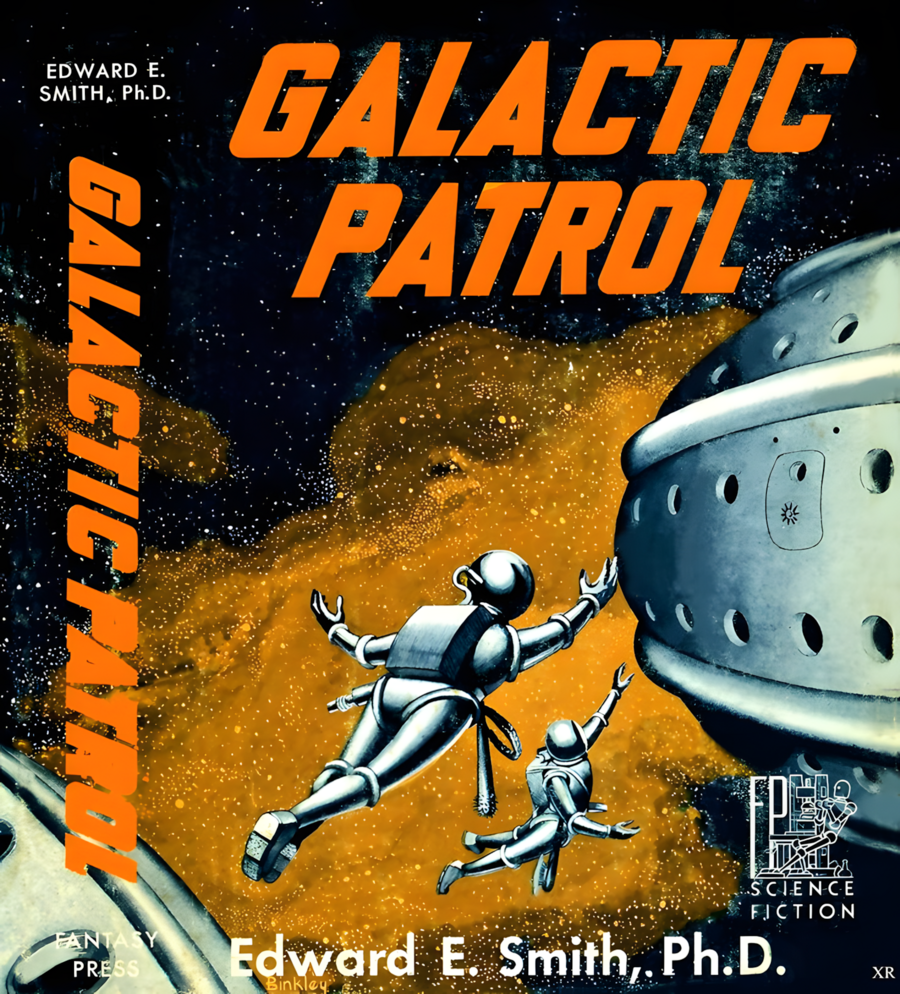
Book cover for «Galactic Patrol» (1950). Fantasy Press Publishing.
Edward Elmer Smith’s novel, «Galaxy Patrol,» was first published in 1937. A year later, German engineer Konrad Zuse created the Z-1, the world’s first programmable electronic computer. Assembled under rudimentary conditions, it weighed half a ton—far from modern computers—yet the dream of miniature digital devices was already timely. This dream is reflected in the character of Linza from «Galaxy Patrol.» Linza is an individual wearable device that allows telepathic communication between sentient beings. Despite its complex operating principle, its physical construction is small and resembles a familiar accessory.
…something resembling a piece of jewelry—a lens shaped like a lens, crafted from hundreds of tiny, dull-white pebbles.
Anime poster for Lensman (1984), based on the novel «Galactic Patrol.»
A frame from the anime Lensman (1984), based on the novel «Galactic Patrol.» The character’s hand displays a Lens.
The device’s form demonstrates an intention to present a complex communication technology in the guise of a compact personal object. The lens does not require bulky equipment and can remain with the owner at all times. The device’s unique feature lies in its method of information transfer:
This pseudo-life also grants Linse telepathic abilities, allowing you to communicate with other sentient beings with her help, even if they lack vocal cords or hearing organs.
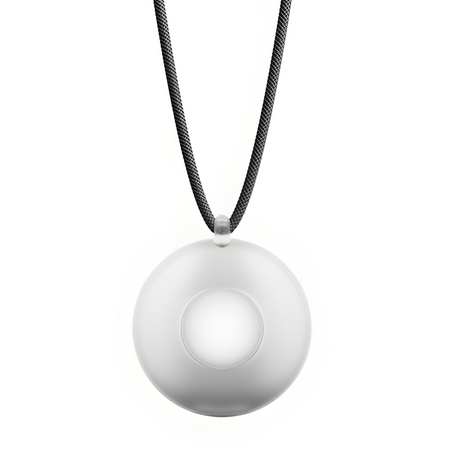
In this piece, communication occurs without the use of auditory signals or the methods of information input we are accustomed to. The lens acts as an intermediary between consciousnesses, enabling communication regardless of the conversational partners’ physiological characteristics. Formally, the Lens can be compared to the Friend coulomb (on the left), developed by Avi Schiffman. Although the device’s functionality is far from the Lens, such a miniature device based on OpenAI is already capable of listening to the user and maintaining a dialogue with them.
Pocket Calculator
Book Cover: «Foundation»
Another device, a miniature version of which was featured in a science fiction work—the calculator. In 1951, Isaac Asimov’s novel Foundation was published, describing a compact computing device used by the mathematician Gary Seldon.
At that time, electronic computers remained largely large-scale: although the first pocket arithmetic unit, the Curta, was released as early as 1948, it was expensive and thus inaccessible to many. Only ten years after Foundation's release, in 1961, the ANITA Mark VIII electronic desktop calculator appeared; pocket electronic calculators became widespread in the 1970s.
Here is how the novel describes the miniature instrument—small enough to fit in a pocket and designed for regular calculations:
He pulled a small calculator from his pocket. Rumor had it that Sheldon kept it under his pillow and took it out as soon as he woke up. From frequent use, the calculator’s shiny panel had dulled.
A still from the AppleTV series «Foundation»
Left: Curta pocket calculator (1948). Right: ANITA Mark VIII calculator (1961).
Hitachi Pocket Computer
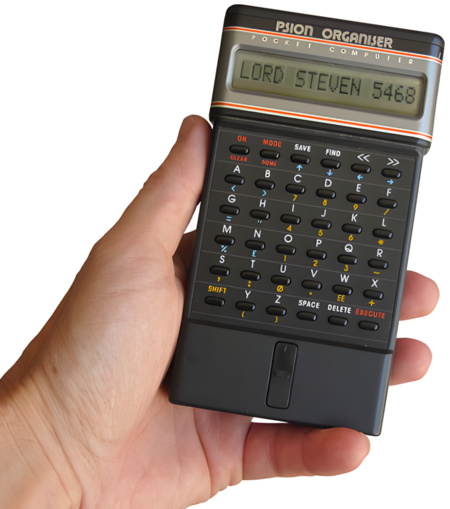
In the mid-1980s, the idea of the portable computer begins to take shape. In 1984, Steve Jobs unveils the Apple Macintosh, IBM releases the first «luggable» computer, and Psion introduces the Organiser I pocket computer (left). That same year, William Gibson’s novel Neuromancer is published, which features a Hitachi handheld computer. In the technological world of the novel, compact personal computing devices exist alongside specialized terminals:
In the room, there was no furniture other than a small Hitachi handheld computer and a small refrigerator.
Comic book adaptation cover of the novel «Neuromancer» (by William Gibson and Bruce Jensen)
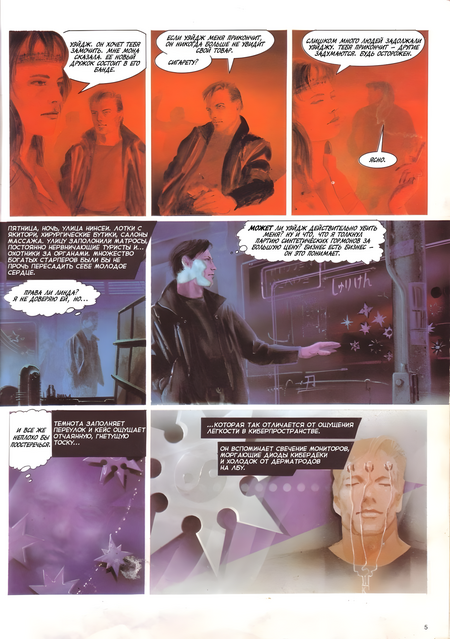
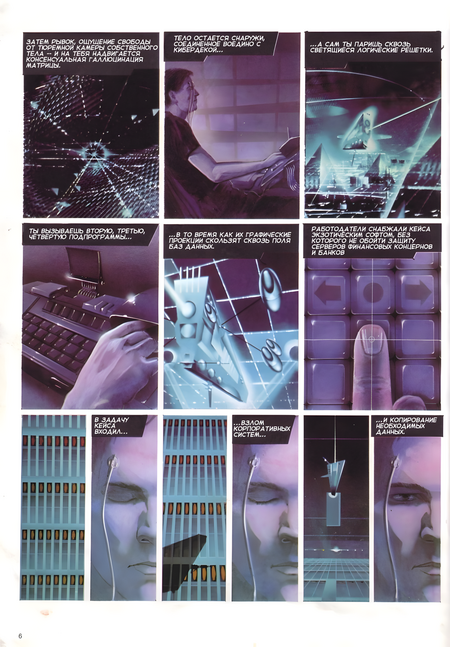
Pages from the «Neuromancer» comic
Evolution of Information Storage, Processing, and Reproduction Technologies
In addition to miniaturization, another crucial quality of future technological achievements, as envisioned by science fiction writers, is the ability to store, process, and transmit vast amounts of information disproportionate to the compact size of the carrier devices.
Option
Cover art for the novel «Return from the Stars»
Stanislav Lem’s «The Return from the Stars» was published in 1961—three decades before Sony presented its first e-book. Lem describes Opton—a technology for electronic reading where the book’s content is separated from the paper medium: