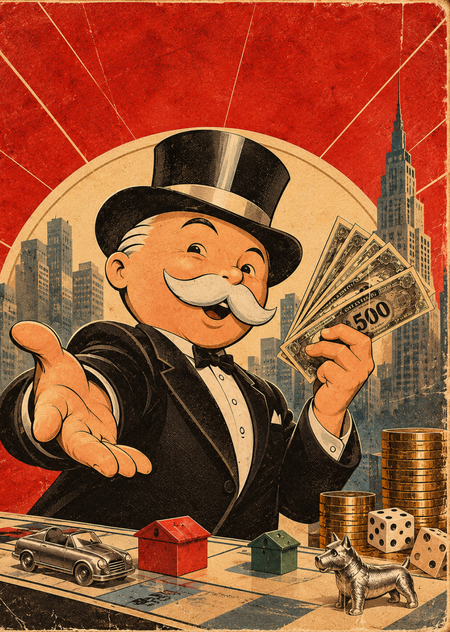
The price of the game: the history and philosophy of «Monopoly»
Concept
«Monopoly» is one of the world’s most recognizable board games, in which participants buy real estate, collect rent, build houses and hotels, make deals, and strive to bankrupt their opponents. Beneath the apparent simplicity of the gameplay lies a complex economic model based on property distribution, capital accumulation, and competition. However, the game’s original concept differed significantly from the meaning it acquired in mass culture. The history of «Monopoly» does not begin with the idea of glorifying wealth, but rather with an attempt to illustrate the dangers of economic inequality and the concentration of land ownership.
The relevance of this study lies in the opportunity to examine the board game as a reflection of the economic and social ideas of a particular era. «Monopoly» is particularly interesting because its history demonstrates how an initial concept changed under the influence of commercialization, mass production, and public perception. A game originally created for the critical examination of monopolies gradually transformed into a form of entertainment where the primary condition for winning is, in fact, the creation of a monopoly. This contradiction allows for the exploration not only of the development of a specific board game but also of the relationship between game mechanics, economic ideology, and consumer culture.
The objective of this visual study is to trace the historical evolution of «Monopoly”—from the early educational game The Landlord’s Game to the international commercial brand—to examine its gameplay mechanics, visual system, and philosophical underpinnings, and to determine how the shift in original intent influenced the game’s perception.
The research is based on the hypothesis that the history of „Monopoly“ reflects the tension between criticizing economic inequality and reproducing the principles of capital accumulation within the game’s space. The transformation of the initial rules changed not only the objective of the game but also its societal significance: a mechanism conceived as a means of demonstrating social problems became a model of competitive struggle in which property concentration becomes the prerequisite for success.
The research begins with the historical and economic background leading to the creation of The Landlord’s Game by American inventor Elizabeth Magie. It examines the ideas of economist Henry George, a critic of land monopolies, and the concept of a single land tax. Particular attention is given to the first patent from 1904, the original game board design, and two sets of rules that allowed for the demonstration of different wealth distribution models.
The next phase is dedicated to the game’s dissemination in the early 20th century, its modifications among American educators, and the subsequent emergence of a version based on the streets of Atlantic City. It explores the role of Charles Darrow, who encountered an existing variation of the game, adapted it, and presented it to Parker Brothers. The story of commercial success is accompanied by an investigation into authorship, the purchase of rights to The Landlord’s Game, and the patenting of Monopoly in 1935.
A separate section of the work details the structure of the game space. It analyzes the game board, property categories, color groups, currency, cards, railroads, utilities, houses, and hotels. By studying the rules, the game’s economic logic is revealed: the movement of capital, the acquisition of rent, property concentration, the risk of bankruptcy, and the influence of chance on strategic decisions. The game mechanics are examined as a simplified model of the real estate market and competitive relations.
Furthermore, the study addresses the transformation of Monopoly into a mass cultural phenomenon. It examines the features of the graphic design, the formation of recognizable symbolism, the introduction of the Mr. Monopoly character, the development of advertising campaigns, international localization, and numerous themed editions. Special attention is paid to the use of game sets during World War II: specific sets manufactured in Britain secretly contained maps, compasses, and other items that helped prisoners of war organize escapes.
The concluding section is dedicated to the philosophical content of the game and its contemporary significance. It examines how the rules shape perceptions of property, wealth, competition, and social mobility. The inherent contradiction between Elizabeth Magie’s original educational intent and the game’s modern goal—which is based on achieving economic superiority over rivals—is also analyzed. Furthermore, the adaptation of Monopoly to a digital environment and its impact on contemporary board game culture are explored.
The visual material for this study will include patent drawings of The Landlord’s Game, historical game boards, archival photographs of Elizabeth Magie and Charles Darrow, Parker Brothers advertisements, early game sets, currency, property cards, historical documents, images of military sets, and modern versions of the game. Comparing materials from different periods will allow us to trace how not only the appearance and rules of Monopoly have changed, but also the underlying system of values embedded within it.
Thus, this research treats Monopoly as a cultural and socio-economic phenomenon where the history of board games, economic theory, commercial design, and the philosophy of ownership converge. The history of the game demonstrates that its rules do more than just organize entertainment—they are capable of shaping a specific worldview: one concerning who controls space, how resources are distributed, and what a person is willing to pay for victory.
To Monopoly: A Game Against Monopolies
Economics as a Play Field
At the end of the 19th and beginning of the 20th century, American society was undergoing a period of rapid industrialization. The development of railroads, industry, and large corporations led to the concentration of capital in the hands of a small number of entrepreneurs. Figures such as John Rockefeller, Andrew Carnegie, and Cornelius Vanderbilt became symbols of an era of vast wealth and economic influence. Simultaneously, discussions about inequality, property, and the fair distribution of public resources intensified. It was within this intellectual atmosphere that the idea arose to use tabletop games as a means of explaining economic processes.
The American economist Henry George played a crucial role in shaping this idea. In his book Progress and Poverty (1879), he examined the problem of concentrated land ownership and argued that an increase in societal wealth does not necessarily lead to an improvement in the condition of every member of society. One of his proposals was a single tax on the value of land—a mechanism designed to curb speculation in real estate. These ideas became known as Georgism and formed the theoretical foundation for the future game, The Landlord’s Game.
Elizabeth Magie:
The Woman Who Invented the Game
Elizabeth J. Magie (1866–1948) was an American inventor, writer, and social activist. She was concerned with the economic and social issues of her time and shared Henry George’s views on land ownership. Magie sought a clear way to explain to a broad audience how land ownership and rent collection could create inequality. Instead of a scientific lecture, she decided to use a game format where economic relationships could not only be discussed but also directly experienced.
Thus was born The Landlord’s Game. In 1903, Maggie filed a patent application, and on January 5, 1904, she received U.S. Patent No. 748626 for her game invention. The initial design already featured a square board with properties arranged around the perimeter, railroads, utilities, taxes, and special game zones. Although the rules and presentation were later modified, this structure formed the crucial foundation for the future Monopoly.
The Game with Two Economic Scenarios
The primary feature of The Landlord’s Game was the inclusion of two rule sets, each demonstrating a contrasting economic model. In the first variation, players could benefit from the creation of collective wealth, and property accumulation was not intended to completely eliminate the opportunities of other participants. This scenario aligned with the ideas of a fairer distribution of income and taxation of land rent. Thus, the game offered not just competition, but an experiment with different principles of economic organization.
The second version of the rules, conversely, focused on asset accumulation and maximizing profit. Participants bought plots, demanded rent, and sought to push competitors out of the game. This scenario later formed the basis of the commercial «Monopoly.» The paradox was that Maggie intended to demonstrate the drawbacks of monopolization, yet the game model that replicated its consequences became the most popular. The game gradually transformed from an economic experiment into a competition for absolute ownership.
How the Empire Works: Rules and Game Mechanics
Game Board: Map of Economic Power
The game board of classic Monopoly features a square track of 40 spaces arranged around the perimeter of the board. Players move along this track based on the roll of two dice, pass the GO space, purchase properties, and interact with various game zones. The board integrates several types of assets: land parcels, railroads, utilities, tax spaces, Chance and Community Chest cards, and jail. This structure creates a model of a small economic space where each participant simultaneously acts as a buyer, an owner, and a potential debtor.
One of the most crucial elements of the field is the color-coded division of property into groups. Plots of the same color form a set, ownership of which allows for the construction of homes and hotels. The more properties an individual owns, the greater their influence over the other players. Thus, the color system serves not only a decorative function; it visually demonstrates capital distribution and helps quickly identify which plots could form the basis of an economic advantage.
Money, Property, and the Mechanism of Accumulation
Money in Monopoly is the primary instrument of player interaction. Each participant begins the game with a specific amount of in-game banknotes, receives income upon passing the starting space, and spends funds on purchasing real estate, paying taxes, rent, and construction. Initially, vacant lots can be acquired by players, and ownership is confirmed by special property cards. These cards contain information regarding the property’s value, the amount of rent, and the cost of construction.
The rental mechanic creates a constant flow of money between participants. If a player lands on another player’s property, they must pay the owner a set amount. Having a complete set of colored properties allows players to develop plots, build houses, and subsequently hotels, which increases the rental income. Thus, the initial purchase of real estate becomes a long-term investment: the asset begins generating income, and the proceeds allow for the acquisition of new assets. A closed loop of capital accumulation is formed within the game.
Risk, Chance, and Bankruptcy
Despite having a strategic foundation, «Monopoly» contains a significant element of chance. Two dice determine the players' movement, and the «Chance» and «Community Chest» cards can bring unexpected income or lead to additional expenses. A player cannot fully control the circumstances; therefore, even a well-constructed strategy can encounter an unforeseen turn of events. Chance creates tension and makes every game unique from the last.
Bankruptcy becomes the primary risk—a situation where a player cannot meet their financial obligations. To settle debts, players are forced to sell homes and hotels, mortgage real estate, or transfer assets to the creditor. If a participant cannot settle their accounts, they are eliminated from the game. Gradually, the number of players decreases, and wealth and property concentrate among the remaining participants. The winner is the one who manages to preserve and increase their capital while others lose the ability to continue playing. This transforms bankruptcy into an integral part of the mechanics.
From Concept to Global Brand: The Birth of Monopoly
The Game’s Journey to Charles Darrow
After its creation, The Landlord’s Game did not disappear when the patent history concluded. It spread through acquaintances, instructors, and small communities where participants independently constructed game boards and renamed the plots. During the 1920s, various local variations of the game existed, gradually moving away from its original educational intent. One significant vector for its dissemination was the Quaker communities, where the game was employed for shared leisure.
In 1929, teacher Ruth Hoskins encountered a variation of the game and brought it to Atlantic City. There, participants began adapting the game board by replacing the original names with the streets and neighborhoods of their own city. Familiar names today emerged, including Baltic Avenue, Park Place, and Boardwalk. Thus, the game acquired a geographical anchor, transforming from a hypothetical market model into a virtual map of a real city.
Charles Darrow and the Commercial Version
Charles Brace Darrow (1889–1967) was a Philadelphia resident who encountered a version of the game associated with Atlantic City in the early 1930s. During the Great Depression, he faced severe financial difficulties and began creating his own game sets. The initial boards were handcrafted, and the cards, game pieces, and boxes were prepared in small batches. Darrow redesigned the game and introduced it under the name Monopoly.
In 1934, Darrow proposed the game to Parker Brothers, but initially received a rejection due to comments regarding the product’s complexity and construction. Following this, he continued independent production and managed to sell about 5,000 copies. Commercial interest in the game prompted the company to reconsider its decision. On March 19, 1935, Parker Brothers acquired the rights to the commercial edition of Monopoly from Darrow, after which the game began to spread widely.
Authorship, Patents, and the Forgotten Creator
On December 31, 1935, Charles Darrow received U.S. Patent No. 2026082 for the game device known as Monopoly. However, the patenting history was more complex than the initial promotional materials suggested. Parker Brothers sought to protect the commercial product and acquired the rights to an earlier patent held by Elizabeth Magie. In November 1935, Magie sold the rights to The Landlord’s Game for $500, receiving no further royalties from Monopoly sales.
As a result of its commercial success, the name Darrow was presented to the public for decades as the game’s creator. Maggie’s role remained virtually unnoticed, although her development was the crucial precursor to the modern «Monopoly.» In the 1970s, the debate surrounding the Anti-Monopoly game and subsequent legal proceedings brought renewed attention to the early history of the board game. Historical documents, participant testimonies, and old game boards allowed for a more complete reconstruction of its origins. The history of «Monopoly» has become an example of how commercial success can alter the public memory of authorship.
Monopoly in History and Mass Culture
The Birth of a Mass Phenomenon
In 1935, «Monopoly» became one of Parker Brothers’ major commercial successes. During the Great Depression, as many American families faced unemployment and financial hardship, the game offered players a chance to temporarily inhabit the roles of real estate owners and entrepreneurs. By Christmas 1935, about 250,000 copies had been sold, and by 1936, sales reached approximately 1.8 million sets. This mass success was particularly notable against the backdrop of the economic crisis.
The company actively developed its advertising campaign and cultivated a recognizable brand image for the product. Monopoly was marketed as an engaging competition where anyone could test their skills in real estate trading, deal-making, and wealth accumulation. Soon, Monopoly evolved from merely a board game into a staple of family leisure and mass culture. In 1998, the game was inducted into the National Toy Hall of Fame in the United States.
Monopoly During World War II
One of the most unusual chapters in the history of Monopoly is connected to World War II. The British company John Waddington Ltd., which manufactured the game under license, collaborated with British intelligence to create special sets for prisoners of war. The game kits could be transmitted through charitable organizations and humanitarian parcels. Hidden items essential for escape—such as maps, compasses, and small tools—were placed inside some of the boards and game pieces.