Introduction
Play is one of the most ancient forms of human activity, existing at the intersection of culture, art, ritual, and daily life. It is not limited to mere entertainment; rather, it represents a unique way for humans to interact with reality. Through play, people master the world, model various situations, and effectively recreate their own existence. The relevance of this study lies in the possibility of examining ancient games as reflections of human perceptions regarding the structure of the cosmos. The geometry of playing fields, the symbolism of figures, the sequence of moves, and the rules of interaction can all be considered expressions of concepts related to space, time, destiny, and the order of existence. My research is grounded in the works of Huw Rainer, «The Playing Man, ” and Johan Huizinga, „Homo Ludens: A Study of the Play-Poet.“ Both philosophers regard play as a phenomenon far more significant to humanity than simple amusement. However, they approach this process from several distinct angles. While Huizinga investigates the role of play in shaping culture and collective consciousness, Rainer addresses the theological and metaphysical understanding of play, viewing the cosmos as the result of the free creative action of a „playing God, ” and human play as merely a „childish, clumsy imitation of the Logos”—that is, Jesus Christ.
Key Research Question: How did humans reproduce and comprehend the structure of the surrounding world through play? Hypothesis: Ancient play functioned as a model of the cosmos, where the geometric organization of space, the symbolism of game elements, and established rules reflected human perceptions of cosmic or divine order, the life cycle, fate, and their own place in the universe.
Research Index:
1. Introduction
2. Play as a Way of Understanding the World
3. The Play Space as a Model of Existence
4. Examples of Ancient Games
5. Conclusion
Play as a way to make sense of the world
In his work Homo Ludens, Johan Huizinga examines play as a fundamental cultural phenomenon that cannot be reduced to mere entertainment. It possesses its own meaning, creates a distinct space, and establishes a system of rules within which the individual temporarily becomes a participant in another reality. Huizinga writes: «Thus humankind repeatedly creates its expression of existence—a second, imaginary world alongside the world of nature.» This idea allows us to view play as a method for symbolically reinterpreting the surrounding world. By creating a play system, a person does not simply copy reality; rather, they isolate certain patterns from it, transform them, and place them within an artificially organized space.
Hyo-ging gives particular significance to the connection between play and ritual. Examining the ideas of anthropologist Leo Frobenius, he describes ancient sacred celebrations in which people reproduced natural phenomena: the changing of seasons, the movement of celestial bodies, the ripening of plants, and the birth and death of living beings. According to Frobenius, humanity «plays out the order of nature» to the extent that it is able to comprehend it. Thus, play becomes not only a reflection of reality but also a means of its symbolic recreation. By participating in the ritual act, humans effectively reenact observed natural processes, lending them the form of a collective experience.
Høysinga emphasizes the inherent value of the game itself: it cannot be reduced solely to a practical objective or the function of reproducing natural phenomena. The game process—its rhythm, tension, order, and emotional experience—is what matters. It is through the medium of play that humans express their sense of connection to the surrounding world. This idea finds continuation in Hugo Rainer’s work, «The Playing Person.» Viewing play through a Christian philosophical lens, H. Rainer references the image of the «playing God.» He interprets the creation of the world as God’s free creative act, and human play as merely a «childishly clumsy imitation of the Logos”—that is, Jesus Christ.
At the core of his arguments is the image of Divine Wisdom, «playing» before the Creator during the creation of the world. Drawing from the Book of Proverbs, Rainer views play as a metaphor for the free, creative formation of the cosmos. The world is presented not merely as a mechanically structured system, but as the outcome of free creation, possessing an inherent harmony. In this context, human play gains additional significance: it becomes a means of connecting with the creative, divine origin—an opportunity to create one’s own order and harmony—in other words, play becomes a way of approaching God.
The Human within the Game Model of the World
The game system does not exist separately from the person: it is the player who becomes a participant in the created space, obeys its rules, and simultaneously influences the unfolding events. Through the act of playing, the person gains the opportunity to experience their own interaction with order, chance, and time. In this context, the game becomes a model of human existence. The movement of figures can be perceived as an image of a life path, reaching a final point—death—while the random result of rolling dice represents the confrontation between human will and uncontrollable circumstances or divine will.
This kind of interaction is especially evident in ancient games based on lots and chance. In these games, a person accepts the rules but cannot always predict the outcome of their own actions. We return to Huizinga. For the philosopher, play presupposes the simultaneous existence of freedom and order. The player voluntarily accepts the established rules, and adherence to them becomes a necessary condition for the existence of the play world.
For the runner—the person who is aware of the limitations of their own existence—there is an opportunity to engage with the world simultaneously seriously and freely, that is, to «play seriously.» Play allows people not only to follow the established order but also to creatively interact with it. Consequently, ancient play can be viewed as a unique form of contemplating humanity’s place in the universe. It reproduces concepts of the life cycle, fate, the opposition of forces, and the possibility of achieving a specific goal.
The Play Space as a Model of Existence
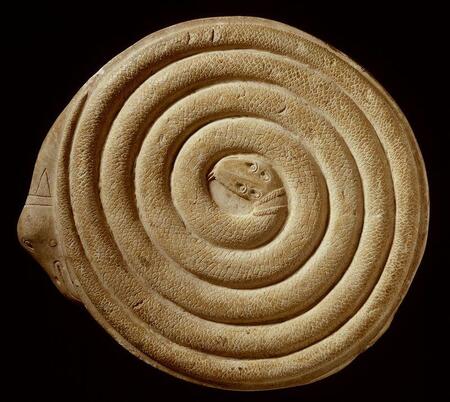
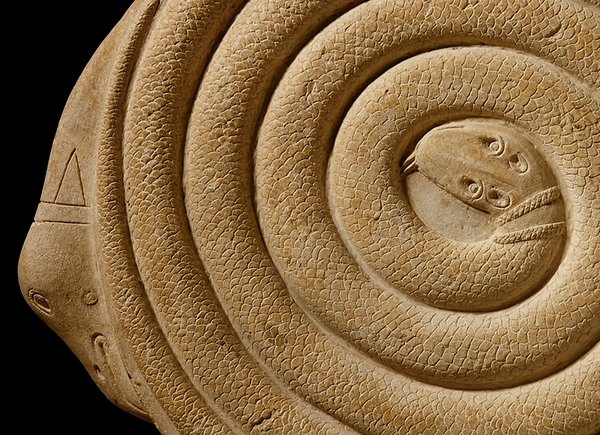
The ancient Egyptian game «Mehen.» The game board is designed in the shape of a spiral-coiled serpent, with the creature’s body divided into individual play areas. The serpent motif is linked to a protective deity that accompanied the sun god Ra during his nightly journey. Movement toward the center of the spiral could symbolically represent this journey and the attainment of the afterlife.
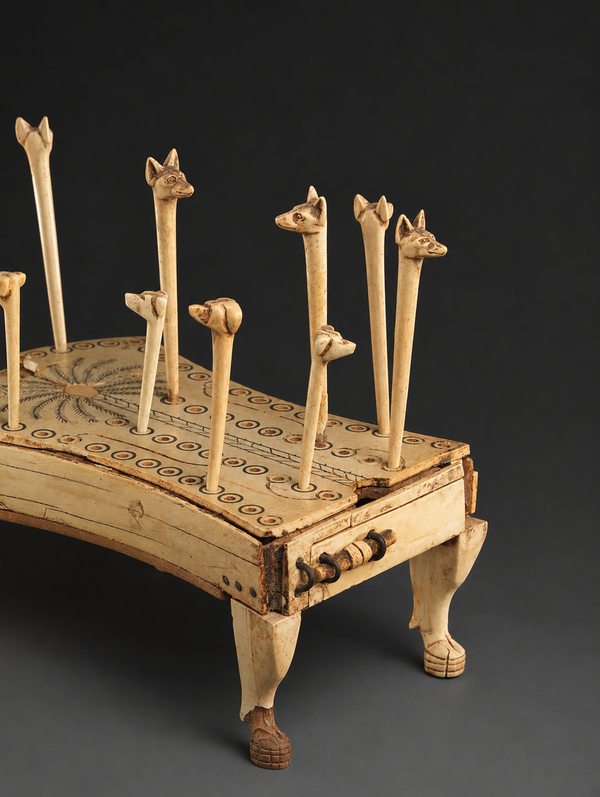
The Ancient Egyptian game Senet. Its board consists of thirty cells arranged in three rows. The movement of the pieces follows a specific sequence, and during the New Kingdom, the game becomes linked to beliefs about the human journey after death. In this context, the game board becomes an image of the life path, incorporating obstacles, transitions, and the possibility of achieving eternal life.
Conclusion
Examining ancient games through the philosophical concepts of Huizinga and Renner allows us to move beyond viewing them merely as historical entertainment. Play presents itself as a distinct form of cultural and symbolic engagement with reality, wherein the individual constructs their own model of the world. The playing field—its geometry, objects, and rules—become mediums for expressing conceptions of the cosmos. Through them, individuals reproduce observed natural processes and contemplate the relationship between order and chance, life and death, and freedom and determinism. Thus, this research aims to uncover the connection between the philosophy of play and its visual manifestation in ancient cultures. The game space is considered not only a site of action but also a material expression of human conceptions of the universe’s structure. Therefore, the playing field can be viewed as a unique model of an ordered universe where a predetermined structure interacts with the unpredictability of events. The individual exists within this system, having the capacity to influence its development but not possessing complete control over the outcome.
Homo ludens. Man the Player — Huizinga, J. — 2011