This project is a student academic work from the School or a faculty research project from the School. This project is non-commercial and serves educational purposes.
Navigation
I. Concept II. How We Know Color: Sources and Method III. Archaism: Color as Sign IV. Classicism: Color and the Ideal V. Hellenism: Color and Emotion VI. Comparison and Conclusions
I. Concept
The notion that Greek sculpture was white developed not in Antiquity, but during the Enlightenment and Neoclassical periods. When European travelers and archaeologists began systematically excavating Greek monuments in the 18th century, they were indeed primarily encountering weathered white marble—the paint had almost completely faded over time. However, traces of pigment were occasionally found, and these were often deliberately ignored: the polychromatic appearance of antiquity contradicted the emerging ideal of «noble simplicity and tranquil grandeur.» Johann Joachim Winckelmann, whose works laid the foundation for art history as a discipline, formulated an aesthetic canon in his treatise Thoughts on Imitation of Greek Works in Painting and Sculpture (1755), wherein white marble was associated with the purity of form. Yet, Winckelmann himself later observed and documented traces of paint on the statue of Artemis from Pompeii—a fact that remained outside the purview of his followers for a long time. It was this selective inattention that fostered the enduring myth: in the museums of the 19th and 20th centuries, genuine Greek artifacts and casts were exhibited as colorless, while colored reconstructions were perceived as something «barbaric» and incompatible with the classical ideal.
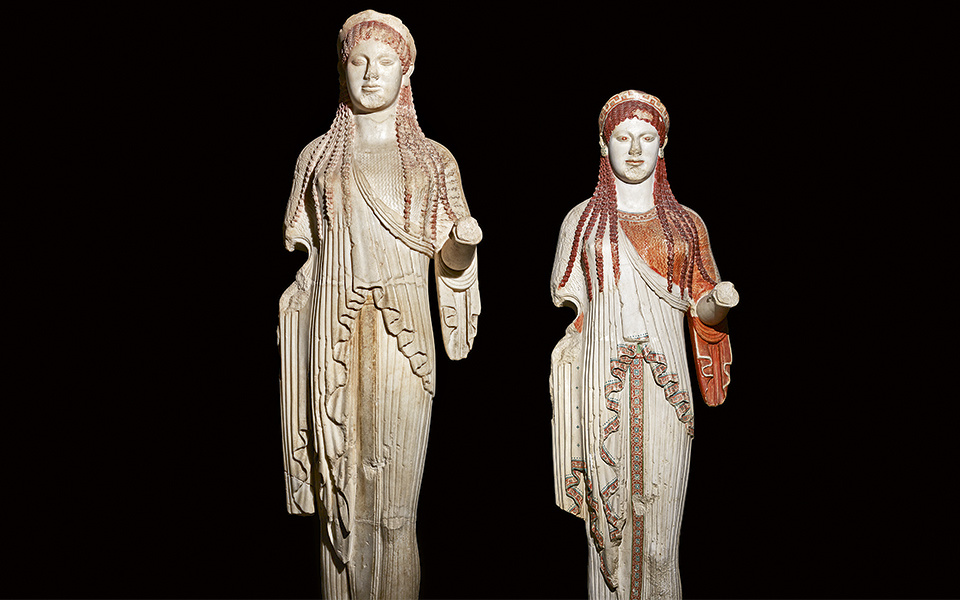
«Kore» (from Ancient Greek for «maiden.» Here, Kore No. 685). The original statue and its replica, painted by the Swiss artist Emil Guyeron using archival sketches made immediately after the statue’s discovery in 1888. Photo source: greece-is.com
Research Question
The question of whether ancient Greek sculpture was colored is no longer a matter of debate—the polychromy of ancient sculpture and architecture is accepted within the scientific community. The problem has shifted to another plane: what precisely changes in our understanding of Greek sculpture when color is restored?Research question: How do modern color reconstructions transform the visual perception of Greek sculpture, and what dimensions of form, meaning, and function do these reconstructions reveal—dimensions that the white museum tradition rendered invisible? This question is significant because color in Greek sculpture was not merely a decorative addition. Libighaus’s research demonstrates that polychromy served as a means to achieve the illusion of reality, ensured the legibility of images from a distance (for example, on temple pediments), and marked the status, gender, and divine affiliation of the figures. Without analyzing color, we read Greek sculpture incompletely—like graphics without color, like form without meaning.
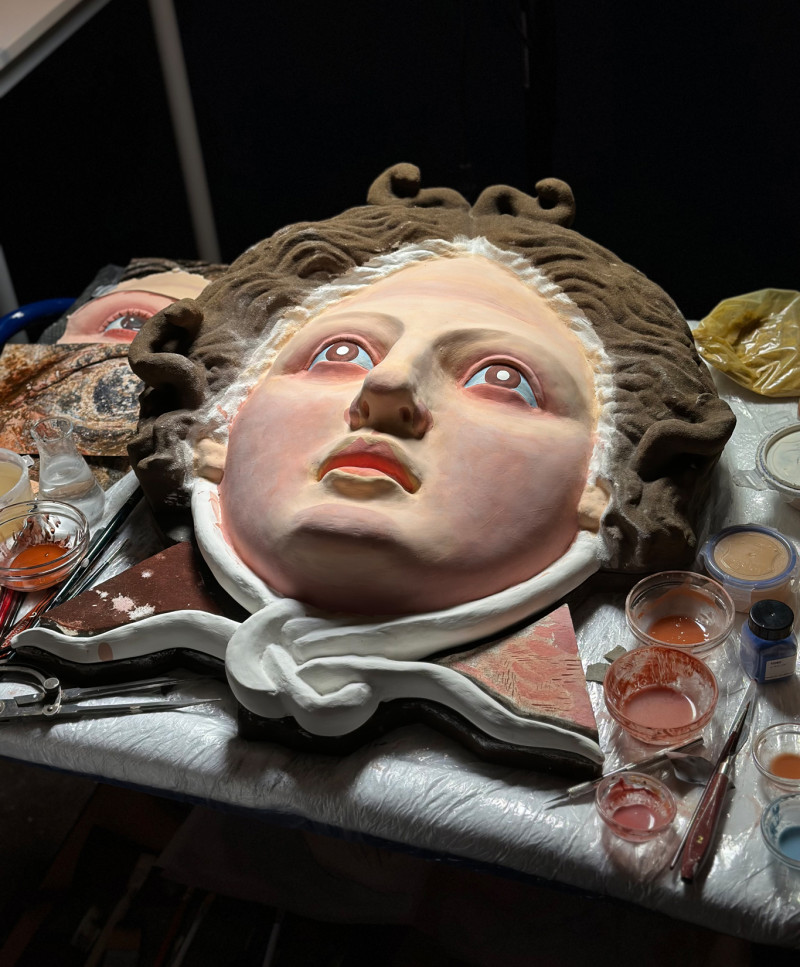
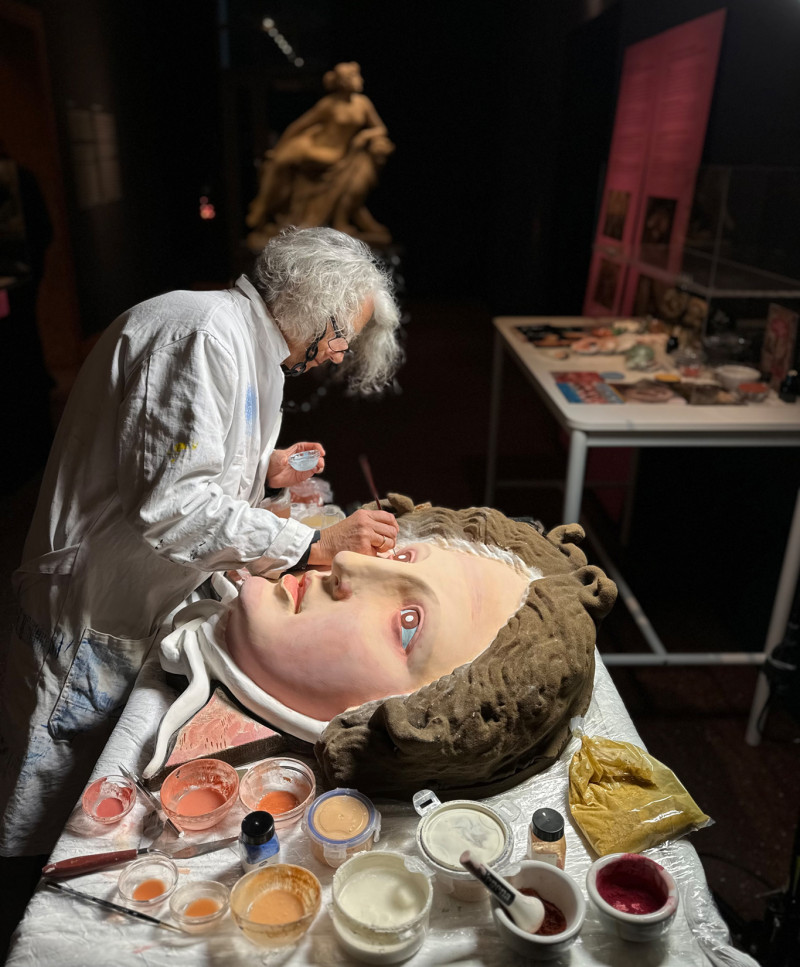
Archaeologist Ulrike Koch-Brinkmann working in an open studio at the Libighaus Photo: Libighaus Sculpture Collection
Since 2003, the exhibition project «Gods in Color» (Bunte Götter), created by Vincent Brinkmann and Ulrike Koch-Brinkmann, has been shown in over 30 museums worldwide—from Munich and Frankfurt to New York, London, and Athens—and has been viewed by nearly three million visitors. The exhibition offers not merely «colored copies, ” but scientifically grounded reconstructions: color is applied to 3D models or casts based on pigment analysis data, ultraviolet and infrared photography, and a comparative study of ancient painting.Alongside the exhibition, academic publications have been released: catalogs from 2007 and 2017, as well as an updated 2020 edition of Bunte Götter, reflecting the current state of research. Between 2022 and 2023, The Metropolitan Museum of Art presented the exhibition Chroma: Ancient Sculpture in Color, which was also based on Libighaus’s reconstructions. Thus, the theme of polychromy has moved beyond narrow academic discussion and become part of public knowledge about Antiquity—making the visual analysis of these reconstructions particularly relevant.
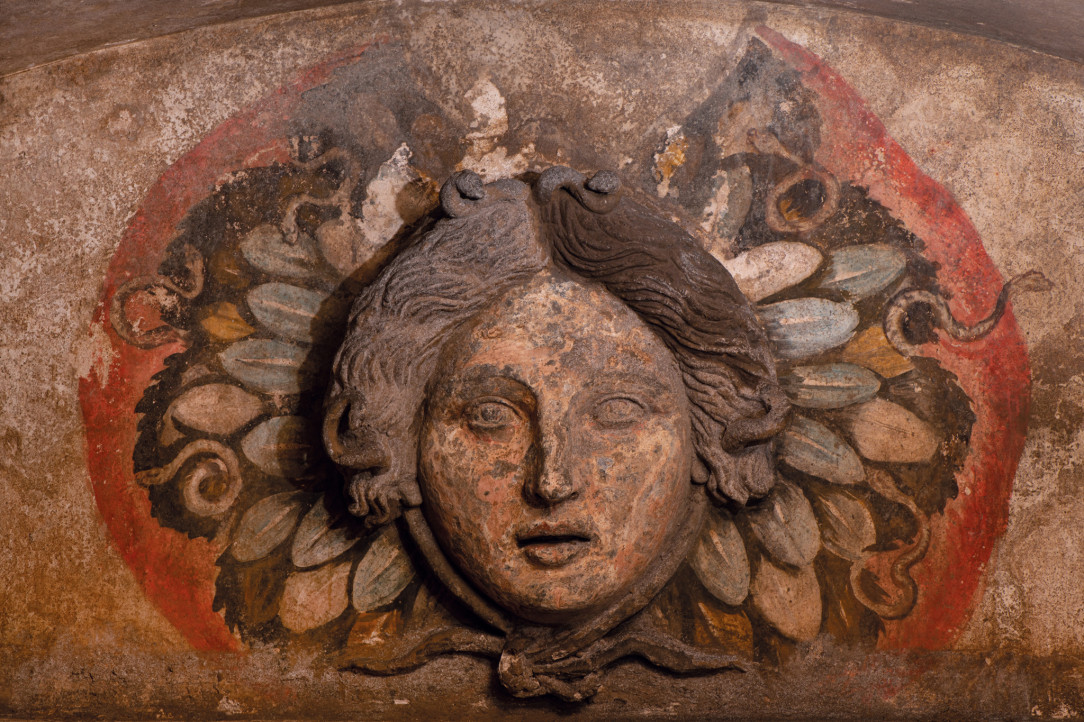
Tomb C in «Ipogeo dei Cristallini» in Naples. Photo: Libighaus Sculpture Collection
The research material is Greek sculpture from the Archaic, Classical, and Hellenistic periods, as well as architectural sculptural decoration. The analysis incorporates three types of visual evidence:
- Originals with preserved traces of pigment—for example, the pediments of the Temple of Aphaia on Aegina, the «Peplos-Kora» from the Athenian Acropolis, and funerary stelae.
- Scientific reconstructions created within the Libighaus project (Brinkmann / Koch-Brinkmann) based on pigment analysis, UV and IR photography, and 3D modeling.
- Museum exhibits of the same monuments in their current «white» state—as a point of comparison.
The methodology is comparative visual analysis: each monument is examined in three states (white original → pigment traces → reconstruction), which allows for the identification of precisely which visual characteristics and meanings are added (or altered) by color. Technical aspects of pigment analysis and paint chemistry are not the subject of this study; they are only utilized to substantiate the reliability of the reconstructions.
Male torso, discovered in 1886. Original and color reconstruction. Source: edition.cnn.com
Structure
1 — Chronology: Archaic $\rightarrow$ Classical $\rightarrow$ Hellenistic. This allows us to trace how the function of color changes across different phases of Greek sculpture. 2 — Three states of the monument (the principle of comparison): State A: Museum white marble (what the viewer sees today). State B: Traces of pigment and scientific data (what has been preserved and analyzed). State C: Color reconstruction (a visual hypothesis based on A + B). Each analytical section is built around «before/after» pairs and crops that demonstrate specific visual differences. Conclusions are not formulated for each monument in isolation, but regarding the function of color in each period and what the comparison of the three states reveals about the visual thinking of Greek sculptors.
II. How We Learn About Color: Sources and Methods
The first thing a polychromy researcher encounters is the gap between expectation and what has actually survived. On weathered marble, paint rarely looks like paint. It appears as faint spots, thin films, or pinkish or bluish washes that the naked eye easily mistakes for natural stone inclusions or signs of age. What was a vibrant color to the ancient viewer has transformed into an almost invisible whisper of the material for the modern gaze.This is why the initial visual analysis begins with macro crops: magnification allows one to see the boundaries of the pigment layer, its unevenness, and instances where paint has been preserved in the recesses of the relief—in the folds of clothing, the grooves of hair, or the eye sockets. These micro-zones of preservation are crucial: they show that the color was not distributed randomly across the surface, but rather followed a specific logic. Even at this level, it becomes clear that we are not looking at «paint remnants,» but fragments of a system. However, the main takeaway from this slide is methodological. Pigment traces themselves are not «read» as color: they demand interpretation, comparison with other monuments, and technical data. What we see with our eyes is not the color of Antiquity, but its trace, and all subsequent work consists of reconstructing the visual logic of the whole from that trace.
Head of a Goddess (2nd century). Photo source: newyorker.com
The Greek palette is being reconstructed based on a synthesis of data: the analysis of pigments found in sculpture and architecture, the study of ancient painting (especially Pompeian art), and cross-referencing with written sources. The foundation comprised mineral pigments: Egyptian blue (a synthetic pigment based on copper and calcium), cinnabar (a red mercury pigment), malachite, green copper compounds, ochres of various shades, lead white, and carbon black. Additionally, organic dyes and gilding were utilized. Importantly, the palette was not a «set of available colors, ” but rather a system of consistent visual values. Specific colors were assigned to specific elements: the skin of male figures was often rendered in a dark reddish-brown tone, while female skin was depicted in a lighter tone. The garments of gods and heroes possessed distinct chromatic markers; architectural details—such as triglyphs, capitals, and pediment backgrounds—were given colors that ensured the legibility of forms from a distance. Color, therefore, operated as a visual code, not as an arbitrary choice by the artist. This is fundamental to further analysis: when we observe a reconstruction, we are not viewing a mere „coloring, ” but the restoration of this coding system—and that is why it is subject to scientific verification.
Modern methodologies allow us to perceive what is invisible to the naked eye. Ultraviolet fluorescence reveals the organic components of dyes and binders that are imperceptible under normal light; infrared reflectography and visible luminescence imaging help differentiate between layers and the boundaries of pigment zones; and X-ray fluorescence (XRF) analysis and spectroscopy provide the elemental composition of the dyes. It is this data—not aesthetic intuition—that underpins Libighaus’s reconstructions. The crucial point for visual research is this: the technique does not «return the color»; it returns the evidence. The UV image shows precisely where the pigment was located and how it was distributed; chemical analysis confirms exactly which pigment was used. Reconstruction only begins once this data has been gathered and correlated. Moreover, it is important to define a boundary: even the most precise compositional analysis does not tell us precisely what the color looked like in antiquity—its saturation, brilliance, or application technique. Here, science concludes and interpretation begins, a topic we will discuss on slide 11.
Written sources do not replace visual data, but they provide crucial context. Pliny the Elder, in his Natural History, discusses pigments and their application, mentioning the works of artists and sculptors related to color; Vitruvius, in his treatise De Architectura, describes the preparation of paints and their use in the finishing of buildings and temples. These texts confirm that polychromy was a conscious practice with its own technology and terminology. However, caution is necessary here. Ancient authors discuss color from the perspective of practice and morality (for example, by debating the luxury or permissibility of certain pigments), rather than from a standpoint of visual analysis. Their testimonies do not allow for the reconstruction of a specific monument’s appearance—they only confirm that color was part of the artistic language. For my research, these sources are important as proof that polychromy was not a random or «barbaric» practice, but rather part of the professional norm. This alleviates the last doubts about whether reconstructions make sense: we are not recreating a fantasy, but rather a system that the Greeks and Romans themselves knew and wrote about.
Any color reconstruction is a synthesis of two distinct types of knowledge. The first is empirical data—retained pigments, analytical results, color zone boundaries, and written testimonies. The second is interpretation—the choice of a precise shade, degree of saturation, application quality, and the decision of how the lost areas originally appeared. The boundary between these two is fluid, and it is this boundary that defines the scholarly integrity of the reconstruction. In practice, this means that any reconstruction inherently contains an element of hypothesis. Where enough pigment has been preserved and reliable analogues exist, the reconstruction leans closer to empirical data; where the color is entirely lost, it relies on comparative material and the logic of the whole. Libighaus consistently distinguishes these levels in his projects: catalogs and exhibitions specify which elements were restored based on direct evidence and which are presumed. This distinction is fundamental for visual study: we are not analyzing the «true color, ” but the reconstruction as a visual hypothesis—and this is why we can discuss what it adds to our understanding of the artifact, and what remains beyond the scope of verifiable proof.
Statue (2nd century BCE) Original and color reconstruction. Photo source: edition.cnn.com
Synthesizing all the evidence considered leads to one conclusion: color in Greek sculpture was not an ornament that could be added or removed without consequence. It was integral to the work’s visual structure—alongside form, proportion, and composition. Comparing the detail with and without paint illustrates this clearly. The white detail reads as form; the painted detail reads as an image endowed with a specific status, gender, or role within the scene. Color dictates how the viewer interprets the image: what they see first, what they perceive as background, and what they identify as the focal point of meaning. The loss of color is thus not a cosmetic omission, but the forfeiture of one layer of the visual language. This is precisely why further analysis focuses not on the question, «What colors were used?» but on «What did the color do in each specific instance?» As we move into the Archaic period, we will see how this function operated at the earliest stage—when color was at its most active and most significant.
III. Archaism: Color as Sign
Archaism is a period where polychromy is most fully and most evidently expressed. It is on archaic artifacts that the greatest number of pigment traces have been preserved, and it is here that the color system of Greek sculpture is read with the greatest clarity. This is connected both to the technique (dense application of paint onto a prepared ground) and to the very character of the archaic image, in which color was inseparable from form.Archaic sculpture—such as kouroi and korai, pedimental compositions, and funerary stelae—gives the researcher a rare opportunity to see color not as a hypothesis, but as a documented fact: the pigment has been preserved in sufficient volume for reconstruction to be based on direct evidence. In this section, we will examine how color functioned in the Archaic period: what roles it played, how it related to form, and what exactly changes in our perception of these artifacts when color is restored.The main thesis of this section is: in the Archaic period, color was maximally active and maximally significant—it marked status, gender, divine affiliation, and ensured the intelligibility of the image. A white Archaic kouros in a museum is not a «restrained classical image, ” but a lost system of signs.
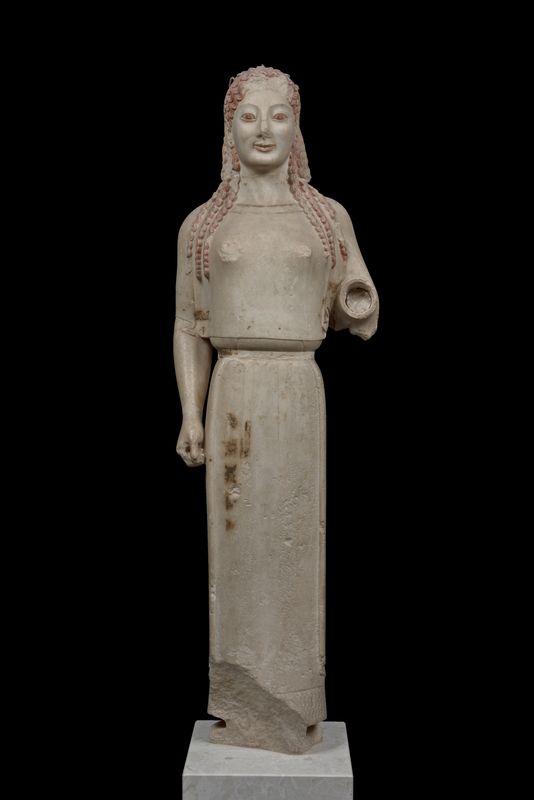
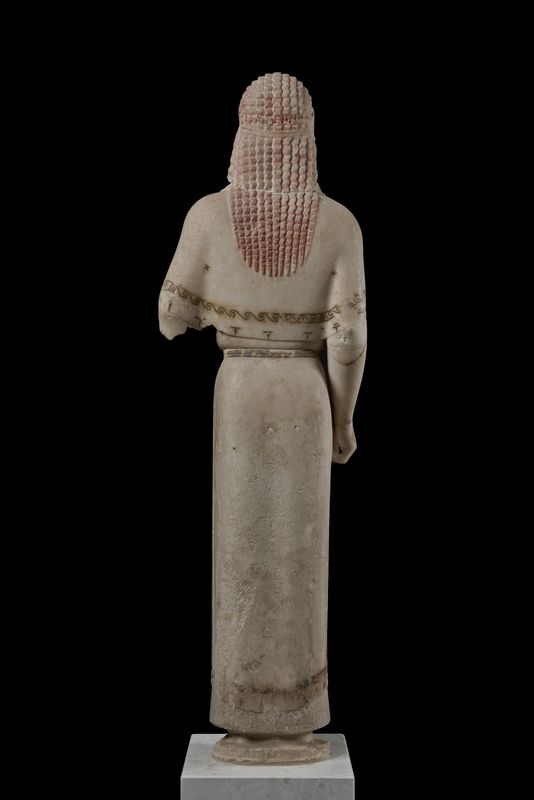
Kora Statue. «Peplos of Kora»
«Peplos Kore» (c. 530 BCE) is one of the most famous examples of the Archaic period and simultaneously a prime illustration of how museum tradition shapes our perception. In the Acropolis Museum exhibition, the Kore appears white, with soft marble modeling. This appearance has become ingrained in the popular understanding of Archaic sculpture: restraint, tectonic quality, and the «Archaic smile» as the sole trace of emotion.
However, the white marble is not the sculptor’s original design; it is the result of loss. The Kore was originally painted entirely—her clothing, skin, hair, eyes, and lips. What we see in the museum is the skeleton of the image, deprived of one of its most important layers. It is telling that even in this state, the Kore retains expressiveness—but this is the expressiveness of the form, not the image itself. Color added to the form what made it vital and concrete: its affiliation with a specific social and ritual context.
This slide establishes a point of reference for comparison: the museum state is not the «norm, ” but rather one of three possible conditions of the monument, and it is this condition that requires explanation, rather than being accepted as given.
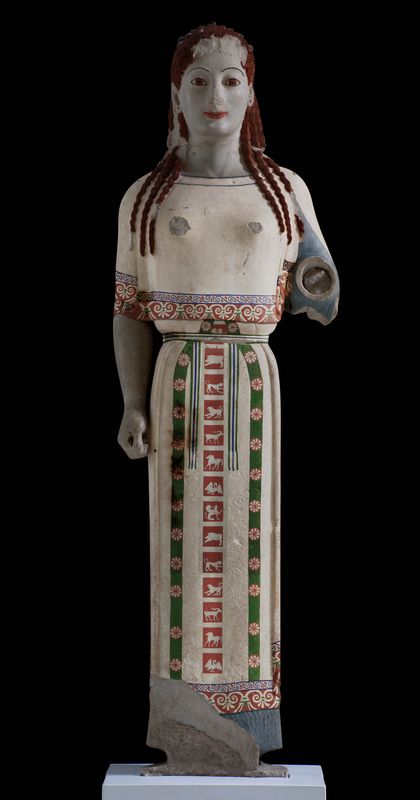
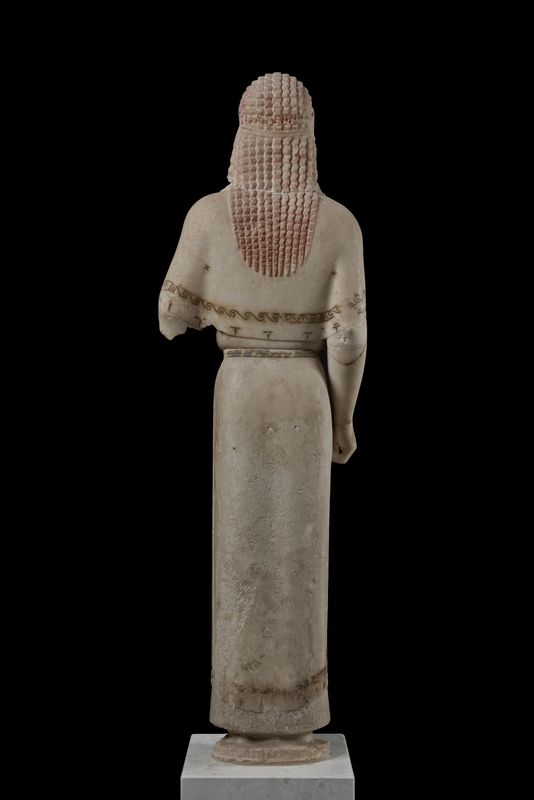
Kora Statue. «Peplos of Kora»