CATEGORIES
[.] Nonsensical text on canvas — highbrow concepts and Dadaist poetry in painting
[/] Illogic as connection. The collision of incompatible objects
[, ] Deconstruction of form
CONCEPT //
Dadaism was a movement that emerged in Zurich in 1916 as a nihilistic reaction to World War I. According to legend, Tristan Tzara found the name in a dictionary, and it meant «child’s wooden horse”—it was deliberately nonsensical. Dadaists rejected rationality, bourgeois culture, and traditional aesthetic canons, canonizing randomness, parody, and the destruction of artistic form. The movement swept through Zurich, Berlin, Cologne, Hanover, New York, and Paris; the Berlin group possessed a distinct anti-militarist and socio-critical orientation. The central question is: how was the Dadaist-derived gesture—nonsensical text, illogical juxtaposition of objects, and the destruction of form—employed in Soviet painting, drawing, and collage from 1914–1924, and why did this gesture, despite aligning with German Dadaism in its techniques, fail to spark an independent movement in the USSR? The subject of this research is the function of this technique: what does an artist achieve when placing an illegible inscription on the canvas, colliding incompatible objects, or obliterating a recognizable form?
The Core Research Question—why did the Soviet version of the Dadaist gesture, despite its visual similarities, fail to become a recognizable «ism,» and can the reason for this shift be found within the pictorial structure of the works themselves, rather than just in the ideology? The hypothesis is that the Soviet «refusal» differs from German Dadaist nihilism in function. For German Dadaists, the destruction of language, logic, and form operates as pure negation, offering no positive program. For Soviet avant-garde artists, the same gesture performs a dual function: it dismantles old forms while simultaneously clearing space for a new, «revolutionary» construction. This constructive function neutralizes the nihilistic charge, preventing the Dadaist impulse from emerging as an independent movement—it is absorbed by the utopian constructionism of Futurism and the mobilization demands of political graphic art.
The topic was selected based on two criteria: first, it revolves around a problem that lacks a ready-made answer. It is contended that Russian Dadaism did not exist as a defined movement, yet the techniques of the Russian Avant-garde from 1914–1924 align with Dadaist principles. This divergence—between the presence of a gesture and the absence of a recognized name—demands explanation. Second, the topic allows this explanation to be tested at the level of pictorial structure, meaning the answer is derived from the analysis of the artworks themselves. The chronological frame is 1914–1924, the period when Russian and German Dadaism coexisted before Socialist Realism became normalized. Only hand-made works are selected: painting, drawing, collage, and handmade book graphics. Within this period, works containing at least one of the three Dadaist characteristics—nonsensical text, illogical juxtaposition, or formal deconstruction—and possessing a German analogue for functional comparison are chosen. Pairs are constructed based on the principle of «the same technique in a similar compositional situation, but within different ideological frameworks, ” which allows for the comparison of specific visual solutions rather than entire „schools.“
[.] MEANINGLESS TEXT ON CANVAS — SURREAL AND DADAIST POETRY IN PAINTING
Let’s consider instances where text, as a visual element, enters a painterly or collage space and loses its communicative function. A common visual technique involves overlaying illegible symbols, word fragments, or sentence scraps onto a pictorial surface—the difference lies in whether the text serves the liberation of language or the negation of language.
«Simultaneous Image of Peak and Crimson Dam» Olga Rozanova, 1914
Linocut «Simultaneous Image of the Peak and Vermilion Dam» was created in 1914. It is part of the design for a Futurist book—an illustration for A. Kruchenykh and R. Jakobson’s «Zaumny Kniga.» Rozanova’s approach to the book further reveals the trend of separating text from illustrations, which practically begin to live their own lives. The text seems to release the image from the obligation to illustrate.
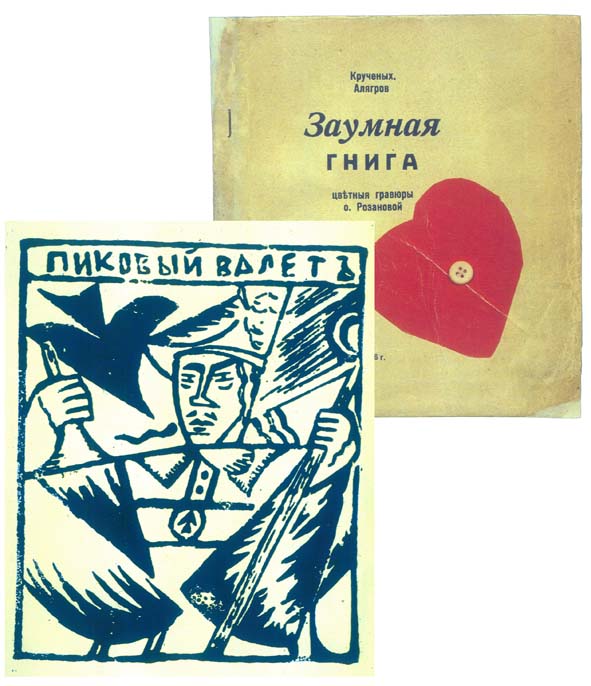
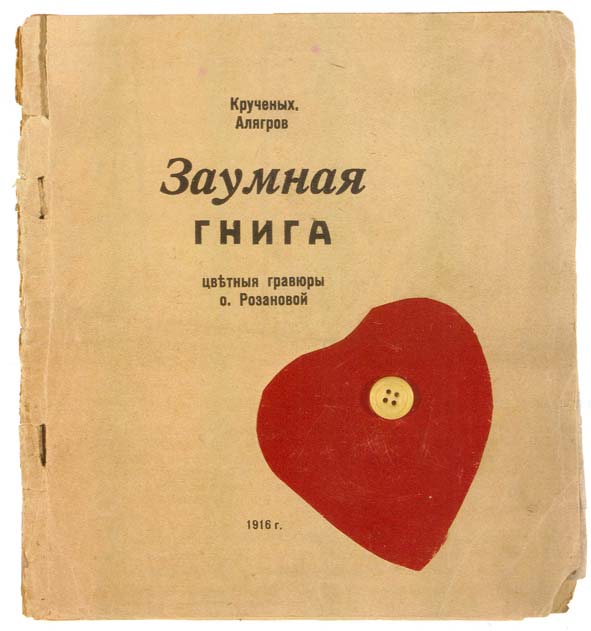
«Zaumnaya Kniga» (cover), Kruchenykh / Jakobson, Olga Rozanova, 1915
«Zaumna Kniga» by Aleksei Kruchenykh and Roman Jakobson featured Olga Rozanova as the artist. This was her first experience creating book collages and stickers—a step toward crafting a unique, handcrafted object. This collage composition serves as a «calling card for the phenomenon of the futuristic book as a whole.» The zaum text and the collage coexist as equal elements.
«Composition with Harmonica» Ivan Punin, 1914
«Composition with Harmonica» by Ivan Albertovich Puny was created in 1914. Its main feature is the combination of painting and collage with readymade elements. There is no fundamental distinction between the elements and the background; the viewer is invited to decode the rebus-puzzle themselves. The text functions as an element of that rebus.
«The Art Critic» Raoul Hausmann, 1919–1920
Raul Hausmann’s photomontage, «The Art Critic, ” was created between 1919 and 1920. It is a striking example of Dadaist photomontage—a technique in which an artist cuts and combines fragments of photographs, newspaper clippings, and printed materials to create a chaotic and shocking composition. The background is a sound poem, simple letters randomly chosen at Hausmann’s request by a commercial typographer. The critic’s eyes are „blind, ” and the text is left to chance—a delegitimization of meaning.
«Merzbild 5 B (Picture Red Heart-Church)» Kurt Schwitters, 1919.
Merzbild 5 B (Picture Red Heart-Church)—a collage work by German artist Kurt Schwitters, created in 1919. It is part of the Merz series Schwitters developed to merge art and life through the use of found objects and debris. The second title reflects a visual metaphor: the chaotically layered fragments create an image reminiscent of a church building, yet with deformed, «worn-down» proportions, underscoring the idea of the dissolution of familiar forms. The work conceals a fragment from the newspaper «Hannoverischer Kurier» dated February 4, 1919, concerning the suppression of the Bremen Soviet Republic. The text is buried within the material—it is neither a clear statement nor has it completely vanished.
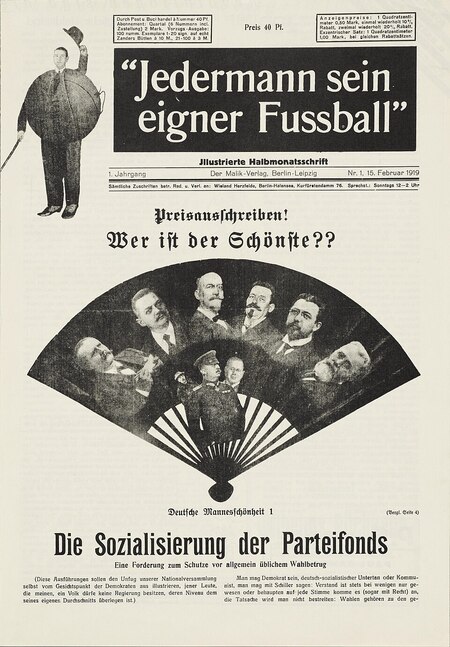
«Jedermann sein eigner Fussball» John Hartfield, No. 1, 1919
Cover of the first and only issue of the satirical magazine «Jedermann sein eigner Fussball» («Everyone for Themselves in Football»), created by John Hartfield. The cover features two photo montages, including «Wer ist der Schönste?”—a „beauty contest“ of political and military leaders holding open fans. The text and imagery function as an exposé.
The visual destiny of nonsensical text is diametrically opposed: for German Dadaists, text is deconstructed as a system, pointing to the inadequacy of language. For Soviet avant-garde artists, text is liberated as material, signaling a new artistic territory that must be claimed. Rozanova and Kruchenykh utilized zaum to «liberate creativity, ” but this liberation was constructive—it paved the way for something new rather than dismantling the old order.
ALGORITHM AS CONVERGENCE. COLLISION OF INCOMPATIBLE DISCIPLINES
Alogism is the combination on a single canvas or collage of objects that lack a logical connection. The general technique involves disrupting conventional spatial and causal relationships; the difference lies in whether the impetus of the alogism is directed toward the illogical nature of the world or toward the necessity of a new order.
«Cubist Composition: A Tribute to Picasso» by Ivan Klun, 1915
Ivan Klyun’s work, «Cubist Composition. A Tribute to Picasso,» was created in 1915. In 1913–1914, influenced by Kazimir Malevich, Ivan Klyun turned to Cubism. Unlike Malevich, who saw the possibility of «alogism» in Cubism, Klyun primarily found logic in it: his objects, though fragmented, retained recognizability. This is first and foremost a drawing, not a canvas, which emphasizes its laboratory nature. The very combination of forms on paper—it is a test of coherence.
«Passing Landscape» Ivan Klyun, 1914–1915
«Running Landscape» by Ivan Klyun was created between 1914–1915. It is an assemblage in which the artist joined various materials. Klyun explored how geometric forms interact with space, striving to convey dynamism—the «running» through forms. The influence of Cubo-Futurism is palpable in the work: the artist deconstructs the object into geometric elements while simultaneously attempting to convey motion and a sense of speed. Klyun translates a motif from painting into an object. The illogical nature here lies in the mismatch between the title and the material, as «Landscape» is a construction made of porcelain and wire. The function of the gesture is to test boundaries: can a pictorial subject exist as a relief?
«Suprematism» Ivan Klyun, 1916.
Ivan Klyun’s painting, «Suprematism, ” was created in 1916. In this work, Klyun focused on investigating the interaction of color and form—their mutual attraction and movement. He consciously limited the number of forms to concentrate on studying the principles of their cohesion and the expressive capabilities of color. The work embodies ideas of metaphysical infinity. The illogical aspect here is that the forms do not represent anything, yet they interact—they draw toward each other, move, and connect. This is the construction of a new logic: the logic of color relationships. Klyun later moved away from canonical Suprematism, stating that „the frozen, motionless forms of Suprematism do not reveal a new art, but rather show the face of a corpse.“ Therefore, one can say that his illogical approach was directed toward a search.
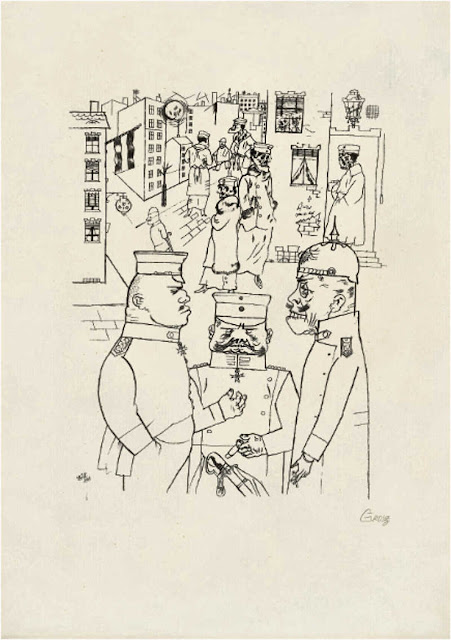
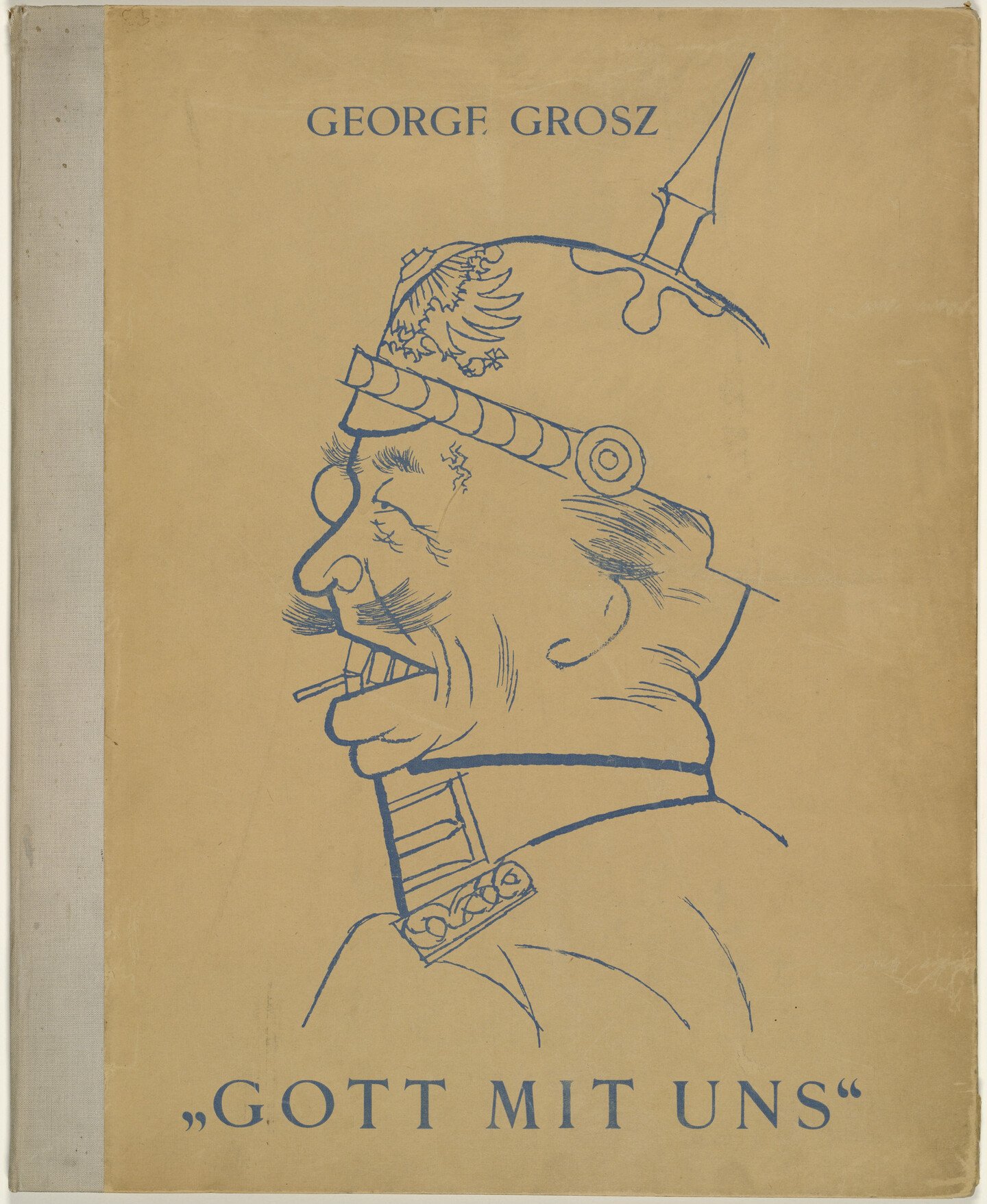
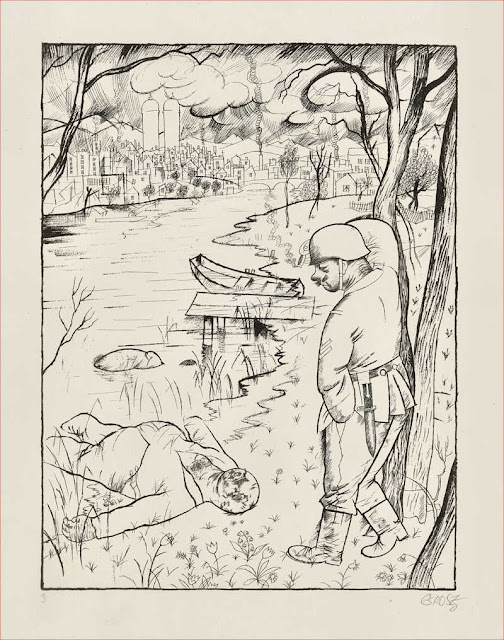
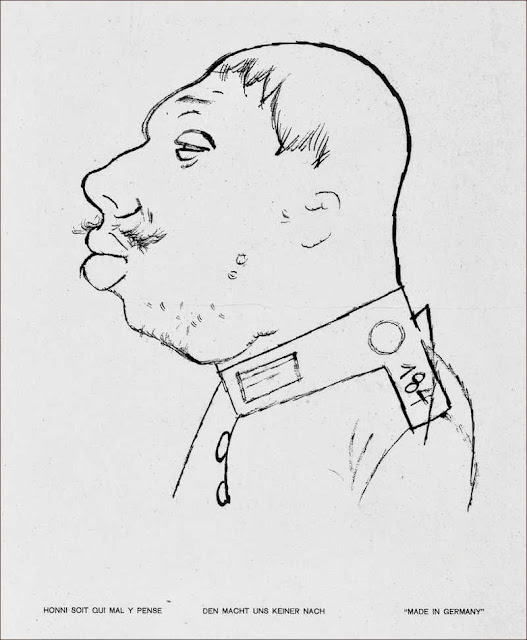
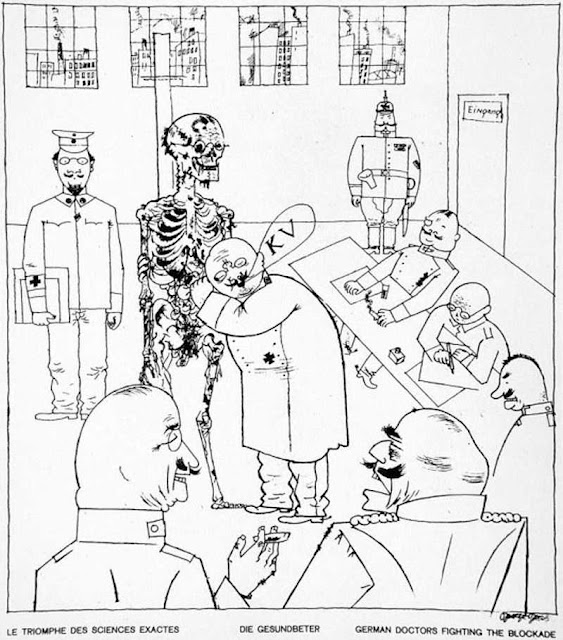
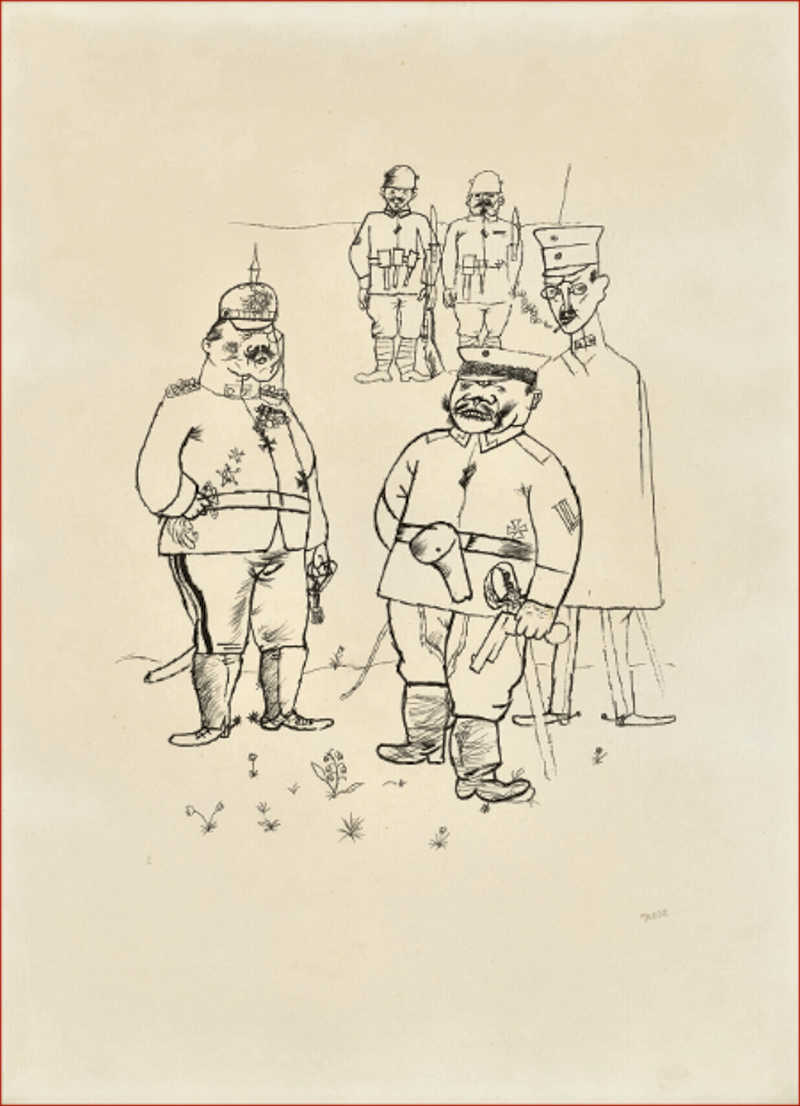
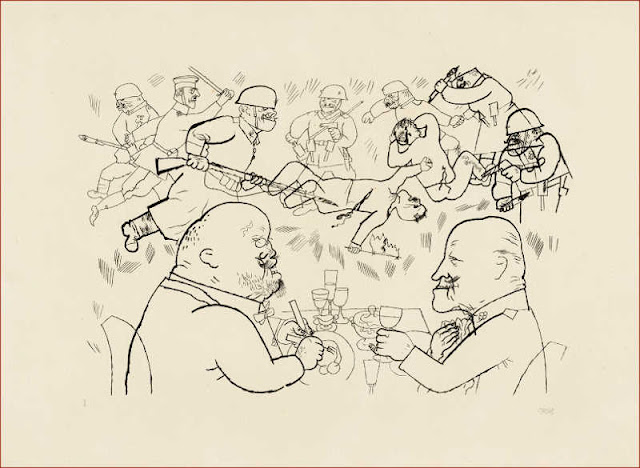
«With God With Us» Georg Gross, 1920