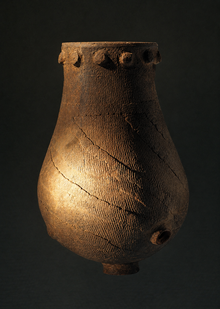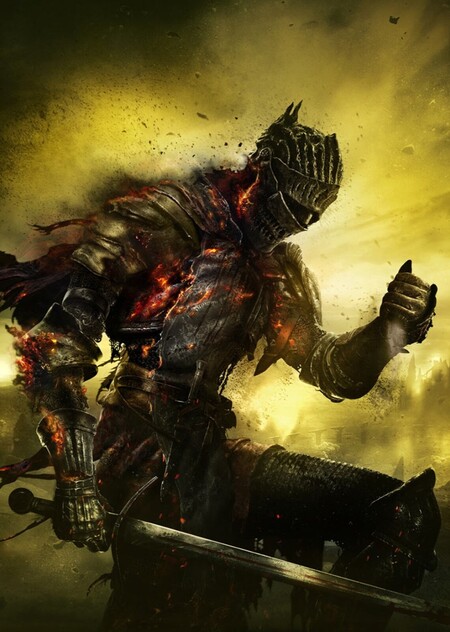
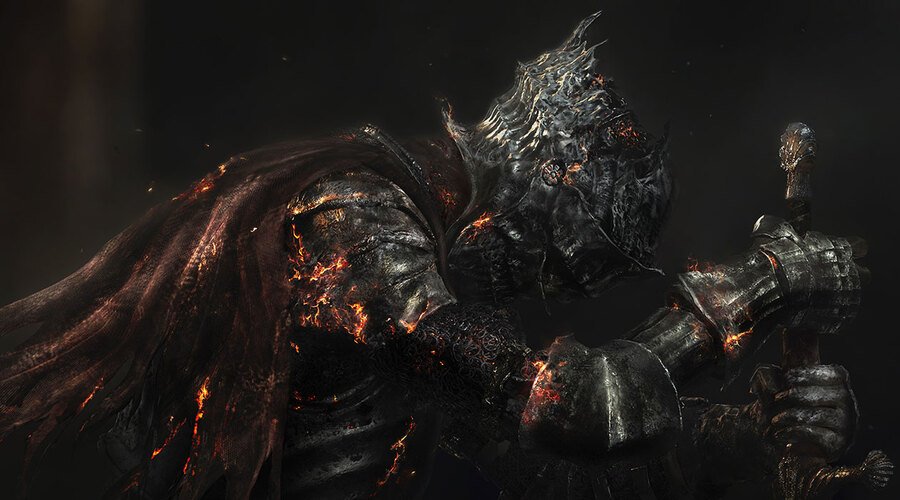
«The fire dies, the world turns to ruins… Only embers glow in the darkness» [1]
Concept
In contemporary humanities scholarship and the discipline of Game Studies, video games are understood not merely as a form of leisure, but as a complete philosophical medium capable of conveying complex existential and theological concepts. Unlike classical art forms, games possess interactivity: they do not simply narrate the fear of death or the crisis of faith, but place the recipient inside a dying space, compelling them to experience this through gameplay mechanics and visual imagery. A striking example of this assertion is the game Dark Souls III (developed by FromSoftware, 2016), where the architecture, the evolution of the celestial dome, and the iconography of relics coalesce into a massive eschatological drama.
The relevance of this research stems from modern culture’s preoccupation with the theme of the «end of history, ” the exhaustion of grand metanarratives, and humanity’s search for footing in the face of Nothingness. Particular attention is devoted to in-game artifacts: due to the fragmented nature of the narrative, the descriptions of objects serve as the primary source of knowledge regarding this world’s mythology, history, and decline. By connecting the visual appearance of the relics with their textual descriptions, the research traces how the degradation of sacred institutions fosters the internal dissolution of the individual.
FromSoftware. Official promotional art for the game «Dark Souls III.» 2016.
Research Hypothesis
How does the visual language, artifact descriptions, and gameplay mechanics of «Dark Souls III» demonstrate the relationship between the crumbling of religious myth and the loss of human identity?
The hypothesis posits that in the world of Dark Souls III, the crisis of sacred authority—the loss of creative freedom by the gods and the transformation of the First Flame cult into a violent necessity—directly engenders an existential crisis for the individual. Having lost authentic grounding, the person becomes trapped in the endless toil of survival, which, without conscious choice, leads to the loss of reason and emptiness. However, the very nature of the game as a «symbol of the world» transforms the experience of death into a tool for achieving subjectivity.
Navigation
Section 1. The Church Crisis and the Dying World Section 2. Existential Decay of the Soul and Emptiness Section 3. Personal Choice in the Face of Nothingness Conclusion
The theoretical foundation of this research is the philosophy of pre-digital games by the German phenomenologist Eugen (Egon) Fink, «Basic Phenomena of Human Being.» According to Fink, humanity is not a composite of animal and god, but is defined by five fundamental existential phenomena—it operates as a «worker, player, lover, fighter, and mortal» [2, p. 102]. In this paper, this system is applied as the primary analytical toolkit for dissecting the digital game «Dark Souls III.»
- Death, Labor, and Power (E. Fink in dialogue with G. Hegel and K. Marx). According to Fink, labor and the struggle for dominance emerge from the perspective of mortality—humans are compelled to work continuously to survive and fight for power to avoid being subsumed by others [2, pp. 189, 263, 300]. In «Dark Souls III, ” this dialectic is revealed through the crisis of divine and clerical power, as well as through the player’s endless „labor“ to overcome an adversarial world.
- Game Theology and the Crisis of the Sacred (H. Ranner, J. Huizinga). To analyze the transformation of religion and temple architecture, the concepts of the „Playing God“ (Deus ludens) and the „Playing Church“ (Ecclesia ludens) by Hugo Ranner („The Playing Man“) [3, pp. 1, 29], as well as the theory of the „magic circle“ by Johan Huizinga („Homo Ludens“) [4, p. 30], are employed.
- Play as the „Symbol of the World“ and Co-existence (E. Fink): In the endgame, play is understood as a space of freedom („oasis of happiness“) and existential co-existence with other players, allowing them to overcome alienation and the fear of death [2, pp. 303, 343, 374].
The theoretical and practical significance of this research lies in the systematization of visual techniques used by contemporary digital media to construct complex religious and philosophical experiences. The results of this work can be utilized in courses on video game theory and history, visual culture, and can also serve as a guide for narrative designers and artists when creating projects with deep existential themes.
1. The Church Crisis and the Dying World
The world of «Dark Souls III» exists at an eschatological precipice: the ancient myth of the First Flame has been exhausted, and the gods have lost their dominion over reality.
E. Fink emphasizes that humanity exists within the horizon of finitude, whereas immortal gods, in their self-sufficiency, know neither death, nor labor, nor play [2, pp. 103–104]. In Dark Souls III, the tragedy begins because the gods and the Lords of Cinder attempt to artificially preserve the fading Age of Fire, distorting space and time itself. Lands from different eras physically fold and slide toward a single center (the «Ashen Estus» location), and the sky becomes the primary indicator of this decay.
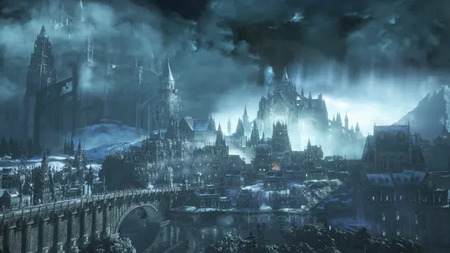
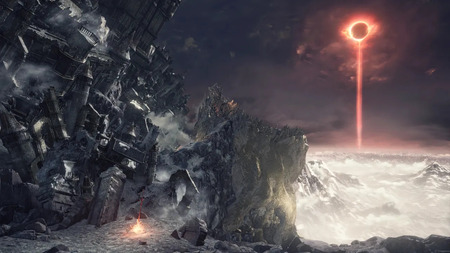
FromSoftware. The sky over Irithyll (1) and the dark sign in the sky after defeating the Lords of Cinder (2) in the game Dark Souls III. 2016.
The evolution of the sky demonstrates a transition from the aestheticization of decay to outright catastrophe. The cold moonlight over Irityll masks the world’s decomposition with an illusion of order. However, after the fall of the Lords of Cinder, this scenery collapses: the Dark Sign appears in the heavens—a bleeding black sun from which ash oozes into the world. The sky ceases to be the abode of the gods and transforms into a visual symbol of the cosmos’s wound.The loss of cosmic order is intrinsically linked to the degradation of religious institutions. The Dutch cultural theorist J. Huizinga, in his work Homo Ludens, notes that every cult requires a strictly defined sacred space—a «magic circle» (temple, altar) isolated from the chaos of everyday life and governed by its own sacred rules [4, p. 30, 37]. In the architecture of Dark Souls III, there is a consistent breach of this circle and a profanation of the sanctuary.
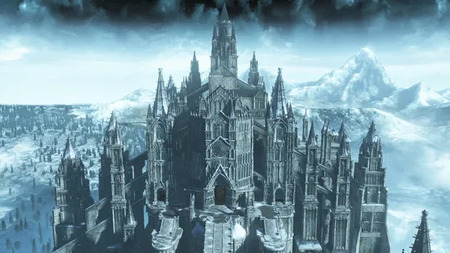
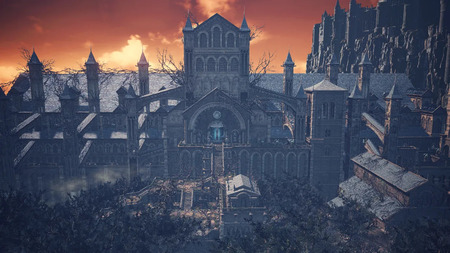
FromSoftware. Locations Anor Londo (1) and the Depths (2) in the game «Dark Souls III.» 2016.
A comparison of two iconic structures reveals two stages of religious decay. The majestic Gothic architecture of Anor Londo maintains the external form of the sublime, yet inside it is merely an empty shell draped in black slime. In the Temple of the Depths, desacralization reaches a point of complete rebirth: the cathedral, built to contain the Abyss, is itself flooded with filth, and the altars and statues are wrapped in chains. Through Hugo Rainer’s theological lens, this records the complete loss of the ideal of the «Playing Church» (Ecclesia ludens): instead of a space for salvation, freedom, and the joy of the Spirit, religion degenerates into a dark, coercive «seriousness» that sustains power through fear [3, pp. 5, 29, 32].
The crisis of power and faith is revealed through the descriptions of the ash lords. According to E. Finke, the foundation of all power is the fear of death and the readiness for violence: a ruler «cannot put down his armor or lay aside his sword even for a second, ” maintaining dominance through the threat of death [2, pp. 299–300]. The general formula of ash in the game states: „If the lords themselves do not return to the thrones, their ash will return“ [5]. Past rulers refused to sacrifice themselves to the Fire: the giant Jorm was aware of the hypocrisy of the subjects, Prince Lotric cursed the tradition of burning itself—“Truly, let those who ignite the fire be cursed» [5], and Saint Aldric pushed the dialectic of dominance and absorption to a grotesque absolute.
FromSoftware. Aldrich, the Devourer of Gods from the game «Dark Souls III.» 2016.
In the description of Oldric’s Ash, it is stated: «Oldric came to the throne devouring people, but, disillusioned with it, he began to devour gods» [5]. In the phenomenology of Fink and Hegel, the master asserts himself through the absorption and annihilation of the other, attempting to extend his own existence at the expense of another [2, pp. 264–266]. Oldric transforms the sacrament of communion into literal cannibalism.
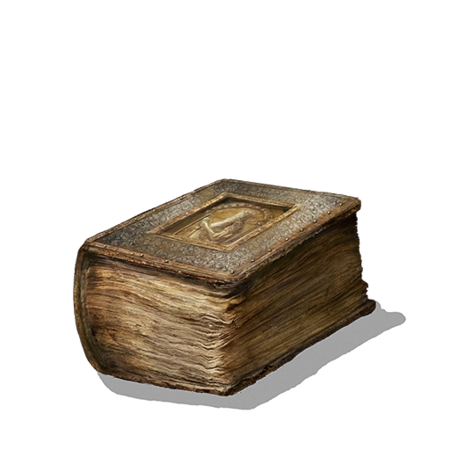
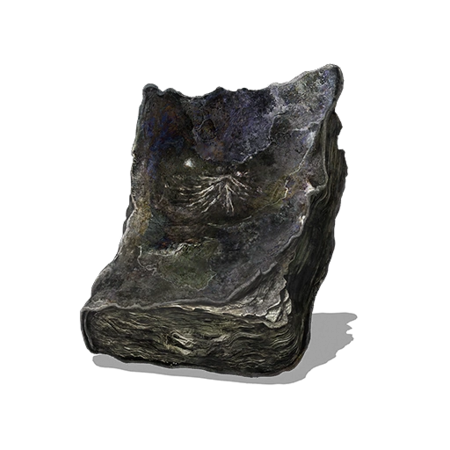
FromSoftware. Items from the game «Dark Souls III»: Karim’s Holy Tome (1) and Profound Holy Tome (2). 2016.


FromSoftware. Items from the game «Dark Souls III»: Child of the Sun’s Ring (1) and Eye of the Evil Ring (2). 2016.
The same degradation is observed in the artifacts, where the visual appearance of the relics directly reflects the shift in sacred orientations. In the mythology of «Dark Souls III, ” miracles are prayers-memories inscribed within holy tomes. As the description of the Deep Sacred Tome states: „Originally, the tome was intended to teach deacons deep divine protection, but later several dark sagas were inscribed within it, and now the book is considered defiled“ [6]. Comparing the Sacred Tome of Karima and the Sun’s Offspring Ring with the Deep Tome and the Eye of the Evil Ring vividly illustrates this rupture: the pure geometry and golden luminescence of the old faith give way to cracked, gloomy forms associated with the absorption of alien life force and the summoning of voracious insects.
When the gods devour each other, temples are desecrated, and the sky bleeds during an Eclipse, humanity is left alone before the ruins of meaning. This inevitably leads to the inner disintegration of the self—the phenomenon of emptiness.
2. Existential disintegration of the soul and emptiness
When the sacred order of the world is shattered, the crisis shifts inward to the human psyche. In «Dark Souls III, ” the loss of higher guides finds a literal, physical, and psychological manifestation in the phenomenon of emptiness.
E. Fink defines humanity as a being that «always lives in the shadow of death, ” with the knowledge of finitude serving as the primary catalyst for contemplating existence [2, pp. 106, 128]. In the world of „Dark Souls III, ” the natural logic of death is corrupted by the curse of undeath: upon dying, the hero and the inhabitants of Lothric revive by the bonfire. Physical demise ceases to be the finality—true death becomes the loss of purpose and sanity, which transforms a person into an aimless Hollow.