Research Concept
During the 1920s and 1930s, the architecture of the United States and the USSR actively sought new forms of expression for modernity. Despite differences in political, cultural, and economic contexts, both countries looked to the imagery of ancient civilizations. In American Art Deco, ancient Near Eastern motifs became part of the skyscraper aesthetic—stepped silhouettes, geometricized ornaments, and motifs from ziggurats and Egyptian temples transformed into symbols of technological progress, wealth, and the vertical growth of the metropolis.
In Soviet architecture, references to ancient civilizations took on a different interpretation. Monumental stepped compositions, pyramidal volumes, and geometric rhythms were employed to evoke the image of a new era, state power, and a collective future. It is particularly interesting to trace this process during the transition from Constructivism to Post-Constructivism and the monumental architecture of the 1930s.
Core Concept: Ancient Near Eastern architecture evolved into a distinctive visual language of the 20th century—a means through which two distinct cultures expressed their ideas about power, progress, and the future.
Research Question and Hypothesis
Research Question: How and why were motifs from ancient Near Eastern architecture reinterpreted in American Art Deco and Soviet architecture of the 1920s and 1930s, and what diverse ideological and artistic meanings did they acquire?
Hypothesis:
Despite employing common ancient Near Eastern prototypes, American Art Deco and Soviet architecture utilized these elements to express divergent ideas. In the U.S., the stepped form of the ziggurat became a symbol of commercial success, technological progress, and individual achievement, whereas in the USSR, ancient Near Eastern monumentality was reinterpreted as an image of collective power, state grandeur, and historical continuity.
Research Goals and Objectives
Objective: to identify the similarities and differences in the use of ancient Near Eastern architectural motifs in the US and the USSR during the 1920s and 1930s.
Objectives:
- Examine the architectural characteristics of ziggurats and ancient Egyptian structures.
- Identify the main ancient Eastern motifs in American Art Deco.
- Investigate the use of stepped and pyramidal forms in Soviet architecture.
- Compare the composition, silhouette, scale, decor, and symbolism of the buildings.
- Determine how historical forms transformed into symbols of the modern era.
Architectural Case Study Selection
I would divide the visual material into two main sections and then add a comparative section.
Part I. The United States — The Ancient East as a Symbol of Progress
- Fred F. French BuildingNew York, 1927–1928. Architects H. Douglas Ives and Sloan & Robertson.The stepped composition of the facade resembles a Mesopotamian ziggurat, combining Eastern, Egyptian, and geometric motifs.
- 130 West 30th StreetNew York, 1920s.One of the clearest examples of a direct reference to ancient Mesopotamian architecture: the stepped silhouette, bas-reliefs, sphinx figures, and fantastic creatures.
- Nebraska State CapitolLincoln, 1922–1932. Architect Bertram Goodhue.A monumental tower reminiscent of ancient Eastern temple structures. Of particular interest is the Assyrian and Babylonian iconography present in the architecture and sculptural program.
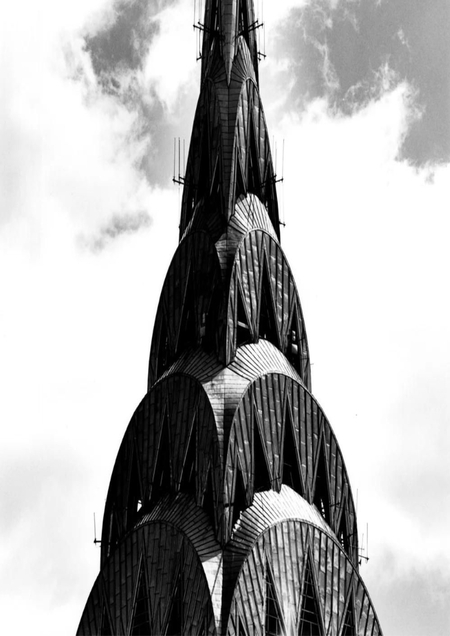
- Chrysler Building
New York, 1928–1930. Architect William Van Alen.
Stepped silhouette, geometric ornamentation, and lotus motifs in the interiors. An example of a more abstract rather than literal reinterpretation of ancient forms.
It is particularly important here to show that the architects were not necessarily copying ancient structures. Instead, they were reinterpreting their silhouettes, ornaments, and symbolism in accordance with the aesthetics of the Machine Age.
Part II. The USSR—Ancient Monumentality as the Image of a New Era
Lenin’s MausoleumMoscow, 1929–1930. Architect Alexei Shchusev.Stepped geometric composition, massive pedestal, monumentality. This can be compared to the ziggurat principle and ancient funerary structures.Note: this is a comparative typological analogy, not proven direct borrowing.
- Palace of Soviets
Competition projects from 1931–1933. Boris Iofan’s design.
Multi-stage volume progression, colossal scale, and vertical composition. The structure is envisioned as a symbol of the new state order.
- Frunze Military AcademyMoscow, 1932–1937. Architects Lev Rudnev, Vladimir Munts.Monumental symmetry, heavy geometric volumes, rhythm of verticals. Suitable for exploring the transition to 1930s monumental architecture.