Navigation Menu
- Concept
- Typology of Camera Movement and Its Visual Functions
- Camera Movement and Frame Depth
- Rhythmic and Compositional Autonomy of Movement
- Conclusion
Concept
For decades, research into classical Hollywood cinema was dominated by an interest in narrative—analyzing plot structures, genre formulas, and storytelling systems. The visual aspect of the film was often treated as derivative of these concerns—as mere «packaging» for the story, rather than an independent level of meaning production. Meanwhile, camera movement—panoramas, tracking shots, zooms, crane movements—is not merely a technical technique for «animating» the frame, but rather a distinct visual grammar possessing its own logic and expressive potential. As Patrick Keating shows, the classical Hollywood camera does not move to imitate the actions of an omniscient observer, but rather to generate a «game of concealment and revelation, ” which is an inalienable part of the exchange between the film and the viewer. It is precisely this idea—camera movement as a system that organizes the visible and the invisible, rather than as a neutral tool accompanying the action—that constitutes the initial problem of this study.
The relevance of this topic stems from the fact that camera movement in classical Hollywood remained on the periphery of academic reflection until relatively recently. Kiting explicitly describes his work as an engagement with «the largely unexplored history of cinematography within the era of the American studio system.» Crucially, this is not a chronological cataloging of technical innovations, but rather an examination of persistent visual norms and types of movement that can be analyzed synchronously, independent of any specific decade. This approach aligns with the broader tradition of studying the classical Hollywood style as a system, established in the seminal works of David Bordwell, Janet Staiger, and Kristin Thompson, where visual techniques—including camera movement—are viewed not as a random assortment but as a reproducible repertoire governed by specific rules. This research continues that lineage but shifts the focus from a general description of style to the internal grammar of movement as a relatively autonomous level of film.
The research question is formulated as follows: In what way does camera movement in classic Hollywood cinema function as an independent visual grammar—that is, does it generate meaning through the organization of space, the concealment and revelation of objects, rather than through plot or acting performance? To answer this question, several objectives must be met: first, to identify the primary types of camera movement (pan, tracking shot, crane shot, dolly) and their visual functions that cannot be reduced to merely «serving» the narrative; second, to analyze how camera movement interacts with frame depth and mise-en-scène, thereby creating semantic connections between the foreground and background; and third, to demonstrate that camera movement possesses its own rhythmic and compositional logic that can be formally described.
Camera Movement Typology and Its Visual Functions
Camera movement in classic Hollywood cinema is not simply a technical device of «following the action.» As Patrick Keating demonstrates, the classic Hollywood camera moves not to imitate the actions of an omniscient observer, but to generate a «game of concealment and revelation» that constitutes the essence of the exchange between the film and the viewer. This implies that camera movement possesses its own functional logic, which can be described through a typology of techniques. The chapter examines four types of movement using material from Hollywood films made before 1930.
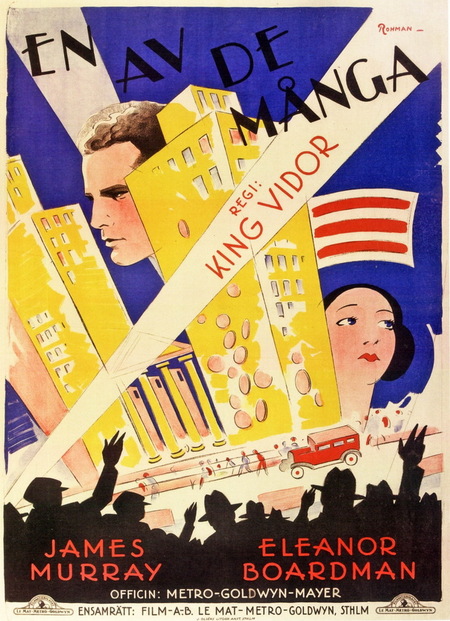
Panorama and movement: selecting figures from the mass. In The Crowd (1928, dir. King Vidor), movement serves the function of visual selection. Critics note that Vidor «weaves the camera into the physical logic of the action, ” rather than demonstrating technique for technique’s sake. The upward-tilted shot of the tram steps is „uncomfortable, ” but justified because it conveys John’s point of view; the shot of descending the hill in Coney Island attracts attention for the same reason. The movement up the skyscraper facade is telling: it functions „as a narrative connecting passage.“ Here, movement takes on the function of editing—selecting the particular from the general—but executes it within continuous motion. Cutting formulates this by stating that each camera movement „can express a character’s emotion, convey attitude and irony, and even challenge an ideological position.“
Vertical Movement: Space as Hierarchy. Seventh Heaven (1927, dir. Frank Borzage) offers an example of engineered vertical movement. To stage the continuous ascent of the characters from the ground floor to the seventh-floor apartment, a three-level structure with an elevator was built: the camera entered the elevator platform and then moved up through a vertical set piece using cables and pulleys, allowing the viewer to «pass through each floor» alongside the characters. Scholarly literature confirms that this kind of «narratively motivated vertical movement» mimics the German style of «virtuosic camera movement, ” enabling the „omniscient camera to vertically pass through ceilings and floors.“ In this context, vertical movement is not mere decoration; it is a means of transforming physical space into a semantic hierarchy.
Dolly and Focus Control: «Selection» Without Cutting. In «The Crowd, ” the camera transitions from the character to the crowd and back using a dolly and variable focus, „avoiding cuts“ while still narrowing and broadening focus. This aligns with Kitting’s concept of „concealment and revelation“: what the moving camera reveals in detail is not equivalent to a cut to the same detail because the continuous movement preserves spatial relationships and makes the selection process itself visible. Here, the dolly is a visual operation that substitutes editing.
Subjective Configuration and Engineering Movement: Boundaries and Limits. In «Sunrise» (1927, dir. F. W. Murnau), movement is typically described as «masterful use of the tracking camera and superimposed visuals, ” yet there is limited academic material analyzing the specific syntax of that movement. In „Underworld“ (1927, dir. Josef von Sternberg), a 1927 newspaper account survives: Sternberg rehearsed with camera operator Bert Glennon every morning regarding the rotation of the camera crank—Glennon was responsible for „smoothness and precision, ” while Sternberg „watched through the viewfinder, observing the scene being shot.“ This evidence comes from a newspaper, not a scholarly study, and cannot serve as a theoretical foundation, but it does document a practical setup: camera movement was controlled via the viewfinder. Regarding „Lonesome“ (1928, dir. Paul Fejes), the materials only mention the use of a „handheld camera“ for crowd shots, but there is no systematic analysis of the movement’s syntax.
Camera Movement and Shot Depth
Chapter two maintains the theme of camera movement but shifts the focus: while the first chapter answered the question, «how does the camera move and what function does each movement type serve, ” this chapter addresses what happens to the frame’s depth when the camera moves. Patrick Keating frames this distinction thus: a moving camera generates „different impressions, moods, and tones“ than editing cuts focusing on the same details, because movement preserves the continuity of space and makes the act of selection visible. In this context, depth is not a static lens characteristic but a variable governed by movement.
«The Crowd»: Reconfiguring Depth Through Rack Focus. In the first chapter, the rack focus in «The Crowd» was examined as a technique of «selection without splicing.» Here, another aspect is important: how the rack focus reconfigures the relationship between layers of depth. The variable-focus camera transitions from the character to the crowd and back, and in this transition, the figure and the mass change their relative position to each other within the frame’s space. Initially, the protagonist is presented within the mass; then, the focus narrows, and the figure is «pulled» from the depth onto the foreground; the reverse movement returns it to the background, where it dissolves. The 1928 technical critique noted that this technique «avoids splices» and «very clearly expresses the film’s fundamental idea.» Significantly, the depth here does not simply «exist”—it is actively reconfigured by the movement of focus, and this reconfiguration is the visual statement.
The final camera movement demonstrates a different operation of depth. According to Deleyto’s analysis, the camera moves away from the characters with a «swift upward motion» and two almost imperceptible rushes; the rapidly increasing distance «reveals the space and uniformity of the crowd,» rendering John merely one among many. The combination of the movement’s «speed and scope» with the rushes «brutally frames» the characters' apparent happiness. Here, the depth created by the movement is not a neutral description of space, but an evaluative visual position: distance itself becomes a meaning.
«Sunrise»: The Non-Sovereignty of the Frame and «Discarded» Elements. As noted in the first chapter, the Murnau camera renders the frame «non-sovereign.» The connection to depth is this: the camera’s movement dictates not only what is captured in the shot but also what is excluded from it. When an element has fulfilled its dramatic function, the camera can «discard» it, and this graphic rejection itself becomes an event. In this context, depth is not a «background receding into the distance,» but rather a dynamic boundary between the visible and the invisible, which is managed by movement. However, it must be stated frankly: the available academic materials do not contain a systematic analysis of the specific syntax of movement and its relationship to depth in «Sunrise.» Discussion of this film is based on framing judgments, not a frame-by-frame analysis.
The depth in the films examined is not a static lens characteristic—it becomes a variable controlled by camera movement.
Rhythmic and compositional autonomy of movement
«The Four Horsemen of the Apocalypse»: composition as a source of rhythm. Ingram began as a sculptor, and this directly influenced his visual methodology. Researchers note that for Ingram, «composition was always the most crucial element; nothing was left to chance—neither the setting nor how characters move gracefully within it.» Significantly, Ingram’s rhythm is created not by camera movement or editing pace, but by the organization of elements within the frame—the placement of figures, the relationship between the foreground and background, and the direction of gazes in crowd scenes. In other words, the rhythm here is spatial, not temporal in the narrow sense. This offers an example of visual autonomy of a different kind than that presented in the first chapter: meaning is generated not by what «the camera does, ” but by „how the frame is structured.“
«The Covered Wagon»: the material basis of rhythm. Cruise’s film is noteworthy for its commitment to material authenticity. The trailers used for filming were not set dressing—they were gathered from families in the Southwest; they were real pioneers' wagons, and their owners and families acted in the mass scenes, driving them in front of the camera and continuing to live in them between takes. Scenes involving animals were also built upon physical reality: herds of bison were filmed on Antelope Island, and during the shoot, seven bison were shot. This mode of production establishes a distinct rhythm: in the migration scenes, the rhythm is created by the actual physical movement of the wagons and animals—their speed, intervals, and direction—rather than by editing or camera movement. The camera largely remains a recorder, and the rhythm arises from the physical properties of the event being captured. The most impressive scenes—the river crossing and the Native American attack—owe their power precisely to this documentary authenticity.
Comparison and preliminary conclusion. Two films present two distinct models of rhythmic autonomy. In Ingram’s work, the rhythm is compositional: the static organization of space within the frame generates rhythmic tension before any movement occurs. In Cruz’s work, the rhythm is material: the physical movement of real objects constitutes the rhythmic basis, which the camera then captures. Neither model aligns with the mechanism described in the first chapter (camera movement as value production), and both confirm that visual organization possesses an inherent rhythmic dimension irreducible to montage or narrative.
Conclusion
Thus, camera movement in classical Hollywood cinema establishes a relatively autonomous visual grammar rather than acting as a neutral narrative accompaniment. It can be noted how camera movement functions like a visual grammar operating independently of the plot and the actors' performance.
iiii