Research Concept
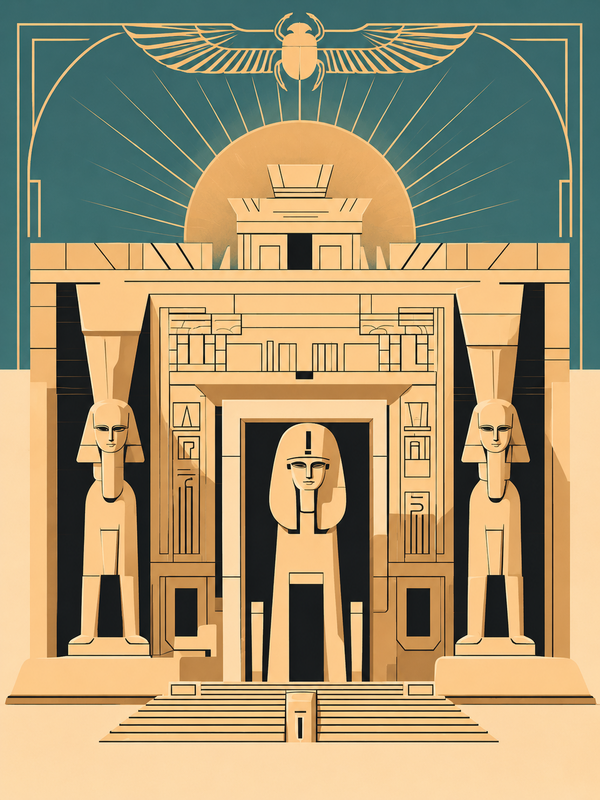
This research focuses on the Egyptian revival in 1920s American cinema architecture. The central idea is to examine how architectural forms and decorative elements from Ancient Egypt were reinterpreted in 20th-century public buildings. Special attention is given to the transition from the traditional architecture of Egyptian temples to the stylized imagery of American movie theaters, where ancient motifs became an integral part of modern architectural composition.
Research Significance
Egyptian Revival is interesting as an example of how 20th-century architecture engaged with historical heritage. American movie theaters from the 1920s demonstrate how ancient architectural forms could be repurposed within an entirely new function and cultural context. Studying these structures allows us to trace the interplay between historical traditions, architectural ornamentation, and the formation of public space.
Research Objective
To identify the characteristics of using and transforming ancient Egyptian architectural forms and decorative motifs in American movie theaters of the 1920s.
Chapter 1.
The History of the Egyptian Renaissance
1.1. The Early Fascination with Ancient Egypt Interest in Ancient Egyptian culture within European architecture intensified particularly at the end of the 18th and beginning of the 19th centuries. A significant event was Napoleon Bonaparte’s Egyptian Expedition of 1798–1801. Alongside the army arrived scholars, architects, artists, and engineers who studied and sketched the ancient monuments. The result of these investigations was the multi-volume publication Description de l’Égypte, released between 1809 and 1829. It presented images of temples, tombs, sculptures, and architectural details. These materials made Egyptian forms more accessible to European architects and artists.
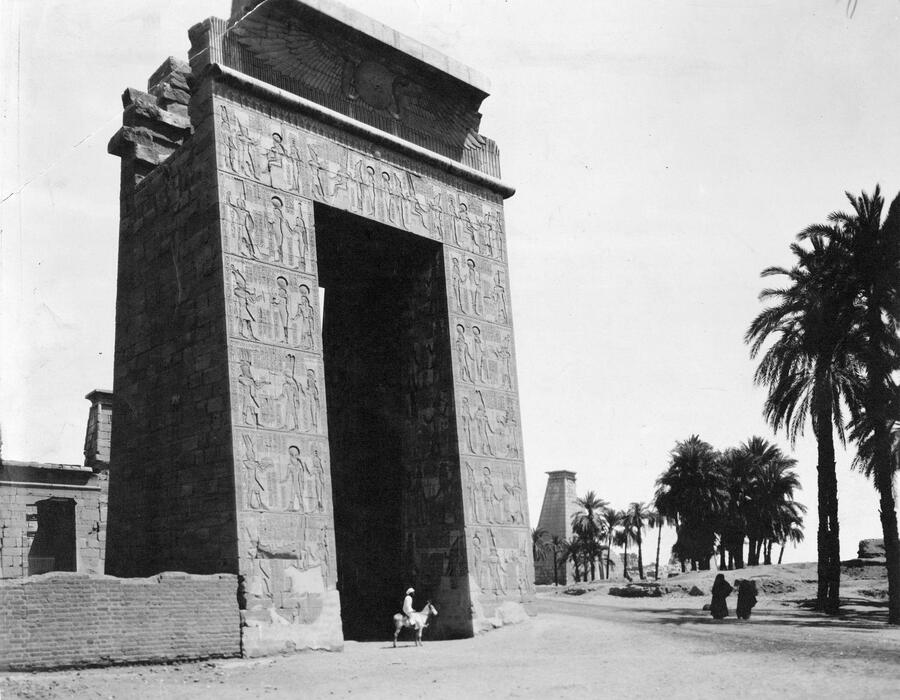
Monumental pylon of the Karnak Temple in Egypt. Ancient Egypt.
In architecture, the Egyptian Revival style emerged—a resurgence of Egyptian design. Architects referenced the distinctive forms of ancient structures: massive entrance pylons, columns with vegetal capitals, obelisks, sphinxes, and ornamentation featuring hieroglyphic motifs. Egyptian motifs began appearing in the United States as early as the first half of the 19th century. One example is the Egyptian Medical College building in Richmond, constructed in 1845. Its facade recalls an ancient Egyptian temple due to its monumental columns, heavy walls, and restrained decoration.
Egyptian Medical College building in Richmond, USA. 1845.
1.2. Egyptomania and the Discovery of Tutankhamun’s Tomb At the beginning of the 20th century, interest in Ancient Egypt saw a new resurgence. In 1922, archaeologist Howard Carter discovered the entrance to the tomb of Pharaoh Tutankhamun in the Valley of the Kings. This find drew global public attention to Egyptian history, art, and symbolism.
Howard Carter at the entrance of Tutankhamun’s tomb. 1922.
After the tomb was discovered, Egyptian motifs became particularly prominent in architecture, interiors, fashion, and decorative arts. This surge of interest was dubbed Egyptomania. In architecture, it manifested through the active use of stylized columns, winged solar disks, lotuses, papyrus plants, sphinxes, and geometric ornaments. It is important to note that the tomb’s discovery did not initiate the Egyptian revival—this style had existed for over a century already. However, Tutankhamun’s find intensified interest in Egyptian themes specifically during the 1920s. For American architecture, this period coincided with the construction of numerous large movie theaters. Egyptian stylistics proved perfectly suited for such buildings: it allowed for the creation of expressive facades, grand entrances, and unique interiors, transforming a trip to the cinema into a special spectacle.
The interior of an American cinema in Egyptian style. 1920s.
The Grauman’s Egyptian Theatre in Hollywood opened on October 18, 1922, and Tutankhamun’s tomb was discovered on November 4. Consequently, the theatre’s design began before this find. This is a good example of how the Egyptian Revival was already present, and the tomb’s discovery amplified the style’s popularity.
Chapter 2. Architectural Origins of the Egyptian Style
2.1. Architecture of Ancient Egyptian Temples Ancient Egyptian temples were constructed as monumental structures where architecture, sculpture, and decorative elements formed a single, unified whole. Their composition often developed along a central axis—moving from the open space before the temple to the interior chambers and the sanctuary. One of the primary elements at the entrance was the pylon—a massive structure made of two sloping towers with a passageway in the center. Obelisks and statues of pharaohs might be placed in front of it. The pylon created a ceremonial entrance and emphasized the scale of the building.
Main pylon of the Temple of Edfu in Egypt. 3rd–1st century BCE.
Outside the entrance, there was typically an open courtyard surrounded by colonnades. Beyond that was a hypostyle hall—a covered space featuring numerous columns supporting a stone ceiling. One of the most famous examples is the Great Hypostyle Hall of the Temple of Amun-Ra at Karnak. It includes 134 columns, some of which rise to a height of about 20 meters.
The Great Hypostyle Hall of the Karnak Temple. 13th Century BCE.
As one approached the sanctuary, the rooms became smaller, the ceilings lower, and the lighting more subdued. This created a gradual transformation of space: from the open and accessible section of the temple to the enclosed and most significant one.
Layout of a longitudinal composition in an ancient Egyptian temple: pylon, courtyard, hypostyle hall, and sanctuary. Ancient Egypt.
2.2. Decorative Elements and Symbolism Columns played a vital role in ancient Egyptian architecture. Their forms often echoed the outlines of plants associated with the Nile Valley’s nature. The most common capitals were lotus-shaped and papyrus-shaped. The shafts of the columns could be adorned with vertical reliefs, plant imagery, and hieroglyphic inscriptions.
Columns with capitals shaped like lotus and papyrus flowers. Ancient Egypt.
Decorative motifs held not only aesthetic but also symbolic meaning. The lotus was associated with rebirth and the renewal of life, while papyrus represented vegetation and fertility. Images of the winged solar disk were linked to the sun deity and protection. Sphinxes and statues at the entrances emphasized the solemnity and guarded the sacred space of the temple.
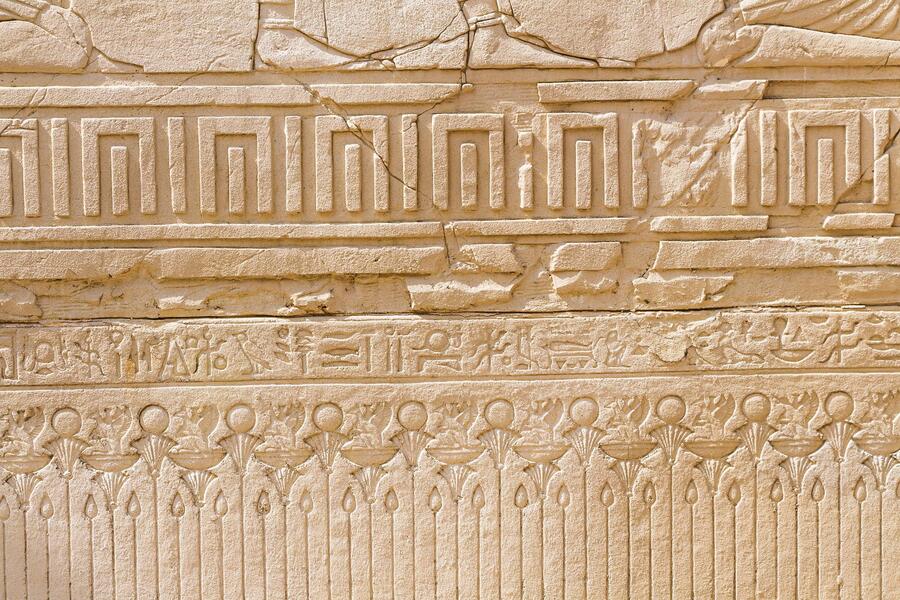
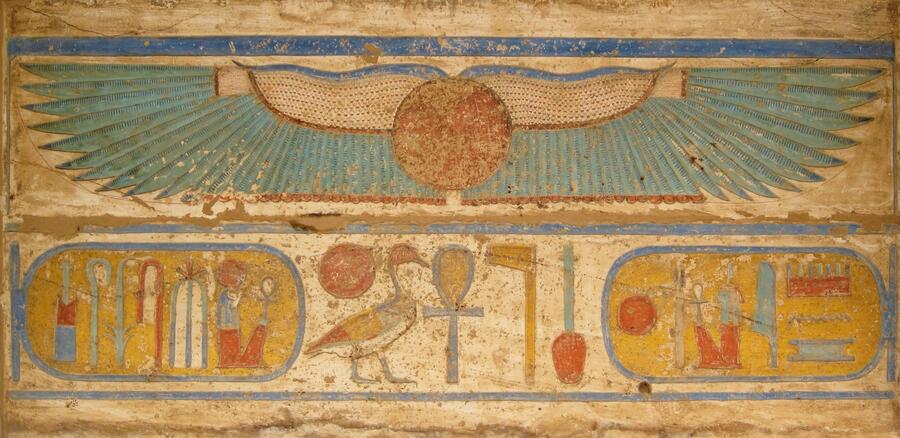
Рельеф с изображением крылатого солнечного диска над входом в древнеегипетский храм. Древний Египет.
In Egyptian Revival architecture, these elements were used as recognizable identifiers, uniting them in new compositions: monumental entrances, columns with vegetative capitals, relief ornaments, and symbolic imagery. This principle of reinterpreting ancient motifs would become the foundation of American movie theater architecture in the 1920s.
Chapter 3. American Movie Theaters of the 1920s
In the 1920s, so-called movie palaces became popular in the United States—large theaters designed to accommodate a massive audience. They distinguished themselves from smaller cinemas not only by capacity but also by the scale of their architecture. Attending the movies transformed into a special event: patrons were greeted by spacious lobbies, grand staircases, decorative columns, murals, and lavishly appointed halls. The architecture of these buildings was meant to make an impression even before the show began. Therefore, these theaters often featured expressive facades, monumental entrances, and thematic design. Architects drew inspiration from various historical styles, including Baroque, Neoclassicism, Spanish, Chinese, Moorish, and Egyptian architecture.