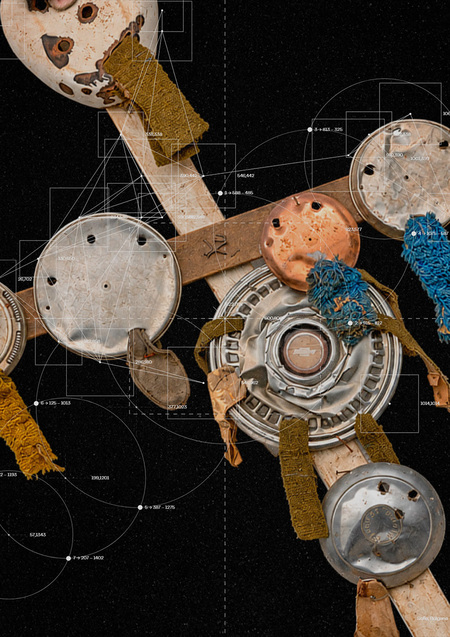
Aestheticization of Trash in Non-Institutional Art of the American South
The Second Half of the 20th Century
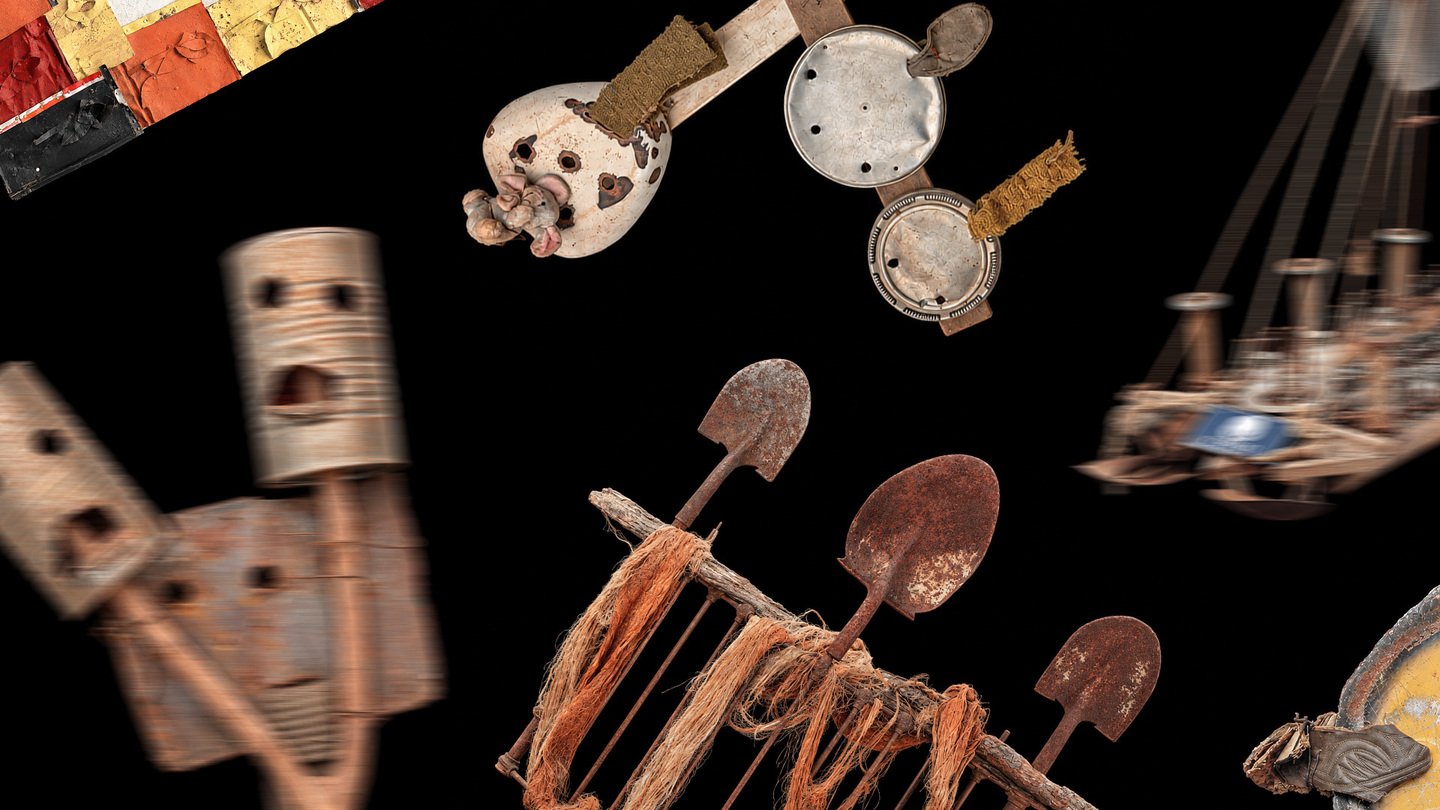
Original collage featuring the works of the studied artists
Relevance
In 20th-century art, perceptions shifted regarding what materials could constitute a work of art. Alongside paint, stone, and bronze, artists began incorporating ready-made objects, fragments, and waste materials. Collage, the ready-made, and assemblage brought everyday items into the realm of artistic language. This raised a question for art history: how does an object, once discarded and deemed worthless, become a subject of careful examination and attain new meaning? Studying refuse as a cultural phenomenon reveals that the boundary between the useless and the valuable depends not only on the material’s condition but also on the relationship established with it [1], [2].Research Question
How does an object, having lost its practical value, acquire aesthetic value?
Selection Criteria for Artists
For this study, we selected Hawkins Bolden, Lonnie Hall, Ronald Lockhart, Thornton Dial, and Joe Minter. What unites them is their consistent engagement with salvaged objects and found materials. This practice developed outside of formal art education, rooted instead in home workshops, courtyards, and local environments. We primarily focus on their works from the 1980s and 1990s. The later institutional recognition of these artists does not negate the circumstances under which their working method emerged; the term «non-institutional art» refers here to its origin, not to the artists' complete isolation from the art world.Hypothesis
We hypothesize that an object gains aesthetic value when an artist utilizes its form, texture, or prior function to create a new artistic image. A curve in metal might suggest the contours of a face, a rust stain could define the color of a relief, and a familiar tool could evoke the people who used it.
Territorial Sampling
Four artists worked in Birmingham and Bessemer, within Alabama’s shared cultural and industrial environment. Borden, who lived in Memphis, allows for an examination of whether similar techniques appeared outside this circle [6], [7]. The selection is limited to artists whose work has been discussed in scholarly literature and is held in museum and archive collections. For the included works, dating, material descriptions, and photographs are available, enabling visual analysis. This is a focused selection for comparing artistic methods; it does not claim to represent all art from the American South.What Do We Mean By Trash?
By trash, we mean items and leftover materials that have been discarded because they are no longer in use—whether thrown away, left behind, or designated as unwanted. An item does not need to be completely destroyed; one can also reject a functional object. The defining factor for our work is the loss of its former function, not the degree of physical damage [1], [2].
Principle of Visual Material Selection
When making selections, our primary consideration was what could be inferred about the found object. Sometimes its identity is evident from its form: the blade remains visible on a shovel, or the rim on a tin can. In other cases, the material’s origin can only be determined through a museum description or an artist’s narrative. For this study, we selected photographs that show both the complete work and the details crucial for analysis: the edge of the metal sheet, the cutout in the can, or the hose attachment point.Hockins Bolden. «Untitled, ” 1980–1987. Fragments. National Gallery of Art, Washington.
Principle of Selecting Scholarly Sources
Scholarly sources were selected based on the questions they help address. The works of A. R. Kozharinova and F. V. Furtay provide the basis for discussing the changing value of discarded objects [1], [2]. A. A. Suvorova’s research refines the boundaries of the concept of «outsider art» [3]. For the history of the Alabama art scene, Alexander’s dissertation and article are particularly important [5], [6]. Technical information is compared with observations made by restorers who examined Diehl’s assemblages [9].Table of Contents
Introduction
Chapter 1. How the Image Emerges in an Object?
Chapter 2. Color and Texture of Worn Materials
Chapter 3. Memory of People in Objects of Labor and Daily Life
Conclusion
The Principle of Chapter Segmentation
The titles of the three chapters denote three ways of perceiving an object. The first chapter begins with a question of similarity: what allows one to see a face in several mundane objects? In the second, the gaze shifts from the object to its material. In Locke’s reliefs, one can trace how the edges of metal sheets define the boundaries of color patches. The third chapter is dedicated to works whose meaning depends on whether the viewer remembers what the collected objects were used for. For instance, in Minter’s sculpture, «Chain Gang,» recognizable tools of labor allude to the history of forced labor in Alabama [6]. The same object can allow for several such interpretations.01. How does an image emerge in a subject?
The first mechanism of aestheticization is related to recognition. The artist notices in an ordinary object outlines that might suggest a face, body, or animal, and makes this resemblance distinct: they alter the object’s positioning, connect it with other details, add an opening, or introduce a curve. The object retains its material definition, but it begins to be perceived as part of another image.
Left. Hawkins Bolden. «Untitled,» 1980–1987. National Gallery of Art, Washington. Right. Hawkins Bolden. «Untitled,» 1970s. Auckland Art Gallery, Chapel Hill.
On Holden’s shovel, two holes are positioned almost at the same height. The eye connects them in pairs, and the longitudinal ridge between them takes on the contour of a nose. On the tin can, the holes are larger, and their edges are dented. Below them, an uneven gap yawns open. Darkness inside the can is visible through it, but when you lift your gaze to the upper pair of holes, the same gap seems like an agape mouth. The difference in expression between the two faces can be traced back to quite tangible properties of the metal: the width of the cut, the bending of the edge, the distance between the holes.
In Sandra Kraskin’s catalog are Borden’s own words about old buckets
«I give them eyes… Sometimes one head had three or four eyes. To resemble a face, it was enough to set the position of the holes. The rest depended on what I had in my hands.» [7]
Hockins Baldwin. «Untitled, ” 1987–1988. Souls Grown Deep Foundation.
Left. Hawkins Bolden. «Untitled, ” 1986. Baltimore Museum of Art. Right. Hawkins Bolden. „Untitled, ” mid-1980s. Philadelphia Museum of Art.
Two jars mounted on wooden slats each feature a pair of dark eyes. Each one reads like a separate head. In a neighboring work, Bolden arranges round metal pieces along a crossbar. The vessels here help reveal an entire figure with widely spread arms. Slightly adjusting one component in the assembly can transform it from a head into a shoulder.Bolden uses stuffed jeans even more sparingly. The empty rectangular frame seems to measure the space for a body, while only bent legs remain in the center. The canvas with cutouts in the wooden headboard is read differently: the eye lingers on the openings through which the wall is visible. One work suggests a person through a familiar article of clothing; the other compels the viewer to find the features directly within the surface’s structure.
Left. Hawkins Bolden. «Untitled, ” 1990. Souls Grown Deep Foundation. Right. Hawkins Bolden. „Untitled, ” 1980–1987. National Gallery of Art, Washington.
Hanging from the gleaming wheel cap of a Holden is a short segment of hose, next to which a small toy horse is visible. Pieces of footwear protrude from the edges of the yellow metal disc. Both objects are oriented toward us with their flat sides facing forward, like a portrait. However, the yellow surface is so filled with holes and markings that the gaze skips over them before settling on a particular pair. The title «Untitled» leaves this work up to the viewer. Lony Holly approaches it differently. Even before encountering his elongated sculpture, the title suggests to us that we are looking at a dog yearning for freedom. Now we can check how this resemblance holds up. If you walk around the sculpture from another side, the familiar profile breaks apart into wooden stumps, a mailbox, wire, and garden hose loops.
Lonnie Holley. «My Hyped-Up, Piped-Up, Egolistic Male Material Dog Busting Loose Behind the Fence, ” 1995. First perspective. Souls Grown Deep Foundation.
Lonnie Hall. «What’s on the Workhorse Today?», 1995. First perspective. Souls Grown Deep Foundation.
The wooden goat legs placed under Holly’s dog establish a pose even before one can figure out where the animal’s head is. Next to the sagging hose, ends of wire stick out, and the long body appears taut. With a change in angle, the details obscure each other, and the dog momentarily disappears. This distinguishes the sculpture from Bolden’s frontal portraits: to see the animal again, the viewer must mentally assemble its silhouette.In the piece, «What’s on the Workhorse Today? , ” Holly himself compared one of the old roots to the head of a goat or a chicken. In the two photographs, you can trace how far this root extends sideways and how little space it takes up among the crossbeams, wire, and hanging objects. The author’s notes provided in the collection card suggest where to look. Alice Pitchamarn Alexander notes that Holly’s selection of found objects was a deliberate artistic decision [6]. An ordinary root might have been chosen specifically because of the unique turn in its contour.
Hocking Holden. «Untitled, ” 1980–1987. Fragments. National Gallery of Art, Washington.
In the works of Hawkins Boland and Lonnie Holly, recognition depends on how the artist arranges found objects and from which angle the viewer looks at them. For Boland, two holes in a canvas shovel are enough for a face to emerge. As soon as eyes are discerned in the holes, the gaze finds the nose—which seems to be a protruding metal ridge. Holly creates the silhouette of a dog using wooden goats, wire, and a garden hose. The title suggests who to look for, and the perspective determines whether the animal can be seen. If you walk around the sculpture, the familiar silhouette breaks down into individual objects.
A Brief Conclusion
In both artists' works, the object remains recognizable even after the viewer has perceived something else in it. One can discern the face and still see the shovel; one can recognize the dog and notice that its posture is dictated by the angle of the wooden supports. This is one of the mechanisms of aestheticization: the artist selects a curve, a twist, or a combination of details where the familiar form receives a second reading. Its expressiveness arises directly from the resemblance the viewer can find and verify with their own eyes.
02. Color and Texture of Worn Material