Navigation
[1] Concept
[2] Creation of Artificial Urban Environments
[3] Creation of Architectural Objects
[4] Photography and Image Formation
[5] Creating Spatial Depth
[6] Conclusion
[7] References
Concept
In cinema, the artificial environment plays a significant role, and it is especially crucial when the action takes place in a fictional world. To portray a city that does not exist in reality, creators must conceive its architecture from scratch and devise a way to shoot it so that the viewer believes it. Previously, artists created such spaces by painting backdrops, building sets, and manufacturing architectural miniatures. The advancement of computer graphics has allowed for the creation and alteration of urban panoramas in digital space. However, the film industry has not abandoned its older methods. Despite technological advancements, physical models are still filmed, and they frequently become part of composite shots.
In this study, I aim to trace environmental shifts using two films as examples: Blade Runner (1982) and Blade Runner 2049 (2017). Both films depict a futuristic Los Angeles, allowing for a comparison of how the same problem was addressed over a 35-year span. I am focusing solely on urban panoramas—how the imagery of streets, buildings, and expansive, off-camera architecture was constructed. For the 1982 film, the production team employed physical miniatures, painted matte paintings, multiple exposures, and optical compositing. The Hades Landscape panorama was assembled using miniatures and flat silhouettes. In the 2017 film, 3D modeling and computer graphics moved in tandem with classic techniques. The creators did not abandon physical models; for key scenes, miniatures were shot live and then combined with digital effects during post-production.
The objective of this study is to determine how the technologies for creating artificial urban environments have evolved and how these changes have influenced the final imagery. To achieve this, I will compare shots from both films, archival photographs, and production materials, paying close attention to the construction of architectural models, camera work, the conveyance of scale, and the integration of individual frame elements.
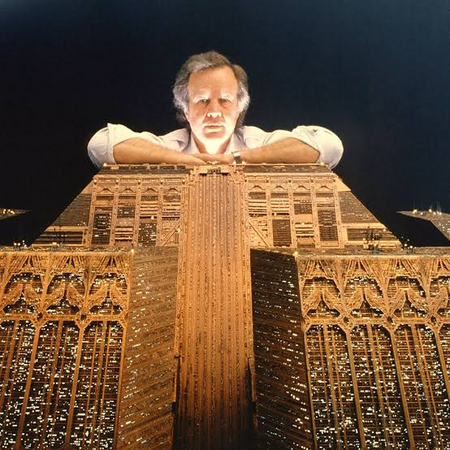
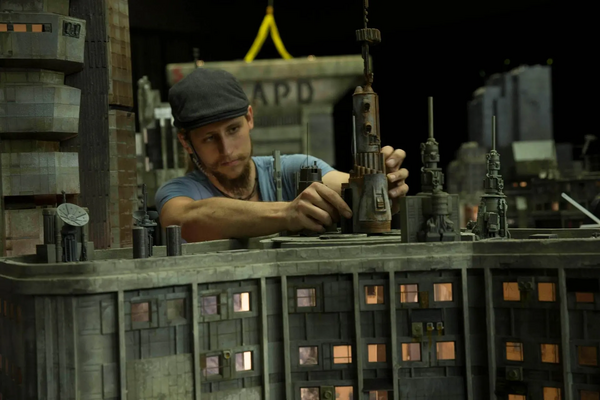
Douglas Tramball posing on the set of Blade Runner (1982) // The photo depicts the process of creating gigantic miniatures for the film Blade Runner 2049
The research hypothesis is that the technologies for creating artificial urban environments have evolved not through the complete replacement of physical miniatures with computer graphics, but through changes in the methods of their construction, filming, and integration with digital elements.
Creating the artificial urban environment
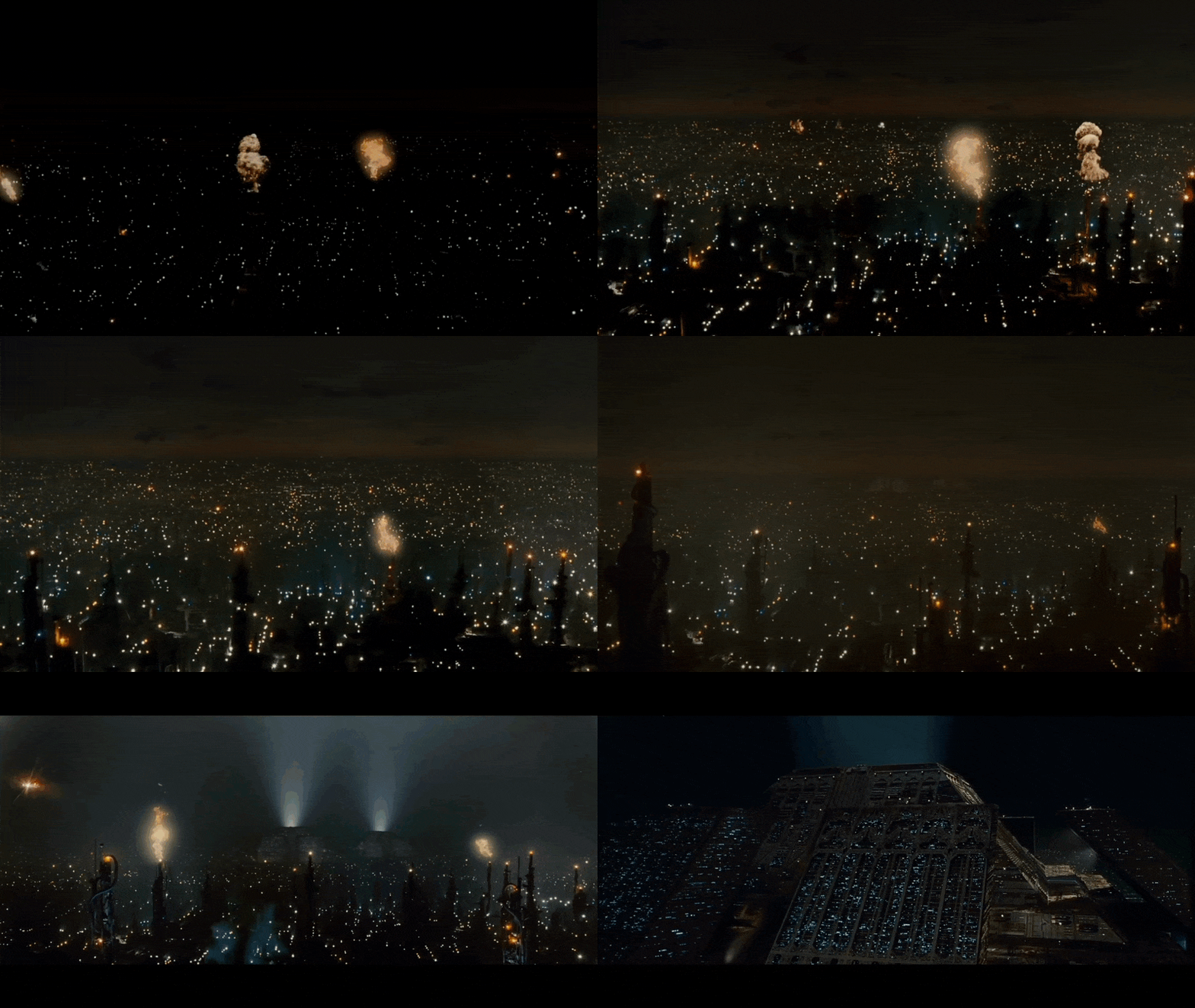
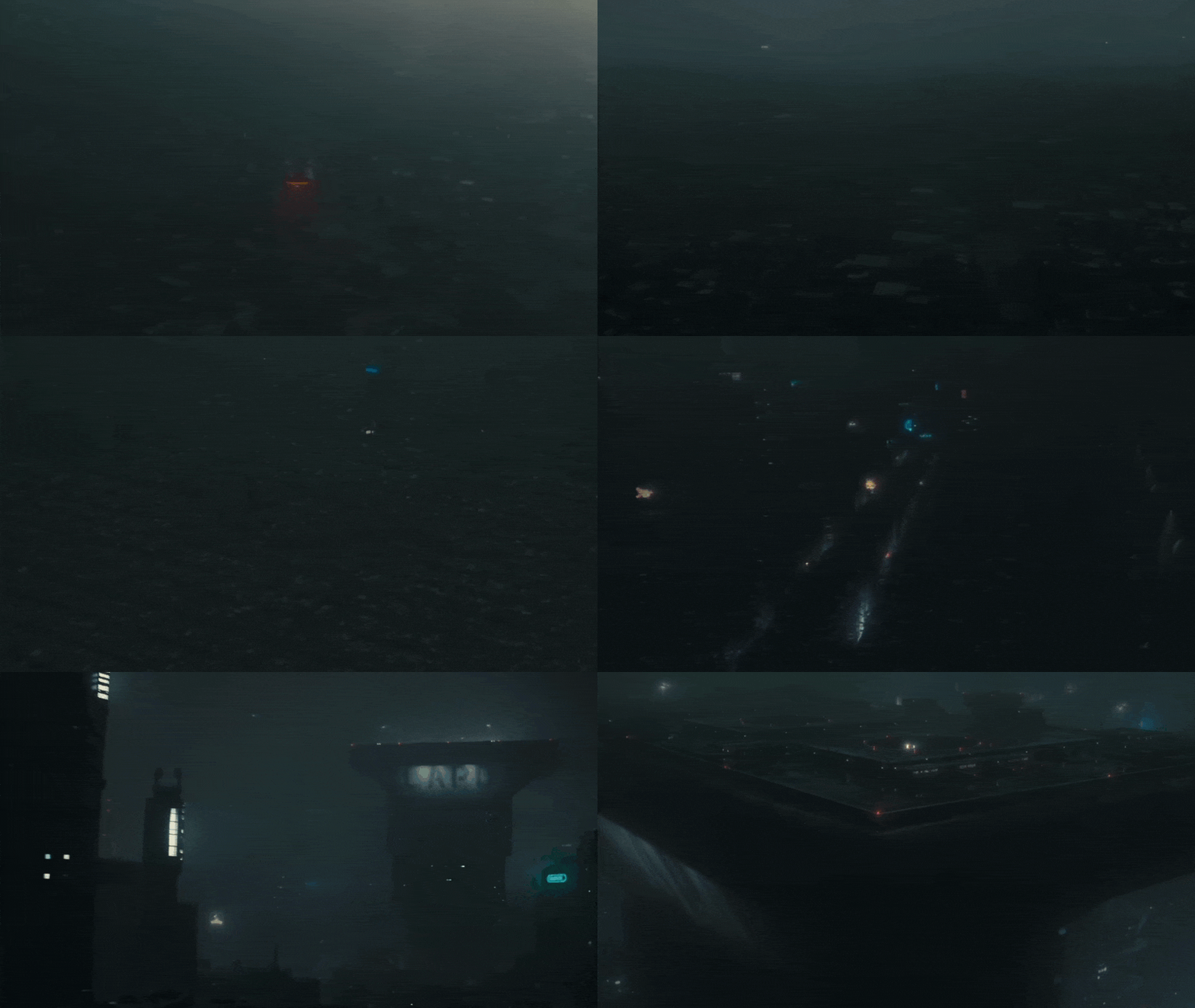
Blade Runner (1982) // Blade Runner 2049 (2017)
In both films, a futuristic Los Angeles is depicted as a sprawling city with dense development. However, in 1982, many panoramas were based on physical miniatures, whereas in 2017, a significant portion of the space was created using computer graphics.
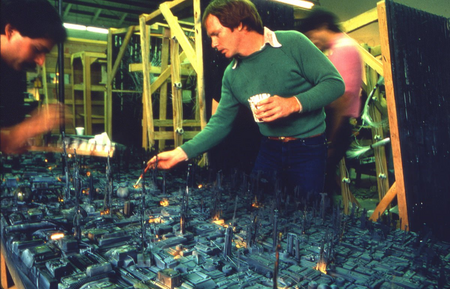
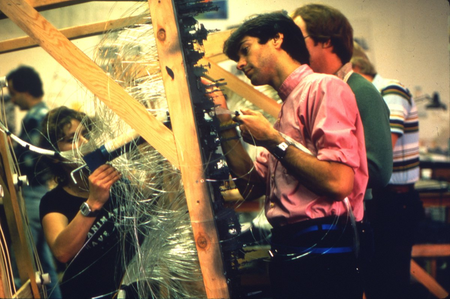
Douglas Trambull (in a green sweater) is working on a miniature model of the industrial landscape of Hades for the film Blade Runner (1982).
For the opening sequence of the 1982 film, the Entertainment Effects Group created a miniature industrial landscape, the Hades Landscape, measuring approximately 4.6 by 2.4 meters. Mark Stetson directed the miniature work, while Douglas Trambull, Richard Yurichich, and David Dryer were responsible for the special photographic effects.
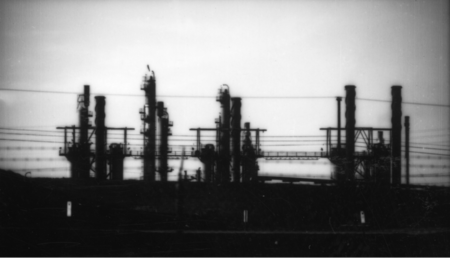
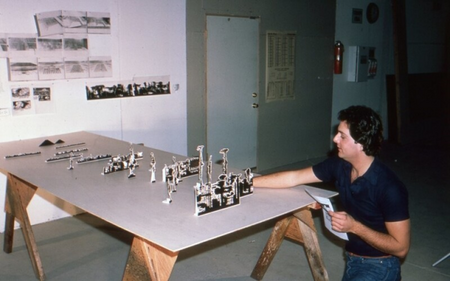
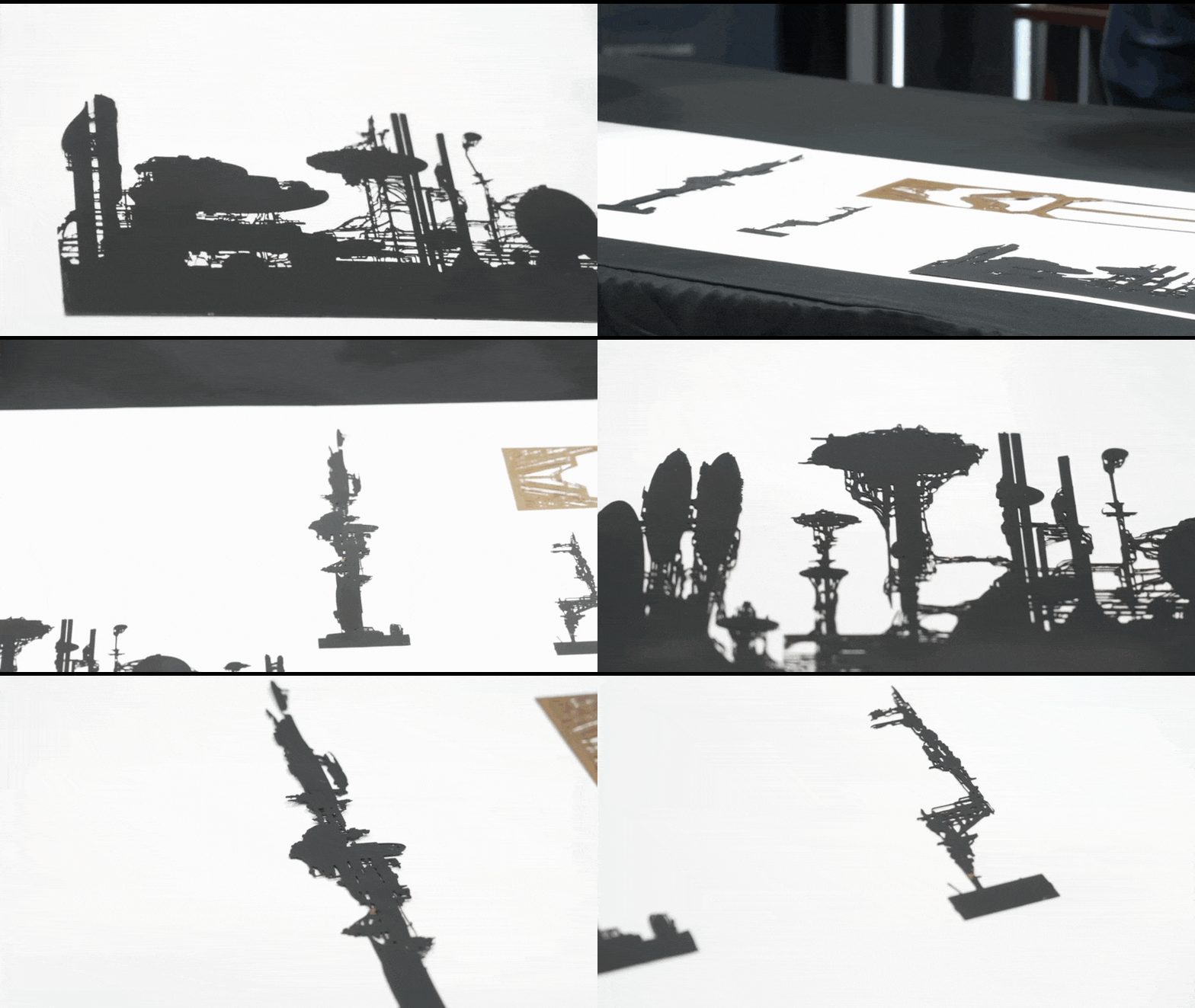
The silhouette of an oil refinery — a reference for the film Blade Runner (1982) // Christopher S. Ross creates a miniature city for the film Blade Runner (1982)
Thomas Keneham’s technical drawing illustrates the compositing process for the film Blade Runner (1982).
For the creation of Hades Landscape, Virgil Mirano’s photographs of industrial facilities in El Segundo were used. Based on these, Christopher Ross developed the silhouettes of the structures, which were then transferred onto brass sheets using chemical etching. This technique allowed for the creation of complex structures without the need to fabricate individual three-dimensional models.
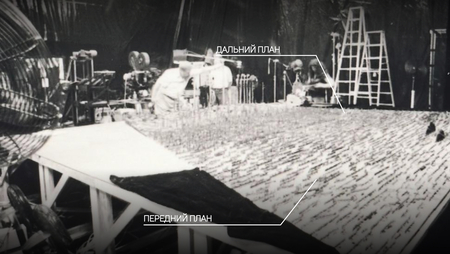
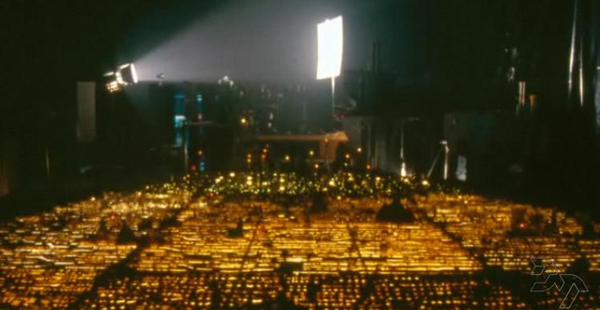
Creation of a miniature Hades landscape using forced perspective for the film Blade Runner (1982) // Lighting effects for filming a miniature urban landscape, 1982
Miniature structures were arranged in several rows before the camera. The foreground featured volumetric models, while the background presented scaled-down constructions and flat silhouettes. This arrangement allowed the depiction of extensive urban development within a limited space.
excerpt from the film «Blade Runner 2049» (2017)
In the film Blade Runner 2049, the DNEG studio, led by VFX Supervisor Paul Lambert, created a significant portion of the city panoramas.
Unlike the first film, many of the architectural elements could exist entirely in a digital environment. Specialists constructed three-dimensional buildings, manipulated their placement, and shaped entire districts using computer graphics.
However, not all panoramas were created from scratch. For some shots, actual aerial footage was used and subsequently heavily modified.
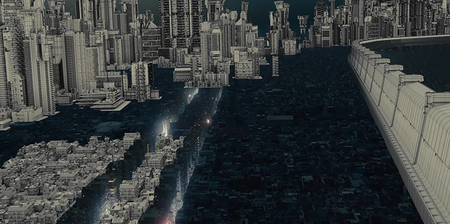
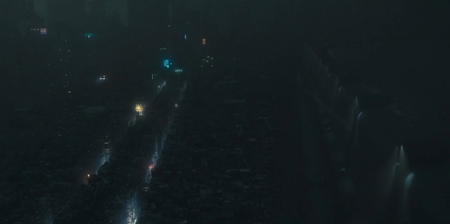
Creating an artificial environment: a 3D model and the final frame from the film Blade Runner 2049 (2017)
For the environment, which was created entirely in CG, DNEG specialists developed three-dimensional architectural assets with varying levels of detail. The most complex models were used for buildings positioned close to the camera. Mid-ground areas were filled with less detailed structures, and the distant cityscape was formed using simplified objects. This allowed for the allocation of computational resources based on how clearly the viewer could perceive the architecture in the final shot.
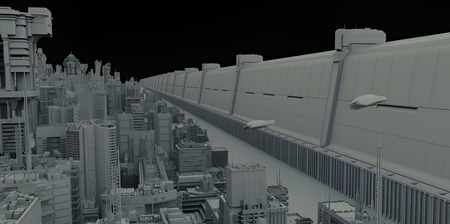
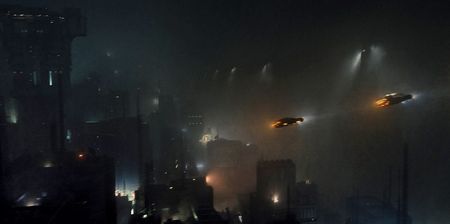
Creating an artificial environment: a three-dimensional model of the architecture and the final frame from the film Blade Runner 2049 (2017)
When creating the digital city, the DNEG team used a modular approach. The architectural models consisted of individual elements that could be combined to create new structures. The placement of major structures within the city panoramas was developed separately, rather than relying entirely on automatic distribution. This approach allowed for the creation of diverse urban development while maintaining control over its placement and the overall composition of the shot.
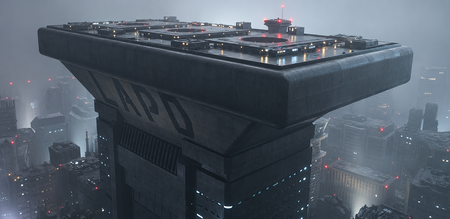
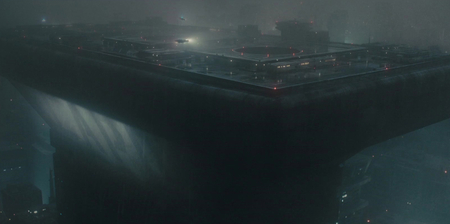
LAPD Headquarters: Final film shot and miniature model of the building for Blade Runner 2049 (2017)
In 1982, the creation of urban panoramas depended on the physical placement of models in front of the camera. By 2017, a significant portion of the space could be shaped and altered within a digital environment.
Creating architectural objects
In both films, physical miniatures were used to depict large buildings. In 1982, the Tyrrell pyramid became one of the main models, and in 2017, the LAPD building and the Wallace Corporation towers were featured.
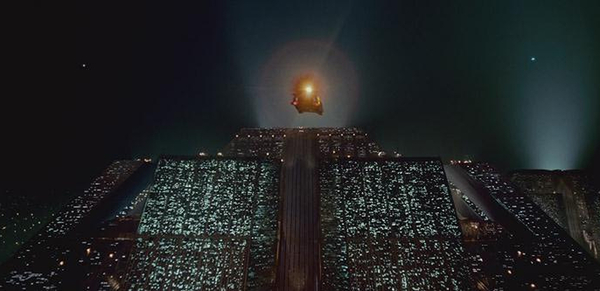
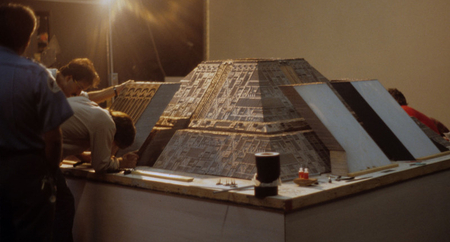
Tyrell Corporation Pyramid. Blade Runner (1982)
excerpt from the film «Blade Runner» (1982)