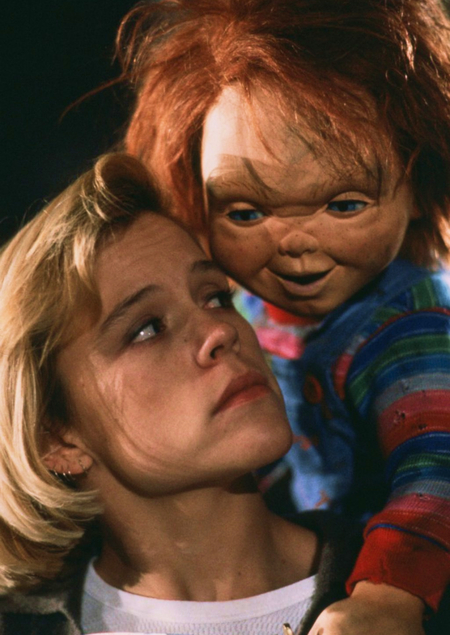
Concept
An animated doll must retain the appearance of a toy while being perceived as a being capable of seeing, speaking, and interacting with a human. Its believability is determined not by its resemblance to a person, but by the consistency of the doll’s body and its independent actions. The Chucky film series or Children’s Games allows for the exploration of this challenge using a specific, recognizable character.
This study focuses on the evolution of Chucky’s animation technologies between 1988 and 2019. The subject matter includes animatronic constructions, puppeteering techniques, digital tools for doll creation, and image processing. The core question is: how did changes in these technologies affect the character’s expressiveness and material believability? The hypothesis posits that Chucky’s development is related not only to the increasing complexity of the mechanisms but also to the redistribution of tasks among the physical construction, the puppeteers, and digital processing. Todd Masters describes the creation of the 2019 Chucky as «a full-scale doll build, like in the 1980s, but with some help from modern technology» [8].
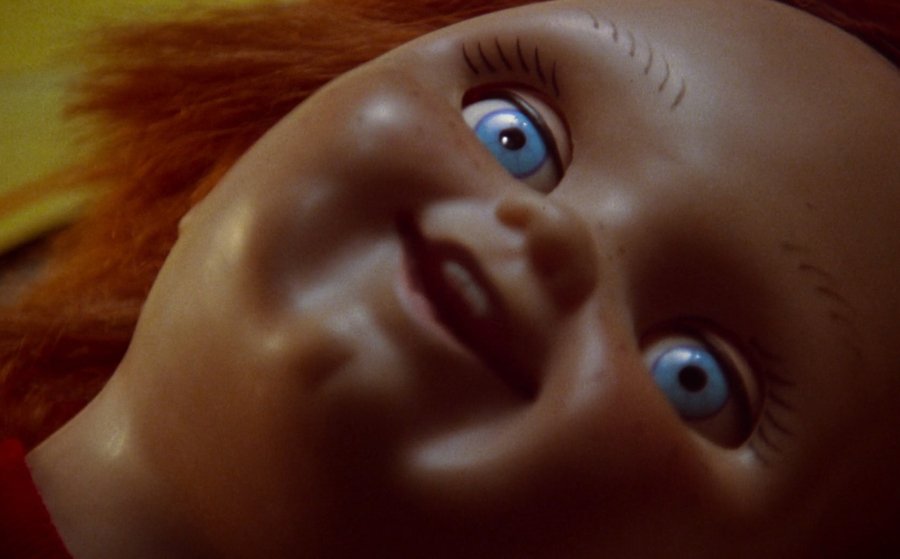
«Children’s Games» (1988), directed by Tom Holland
Tony Gardner explains another approach to combining techniques: «In some scenes, we can use rod puppetry, and then remove the rod or the puppeteer from the frame» [3]. These examples suggest that digital tools can be viewed not just as a substitute for practical effects, but also as a means to expand their capabilities.
The selection includes «Children’s Games» (1988), «Chucky’s Legacy» (2004), «Chucky Cult» (2017), and «Children’s Games» (2019). The selection was based on the availability of production materials regarding the construction and control of the dolls. The remake is examined as a distinct technological interpretation, not merely a continuation of the previous team’s work.The work is structured chronologically. Each section explores the on-screen challenge, the validated methods for solving it, and the final result captured in the footage. New examples are compared to previous ones using unified criteria: facial expressions, body control, and interaction with the environment. The visual material will consist of shots with similar actions, camera angles, and image scale. The filming materials will explain the mechanism’s design but will not replace an analysis of the finished film.
«Children’s Games» (1988), directed by Tom Holland (Kevin Yager and team)
The foundation will be specialist interviews, relevant publications, and documentary materials. Priority will be given to testimonials from direct participants; their names and titles will be verified. A design change will not automatically be considered technological advancement. The outcome will be identifying the connections between specific solutions, the doll’s available actions, and the persuasiveness of its presence in the frame. A later decision is not automatically assumed to be superior—that must be tested.
Creating an animatronic character
«The idea of the killer doll wasn’t new, but I realized no one had ever made the doll a fully realized character with dialogue and its own narrative arc,» said Don Mancini [4].
«Children’s Games» (1988), directed by Tom Holland (backstage)
«Children’s Games» (1988), directed by Tom Holland (backstage)
«Chucky’s Toy Games”—a horror film directed by Tom Holland where the toy doll Chucky becomes the central character and the focus of the special effects specialists. Kevin Yager was responsible for the development and creation of Chucky, and Howard Berger served as the shop team supervisor for the doll’s production. The special effects supervisor was Richard O. Helmer. Special effects experts who participated included Tom Savini, Alec Gillis, Shane Mohan, and Tom Woodruff.
«Children’s Games» (1988), directed by Tom Holland
«Children’s Games» (1988), dir. Tom Holland
The challenge for the effects creators was to transform the toy into a character capable of speech, changing facial expressions, and physically interacting with the actors. Kevin Jaeger was responsible for developing and manufacturing Chucky. The visual starting point was the drawings by producer David Kirshner, which the team used to create the 3D model and mechanical structures [4].
Drawing by Producer David Kirchner
The realization of the Chucky puppet involved several solutions: complex radio-controlled animatronics, wire and rod control, specialized mechanical models, and individual shots featuring an actor in costume. This division allowed the design to be tailored to a specific action, rather than demanding that a single mechanism provide equally convincing speech, gestures, and full-body movement.
«Children’s Games» (1988), directed by Tom Holland (props from set)
«Children’s Games» (1988), directed by Tom Holland (excerpt from a documentary)
Chucky’s face was operated by several performers. One puppeteer handled the eyes and blinking, another managed the eyebrows and cheeks, and a third controlled the mouth. Jaw movement was combined with separate lip articulation, which the operator achieved using small joysticks. Speech required coordinating the mouth opening with changes in lip shape. The facial expression depended heavily not only on the number of movable elements but also on the coordination of the puppeteers.
«Children’s Games» (1988), directed by Tom Holland (excerpt from a documentary film)
«Children’s Games» (1988), directed by Tom Holland (excerpt from a documentary film)
«Children’s Games» (1988), directed by Tom Holland (excerpt from a documentary)
For different actions, the team used various mechanisms. The radio-controlled version included small servo motors that powered the doll’s elements.
«Children’s Games» (1988), directed by Tom Holland (excerpt from a documentary)
«Children’s Games» (1988), dir. Tom Holland
«Children’s Games» (1988), directed by Tom Holland
In another version, motion was transmitted via cables from the control mechanisms to the body parts. The camera angle was specifically chosen so that the cables were not visible.
«Children’s Games» (1988), directed by Tom Holland (excerpt from a documentary)
«Children’s Games» (1988), directed by Tom Holland