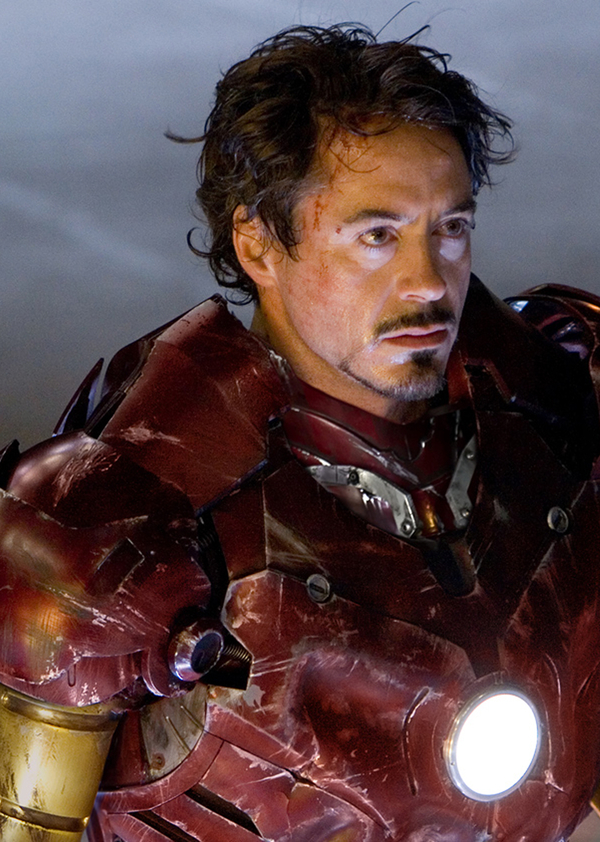
Concept
Films: Iron Man (2008), directed by John Favreau; Iron Man 3 (2013), directed by Shane Black.
The Iron Man armor is a fictional object that must appear as a genuine metallic construction. The viewer must believe that its plates have depth, that the components are joined together, and that there is a person inside. This impression is built through subtle cues: reflections, scratches, dark gaps between the plates, and how the armor’s collar sits in relation to the face.In the films Iron Man and Iron Man 3, this image is created in several ways. The actor might wear fabricated parts of the suit, which are then augmented with computer graphics. Alternatively, practical elements may be replaced by digital ones. Finally, the armor can be entirely created digitally.However, there is no simple boundary between these methods. A practical suit might be present on set but disappear from the final shot. Yet, it continues to influence the result: it helps define the armor’s volume, restricts the performer’s movement, and serves as a reference model for the digital surface.I am interested in how the balance between these technologies changed between 2008 and 2013. The first film already featured entirely digital armor. Therefore, the development cannot be explained solely by its appearance or the replacement of a practical suit with a computer model. It is crucial to understand what specific problems the digital armor solves in each film and how it maintains a convincing appearance.
Research Question: How have the methods of combining practical and digital armor evolved between the two films, and how has this impacted the rendering of metal, component connections, and the transition from armor to the actor’s bare face?
Hypothesis: The evolution of technology is demonstrated through the expansion of the digital suit’s capabilities. It must maintain its believability during partial assembly, human interaction, disassembly into components, and presence across diverse environments. Furthermore, physical prototypes retain their significance even when the completed armor is entirely digital.
A separate complication in comparison relates to suit design. The silver Mark II, the red-gold Mark III, and the predominantly gold Mark 42 present visually distinct appearances. The difference in color or sheen alone does not indicate a change in graphic fidelity. It is crucial to determine whether the surface corresponds accurately to the object’s device and the environment within a specific frame.
Table of Contents
1. Practical and Digital Armor: Task Distribution. 2. Metal Surface: Processing, Coating, and Damage. 3. Reflections: The Armor’s Relationship with the Surrounding Space. 4. Component Joints: Showing the Suit’s Construction. 5. Assembly and Partial Armor: Integrating Digital Elements with the Human Form. 6. Open Face: The Boundary Between Human and Suit. 7. Fully Digital Armor: Maintaining Believability in Complex Shots. 8. Conclusion. 9. Bibliography and Text Sources. 10. Image Sources.
1. Practical and Digital Armor: How Tasks Are Distributed
In the first film, the custom-built armor served several functions. It allowed the performer to be removed from inside the suit, displayed their actual dimensions, and provided a surface reference for the computer-generated version. The practical costume was not entirely metallic, however. Different materials were used for various sections. Parts that required mobility could be constructed from a more flexible material finished with a metal-like coating. The construction of the costumes took place at Stan Winston Studio under the direction of Shane Mahan.
«Iron Man, ” 2008. Work on the practical Mark I in Stan Winston Studio. Suit creation—Shane McMahon’s team. Filming documentation.
These photographs show the physical volume of the armor. The shoulders, torso, and helmet must not only match the intended image but also allow space for the wearer. The gaps between the elements are necessary for assembly and mobility.
However, the presence of a full suit does not solve all problems. Its weight, rigidity, and permissible poses limit what can be photographed.
Practical and digital versions of one object
«Iron Man, ” 2008. Practical Mark I in the cave exit scene. Stan Winston Studio; suit creation by Shane Mahan’s team. „Iron Man, ” 2008. Digital Mark I in the escape scene. The Embassy; VFX Supervisor Winston Helgason.
In both images, large plates, an uneven surface, and visible joins are preserved. It is the coincidence of these features that allows the practical and digital versions to be perceived as a single object.
The technological difference is established through the production documentation. It is not possible to reliably determine which version was used from a single finished image.
Digital details on the performer
«Iron Man 3,» 2013. Original footage of the Mark 42 assembly sequence: actor with tracking markers. «Iron Man 3,» 2013. Final shot with digital components of the Mark 42.
This pair presents the third option: a living person is retained in the image, and parts of the armor are added around them. Markers help reconstruct the body’s position. Then, digital elements are composited with the footage.
Conclusion: Both films already utilize different combinations of practical and digital elements. The focus for change should be on how the tasks are distributed between them.
Metal Surface: Processing, Coating, and Damage
Silver color alone does not make an object metallic. The shape and width of highlights, the unevenness of reflections, and fine traces of finishing are what matter. For Mark II in the first ILM film, the surface of finished metal was reproduced. One of the challenges lay in the directionality of the highlights: microscopic traces of finishing cause the surface to reflect light differently in various directions. This behavior is called anisotropic reflection.
Mark II Processed Metal
«Iron Man,» 2008. Mark II in the workshop. Digital armor — ILM; VFX Supervisor — Ben Snow.
Various light-colored areas are visible on the chest, shoulders, and helmet. They follow the contours of the surface, helping to communicate volume. Furthermore, the metal does not appear uniformly smooth across all components.
Mark III Colored Surfaces
«Iron Man, ” 2008. Mark III in the night sequence. Digital armor — ILM; VFX Supervisor — Ben Snow.
The red and gold sections are distinctly highlighted against the dark background. The light stripes on the surface reveal the curvature of the panels, while the dark gaps separate them from one another.
Compared to Mark II, it’s not just the color that changes. The suit has a different finish, so you cannot expect the same type of reflection from it.
Mark 42 Materials
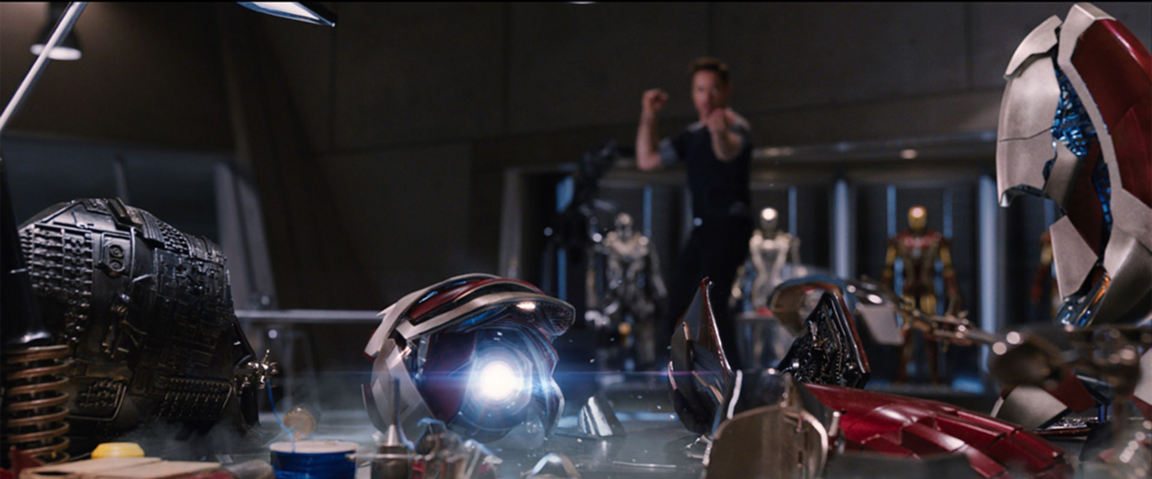
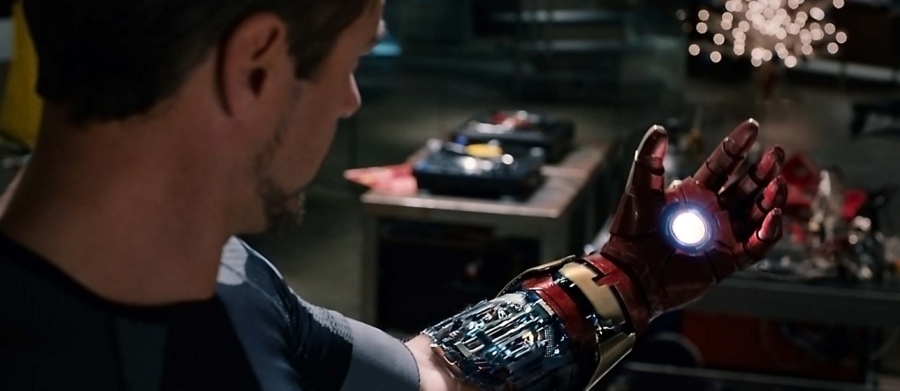
«Iron Man 3,» 2013. Digital Mark 42 glove in the workshop. Trixter; VFX Supervisor—Alessandro Cioffi. «Iron Man 3,» 2013. Mark 42 parts before assembly. Trixter; VFX Supervisor—Alessandro Cioffi. Final frame.
1