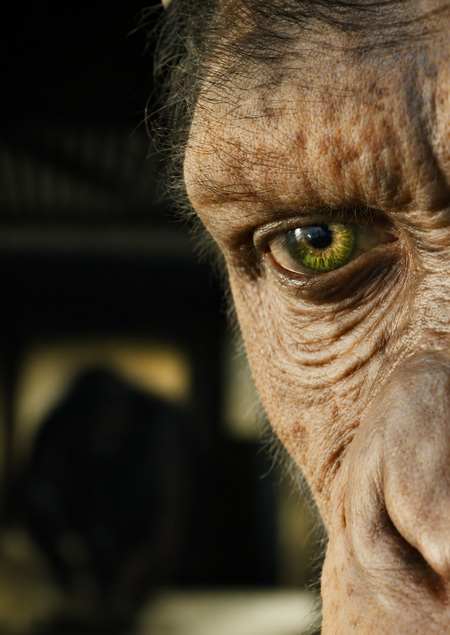
Andy Serkis played Caesar in all three films, and Weta Digital created his digital likeness. In this study, I will trace how the team transferred the actor’s facial expressions onto the chimpanzee’s face and how changes in the modeling and animation refined the close-ups of Caesar.
The reboot of «Planet of the Apes» began with the idea of screenwriters and producers Rick Jaffa and Amanda Silver. Jaffa collected newspaper stories about chimpanzees that people tried to raise at home and about the difficulties the animals faced in captivity. These stories gave the screenwriters a starting point: showing Caesar in a human family, and then tracing how he realizes his place and becomes the leader of the apes. With this concept, they approached 20th Century Fox studio.Rupert Wyatt directed «Rise of the Planet of the Apes» (Part 1, 2011). Matt Reeves directed the two sequels, «Planet of the Apes: Revolution» (Part 2, 2014) and «Planet of the Apes: War» (Part 3, 2017). The Weta Digital team created the digital Caesar in all three films. Since the story revolved around him, the model had to withstand close-ups and look convincing next to the live actors.
The main research question
I became interested in how Caesar looks more and more believable in the frame with each film. Using one character as an example, I can trace how his 3D model, skin movement, and fur detailing have changed. I want to understand which of these changes are noticeable in the final shots and what makes the digital chimpanzee appear alive.
Navigation
1. Creating the face of Caesar. 2011
2. Transferring acting skills to a live stage. 2014
3. Facial expression in a dramatic close-up. 2017
The most significant technological changes occurred in the first two films. In «Rise of the Planet of the Apes» (Part 1, 2011), Weta Digital created a digital model of Caesar complete with muscle and soft tissue simulation. In «Planet of the Apes: Revolution» (Part 2, 2014), the team substantially refined the facial animation system, including the mouth shapes required for speech and ape vocalizations. I will focus more closely on these two films.For «Planet of the Apes: War» (Part 3, 2017), the team improved the already established model: they enhanced the fur simulation and added details that conveyed Caesar’s age—deep wrinkles, graying, and scars. In the close-ups, I will demonstrate how these enhancements affected his appearance.
Sources
The research is based on footage from three films: Rise of the Planet of the Apes (Part 1, 2011), Planet of the Apes: Revolution (Part 2, 2014), and Planet of the Apes: War (Part 3, 2017). For comparison, I have selected close-ups of Caesar, focusing on the facial structure, skin movement, and how the fur appears under different lighting conditions.To trace how these shots were created, I utilized behind-the-scenes videos and visual effects breakdowns from YouTube. These clips demonstrate various stages of the process—from digital anatomy and facial deformation tests to integrating the model into the filmed scene.I further clarify the technical details using materials from Weta FX and interviews with production members. For example, the team discusses changes in facial animation in the Ape Acting article on fxguide, while in the Rise of the Planet of the Apes: Dan Lemmon — VFX Supervisor interview on The Art of VFX, Dan Lemmon explains how muscle, fatty tissue, and skin interaction were modeled in the first film. These sources help connect what is visible in the frame with the specific decisions made by the production team.
Creation of Caesar’s Face. 2011
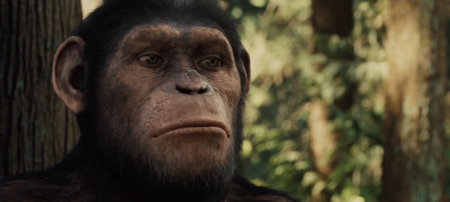
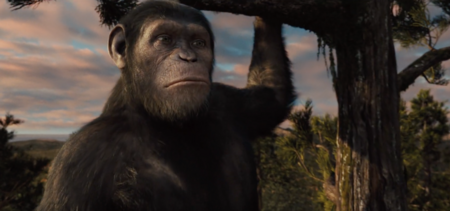
Stills from the film «Rise of the Planet of the Apes.» 2011. Directed by Rupert Wyatt. Lead Visual Effects Supervisor Joe Letteri (Weta Digital Computer Animation Studio)
In the film «Rise of the Planet of the Apes» (Part 1, 2011), the Weta Digital team created Caesar in several stages.
- Chimpanzee study
- Building digital anatomy
- Creating skin texture
- Developing fur
- Detailing eyes and facial expressions
- Animating the model
3D model. Footage from interviews about the film’s creation (see sources p.1)
The team at Weta Digital, while working on the digital Caesar for the film «Dawn of the Planet of the Apes» (Part 1, 2011), began by observing chimpanzees at the Wellington Zoo. According to Weta Digital VFX Supervisor Christopher White, the artists studied how the apes moved, changed their expressions, and how their muscles functioned during these movements. Based on these observations, the team constructed a multi-layered 3D model: beneath Caesar’s skin were his skull, muscles, and soft tissues, which determined how the face would change shape during movement.
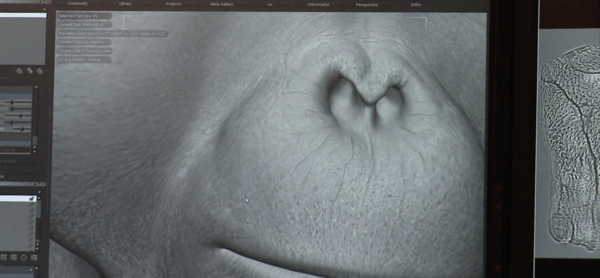
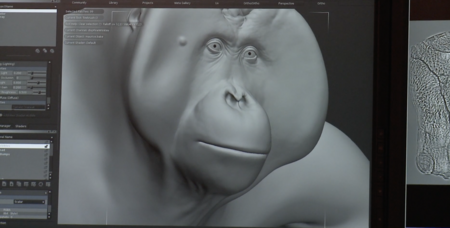
Jinho Acevedo is the Texture and Digital Creature Artist at Weta Digital. Stills from an interview about the film’s creation (see sources p.1)
Nicolas Gole is a leading specialist in creating and styling digital fur at Weta Digital. Footage from an interview about the film’s creation (see sources p.1)
The texture department focused on pores, wrinkles, and skin folds, while a separate team worked on fur. In the Barbershop program, artists brushed the fur, altered its growth direction, and corrected individual hairs when necessary. To develop the gaze, the team consulted with an ophthalmologist to understand how the eyes and eyelids move during blinking and how tears are held at the lower eyelid margin.
Stills from the film «Planet of the Apes Rebellion.» 2011. Director Rupert Wyatt. Lead Visual Effects Supervisor Joe Letteri (Weta Digital computer animation studio)
Andy Service as Caesar. The use of motion capture technology Stills from the film creation interview (see sources p.1)
In the animation of Andy Serkis’s movement, the proportions were adapted to those of Caesar. This work is particularly noticeable in the scenes with the infant, where it was necessary to convey the weight and movements of the small chimpanzee.
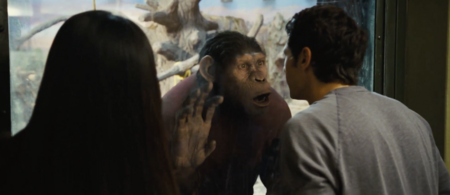
Stills from the film «Rise of the Planet of the Apes.» 2011. Directed by Rupert Wyatt. Lead Visual Effects Supervisor Joe Letteri (Weta Digital).
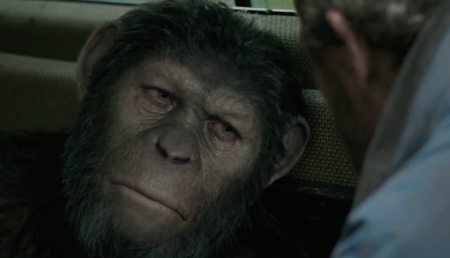
In the film «Rise of the Planet of the Apes» (Part 1, 2011), one of the main challenges was making Caesar’s face believable in a close-up. The Weta Digital team needed to maintain the chimpanzee’s anatomy while ensuring his emotions were understandable to the viewer. The scene involving the glass was also complex: upon contact with the surface, the soft tissues had to compress, and the skin had to shift along the glass. To achieve this, the team modeled the glass and calculated the facial deformation upon contact.
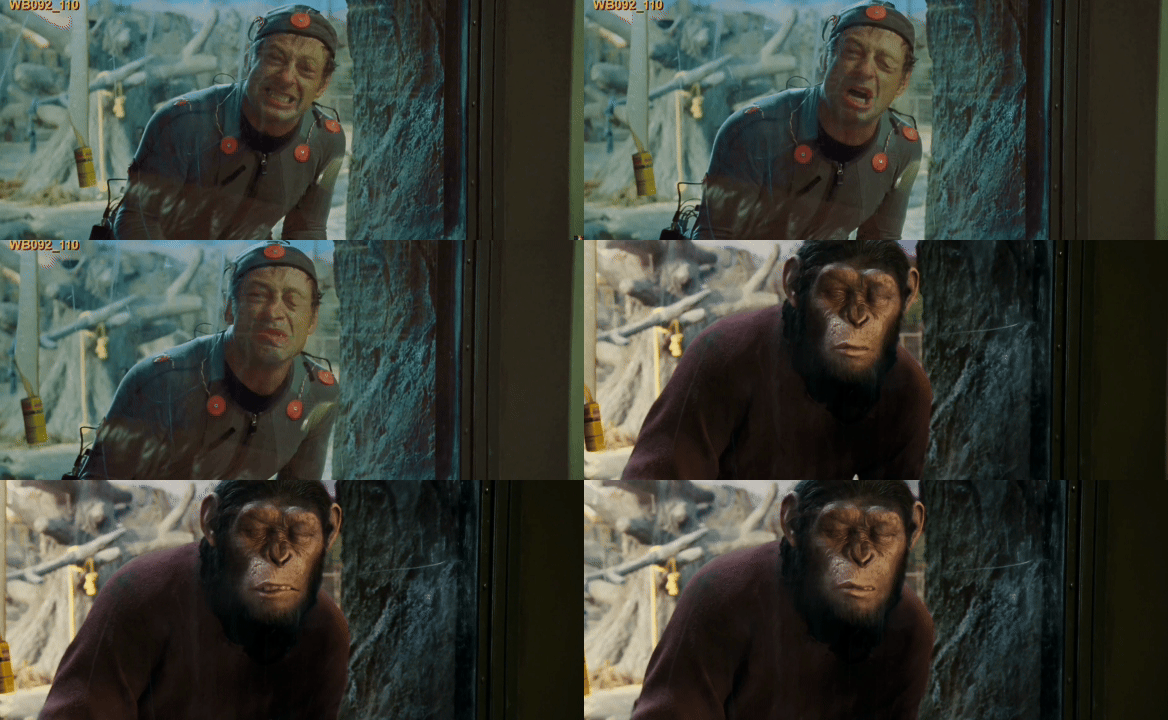
Behind-the-scenes photos from interviews about the film’s creation (see sources p.1)
Frame from the film «Planet of the Apes» (2011). Directed by Rupert Wyatt. Lead Visual Effects Supervisor Joe Letteri (Weta Digital Computer Animation Studio).
In my view, the first model has some shortcomings, even though overall it is executed with quality. The light fur helps to understand where Caesar is looking, but it gives his gaze a more human quality. Another debatable point is the transition from exposed skin to fur. In some close-ups, if you look closely at the temples and cheeks, questions arise about how smoothly the sparse hairs at the edge of the face transition into thick fur and how this boundary appears in the light.
Transferring acting to a natural setting. 2014
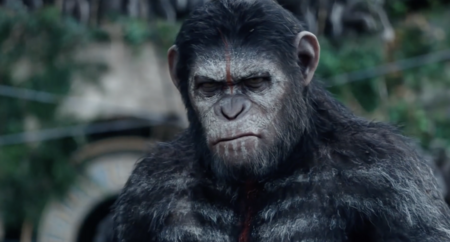
Still from the film «Planet of the Apes: Revolution.» 2014. Directed by Matt Reeves. Senior Visual Effects Supervisor Joe Letteri (Weta Digital computer animation studio).
In the film «Planet of the Apes: Revolution» (Part 2, 2014), Caesar appears older, slightly bulkier, and grayer. As VFX Supervisor Joe Letteri explains, these changes reflect the ten years that have passed in the storyline. A more significant technical refinement involved facial animation. Since Caesar speaks more frequently, the Weta Digital team developed separate mouth shape libraries for human speech and for chimpanzee vocalizations.
Weta Digital enhanced the facial solver—a program that translated the movements of Andy Serkis’s facial points into commands for the digital model. The recordings were stabilized and filtered, and then this data determined which facial shapes (blend shapes) needed to be mixed and how Caesar’s muscles should move. Thus, the actor’s lip movements were transformed into motions suitable for the chimpanzee’s muzzle, complete with its proportions and jaw structure.
A frame from the VFX breakdown by Weta Digital (see sources p.2)