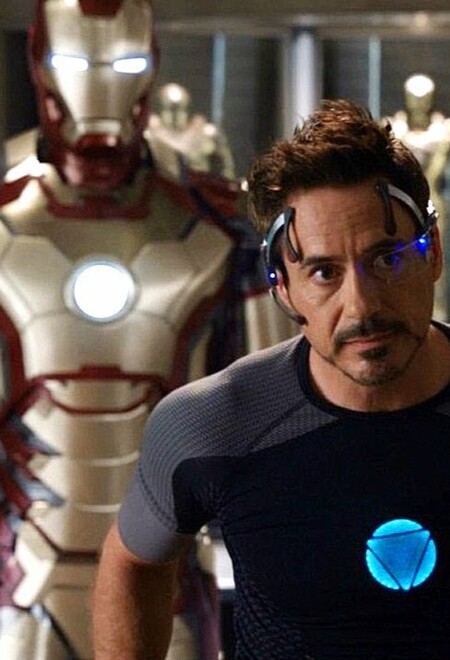
Navigation
[1] Concept [2] Iron Man (2008) [3] Iron Man 3 (2013) [4] Comparison of Technologies in the Two Films [5] Conclusion
[1] Concept
Iron Man’s armor is an interesting example of how computer graphics gradually transformed from a supplemental effect in filming into a full-fledged character creation tool. Tony Stark’s suit is a complex metallic apparatus. His suit features movable joints, large panels, illuminated elements, and intricate mechanisms. This structure must move naturally with the actor, reflect the environment, and integrate seamlessly into the overall visual picture.
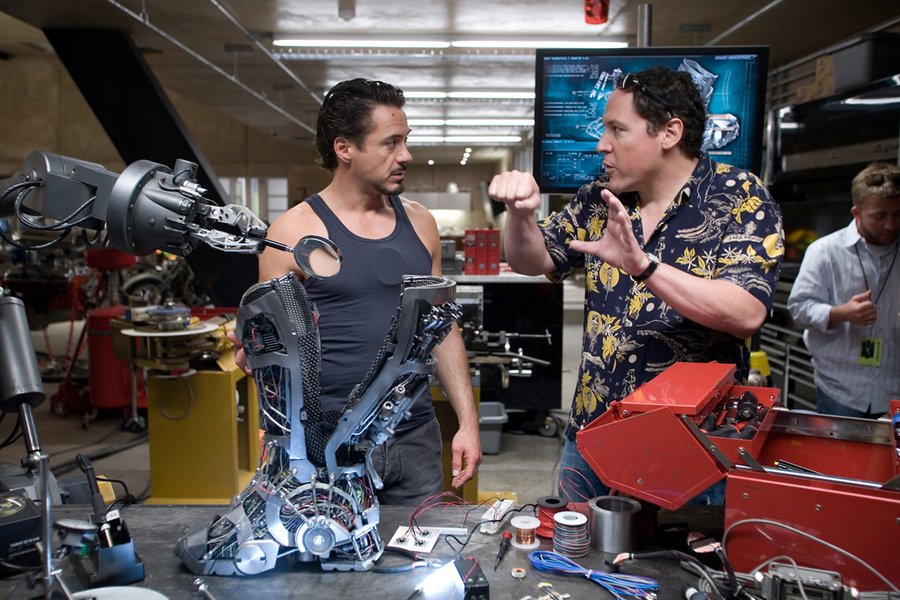
Iron Man (2008) Robert Downey Jr., Jon Favreau
To achieve a similar effect, it is not enough to create a 3D model; you must develop its geometry, materials, animation, lighting, and interaction with the set. Therefore, the work on the armor included several stages: modeling, texturing, rigging, animation, rendering, and compositing.
This study examines two Marvel films: Iron Man (2008) and Iron Man 3 (2013). They are well-suited for this comparison because five years elapsed between their releases—a period during which the approach to creating digital suits evolved. In the first installment, practical armor models were integrated with computer graphics, whereas in the third, the digital suits became a more complex construction capable of achieving visualizations that could not be reproduced with conventional physical props.
The goal of this research is to trace how the technologies for creating Tony Stark’s armor have evolved and to determine the role that the advancement of computer graphics has played in this process.
«Iron Man 3» (2013) Robert Downey Jr., Paul Bettany
Hypothesis: Over five years, digital armor has transitioned from being a predominantly supplementary element augmenting real costumes to becoming a self-contained, animatable object with complex construction and autonomous behavior.
[2] «Iron Man» (2008)
In the first film, the creators needed to convincingly portray the armor as a physical object: it had to look massive, metallic, and visually convey technical complexity so that the viewer would believe in its engineering. To achieve this, the team utilized real costumes fabricated by Stan Winston Studio; these models were used directly on the set. The actor could interact with individual components of the armor, and the camera captured the reflections, shadows, and surfaces. This method helped preserve the sensation of the costume’s physical presence within the frame.
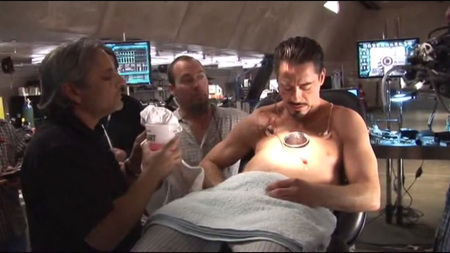
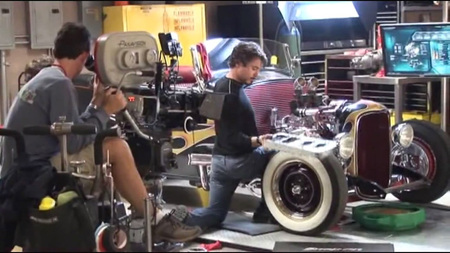
«Iron Man» (2008) Robert Downey Jr. / «Iron Man» (2008) Robert Downey Jr.
However, a full suit restricted the actor’s movements, and some scenes required complex actions that were difficult to capture using physical props. For example, flight sequences, rapid movements, and intricate fight scenes were augmented with computer graphics. Industrial Light & Magic (ILM) Studio handled the primary work on the digital versions of the armor and the flying sequences. The project’s official page states that the studio created over 400 frames with visual effects, a significant portion of which was directly related to the Iron Man suit.
To integrate the actor with the digital armor, the Imocap system was used. Robert Downey wore a specialized suit with markers that allowed specialists to track his position and movements, enabling the digital model to be matched more precisely to the actor’s body.
It is important to distinguish between motion capture and tracking. Motion capture allows an actor’s movements to be transferred to a digital character. Tracking is used to monitor the position of objects or a camera in space. In the case of «Iron Man,» these tools helped the specialists achieve the correct alignment between the actor and the digital armor. The Imocap system, described in the ILM materials, was a specialized solution used during filming to create a digital version of the suit.
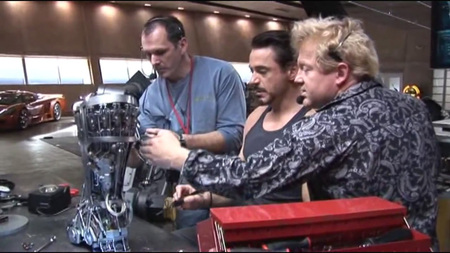
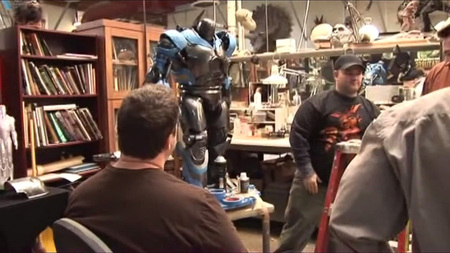
«Iron Man» (2008) Robert Downey Jr. / «Iron Man» (2008)
Iron Man (2008) Robert Downey Jr.
One of the primary technical challenges was ensuring that the real and digital parts of the armor looked identical—so that if a viewer saw the physical suit in one shot and its computer-generated version in another, the difference would not be noticeable. To achieve this, the specialists created 3D models of the armor: during the modeling phase, the suit’s form, individual metal plates, joints, and other components were refined. Next, materials and textures were created to define the surface appearance, but it was crucial to convey the characteristic metallic sheen and the overall sense of the physical suit’s presence in real life. After modeling and texturing, the digital model was used in animation; specialists configured the armor’s movement, and then rendering was performed—the process of generating a final image from the 3D scene. Finally, the digital elements were composited with the filmed material.
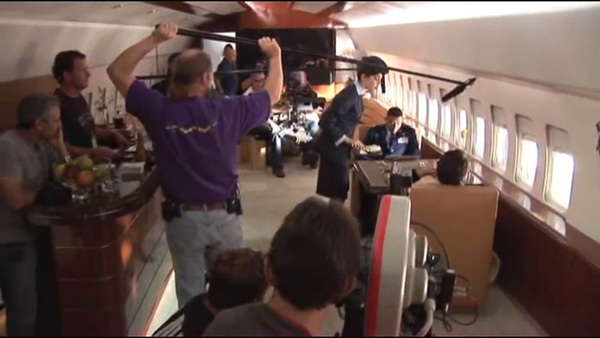
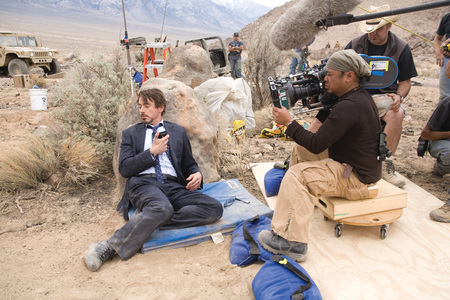
Iron Man (2008) Terrence Howard, Robert Downey Jr. / Iron Man (2008) Robert Downey Jr., Matt Liebatick
Iron Man (2008) John Favreau
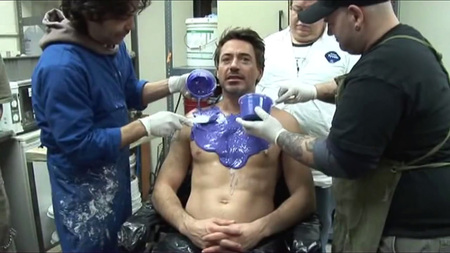
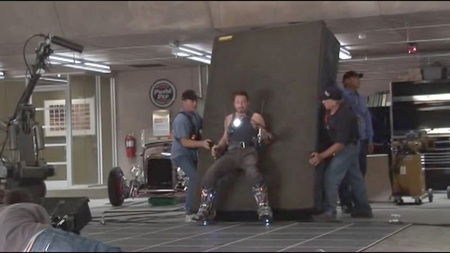
Iron Man (2008) Robert Downey Jr. / Iron Man (2008) Robert Downey Jr.
In Jody Duncan’s article, «Iron Man: The Man in the Iron Mask, ” published in Cinefex Issue 114, the collaborative work of Stan Winston Studio, Industrial Light & Magic, and The Orphanage is also noted. The material description specifically mentions Visual Effects Supervisor John Nelson, yet the ILM page lists Ben Snow as the studio’s Visual Effects Supervisor. Ultimately, the first Iron Man employed a blended approach: physical costumes facilitated interaction with the actor and the environment, while computer graphics expanded the scope of the filming. The digital armor primarily mirrored the structure of the physical costume but allowed for the portrayal of more complex movements and scenes.
[3] «Iron Man 3» (2013)
Iron Man 3 (2013) Robert Downey Jr.
Iron Man 3 (2013) Robert Downey Jr.
By the time the third film was released, computer graphics were being used much more actively; we can see this in the creation of the Mark 42 armor. Unlike previous suits, its individual components could move independently in space and then assemble around Tony Stark’s body. This construction required more complex work with 3D modeling and animation because specialists now had to design not only the physical appearance of each part but also its behavior—determining its trajectory, the moment it connected with other elements, and its final position within the assembled structure.
Several studios participated in the creation of the digital armor: Digital Domain was responsible for the initial design development and modeling of Mark 42; Scanline VFX and Trixter also created their own digital versions of the suit for specific scenes. To ensure the armor maintained a consistent look across different episodes, the studios exchanged model files in OBJ format, material settings, and animation solutions.
«Iron Man 3» (2013) Robert Downey Jr.
We also want to highlight the work on the scene where parts of the suit fly toward Tony Stark on their own. Trixter was responsible for this creation. FXguide notes that for this scene, the suit was divided into 24 pieces, and each piece had to move independently before settling into its final position. Initially, the specialists developed a preliminary visualization of the scene—a previsualization (previs). This allowed them to determine the main movements, object placement, and a rough sequence of actions in advance. Following this, the final digital models and animation were created. We would also like to point out the importance of rigging, which is the preparation of a digital model for animation. The specialists created a system of control elements that allowed animators to move individual parts of the armor and control their behavior. In addition to the complete suit, work had to be done on individual details that needed to behave like independent objects. For the assembly scene, Trixter used Maya and RenderMan, and later Katana was incorporated into the production process for lighting work. 3ds Max and FumeFX were used for additional effects, and individual element rendering was performed using V-Ray.