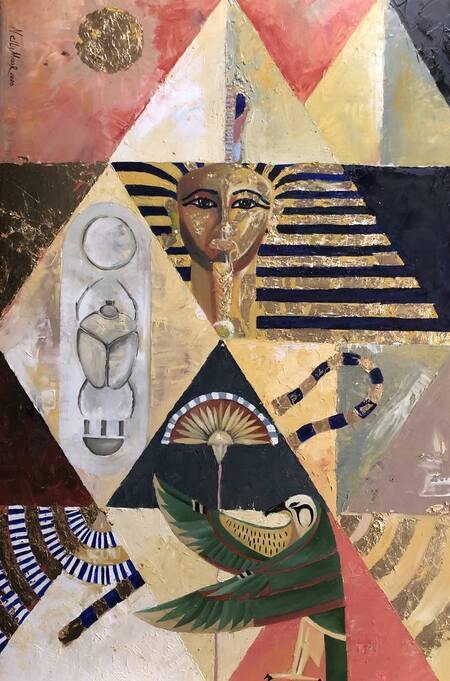
Concept
Starting in the Renaissance, perspective became considered the «correct» way to depict the world, and everything preceding it is often described as inept. Ancient Egyptian relief and painting followed a different, rigid system for almost three millennia: the subject was depicted as it was known, not as it appeared from a single viewpoint. In the early 20th century, Cubists also rejected the single viewpoint, and their work sometimes resembles Egyptian art superficially.
However, superficial similarity of the techniques does not mean they are based on the same principles or serve the same functions.
Therefore, the comparison in this paper is structured across three levels: the technique (what we see in the image), the principle (what this technique is based upon), and the function (what the image was created for and for whom). The primary subject of analysis is Egyptian art; Cubism serves as a contrasting backdrop, allowing the specificity of Egyptian imagery to become clearer. This is not a discussion of influence—the Cubists drew inspiration from Cézanne, African and Iberian sculpture, not Egypt.
Research Question
What lies behind the «invisible» Egyptian imagery when compared to superficially similar Cubist techniques?
Thesis
The techniques only coincide on the surface.
Egyptian perspective is a universal canon that renders an image complete, recognizable, and immutable—because it must remain effective and identifiable, whether in a tomb, a temple, a royal monument, or a domestic shrine. Cubism, on the other hand, is an individual experiment that investigates the process of vision itself and is aimed at the contemporary viewer. A similar form, yet opposite principles and functions. It is important to note that Egyptian imagery was not solely created for tombs: the same rules apply to temple reliefs, royal monuments, and domestic cult objects, such as the Amarna altar. Therefore, the focus is on the function of the Egyptian image as a whole—to render what is depicted complete, clear, and enduring—not merely its funerary function.
Rubrication Principle
1. Composite figure 2. Object from the main side 3. Flat space 4. Grid
Typology of Techniques. Each chapter begins by analyzing Egyptian material, followed by a Cubist parallel, and concludes with a comparison of the technique across three levels. Material: reliefs and paintings from Ancient Egypt, spanning the Early to New Kingdoms (c. 3100–1300 BCE), and Cubist paintings from 1907–1921.
Introduction. Two Visual Systems
Fig. 1. Narmer Palette, obverse and reverse sides. Circa 3100 BCE. Alabaster. Egyptian Museum, Cairo.
On the Narmer palette, the Egyptian system is fully established: a composite figure, horizontal registers, and figures sized by value. From this point on, it will remain almost unchanged for about three thousand years. This is not a «pre-perspective» stage, but a complete visual language. Egyptologist Emma Brunner-Traut called it «aspectivity"—the object is broken down into aspects, and each is shown from the side from which it is easiest to recognize.
Fig. 1a. Narmer Palette, side depicting the vanquishing of the enemy. Circa 3100 BCE. Egyptian Museum, Cairo.
On this side of the palette, the king occupies almost the entire field height and is depicted according to the same rules as thousands of years later: profile head, spread shoulders, and legs in a side-stepping stride. Above the scene is the king’s name within a cartouche, inscribed with Sumerian and chisel signs: the image and the inscription existed together from the very beginning. The location where the palette was found is also important—in a temple treasury in Hierakonpolis, not in a tomb. This suggests that the iconographic rules were at work from the start, not only in funerary art.
Chapter 1. The Composite Figure
Fig. 2. Hesy-Ra’s Panel from the Mastaba of Hesy-Ra at Saqqara. 3rd Dynasty, c. 2650 BCE. Cedar. Egyptian Museum, Cairo.
The head of Hesyros is presented in profile: this allows for the clearest view of the forehead, nose, and chin. The eye is depicted entirely, frontally, because it loses its form in profile. The shoulders are spread wide toward the viewer, and the legs are once again in profile to show the step. What we see in front of us is not a person in a single pose, but several different perspectives of him unified into one figure.
Fig. 2a. Hesira Panel, detail: head
In a close-up view, the system is even clearer. The eye is integrated into the complete profile face, as if we are looking directly at the face, while the line of the eyebrow, nose, and lips is rendered strictly from the side. The transition between the two projections is smoothed out—the eye is «built into» the profile so naturally that the viewer doesn’t notice any contradiction.
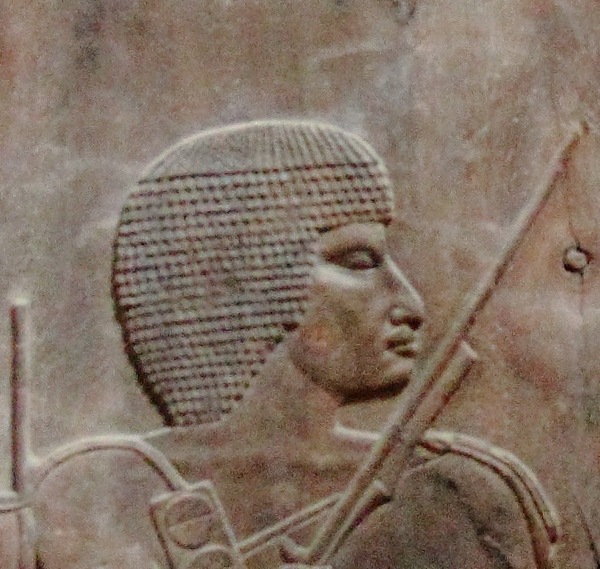
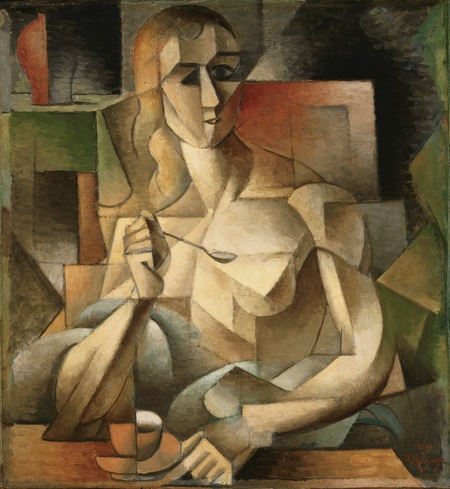
Comparative spread. Left: Hesira (detail). Right: Illus. 6a. Jean Metzinger. «Afternoon Snack.» 1911. Cardboard, oil. Philadelphia Museum of Art
Similarity
In both images, one object is shown from two sides simultaneously. In Metzenge’s work, the teacup in the woman’s hand is drawn halfway from the side and halfway from above.