1988 marks the centenary of the series of murders committed by Jack the Ripper in the impoverished Whitechapel district of London. A century later, the killer’s image had become mythologized due to widespread coverage in mass culture. It was in this year that Alan Moore, one of the most influential comic book writers, set out to investigate this phenomenon.
«From Hell» is a comic written by Alan Moore and illustrated by Eddie Campbell. Published between 1989 and 1998, it has become one of the most significant works in the horror genre. The story is based on the real events of the series of murders committed by Jack the Ripper in late 19th-century London, but its primary goal is something different—something hidden within its multilayered narrative.
Alan Moore, who conducted an extensive study of the era, had previously created iconic works such as «Watchmen, ” „V for Vendetta, ” „Batman: The Killing Joke, ” and many others. Eddie Campbell, an independent Australian artist known for his raw and realistic drawing style, teamed up with him in this symbiosis to create a project that received the International Horror Guild Award for Graphic Story/Illustrated Narrative in 1996.
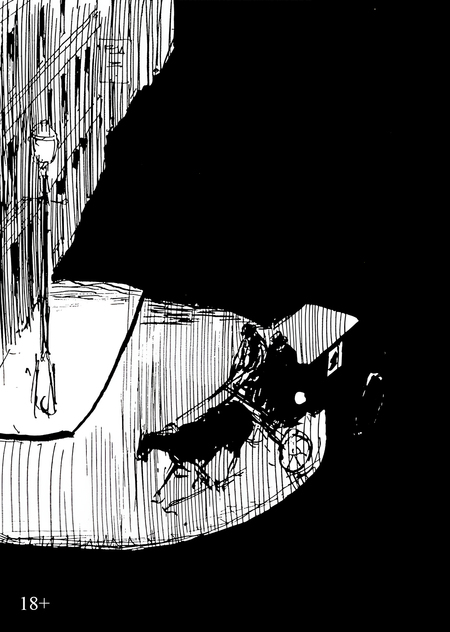
Alan Moore, Eddie Campbell. From Hell. Chapter 5
This is more than a detective story—the comic transports the reader to the grim alleys of Whitechapel, but it does so not to glorify the bloody figure of Jack the Ripper, but to explore gender inequality and Victorian society. The crimes were merely a consequence of a corrupt and patriarchal system that allowed the killer to go unpunished.
«From Hell» is more an examination of the Ripper phenomenon and the Victorian era itself than just a story about him.
«Murder is a small apocalypse… when social restrictions, all the world’s barriers suddenly collapse, and something extremely powerful and primal occurs, capable of influencing society and causing a ripple. It occurred to me that if one observes such an intense human event as murder in sufficient detail, one can draw broader conclusions about the world in which it took place, ” Alan Moore said in an interview for What DVD in 2002.
In this visual study, I will examine how Alan Moore and Eddie Campbell convey a sense of dread through the comic book pages; how the image of Jack the Ripper evolves under the influence of theories developed across a century of discussion and attempts to explain the killer’s psychology; how historical horrors resonate with contemporary social issues and help reveal the realities of late 19th-century England; and how the concept of time impacts the perception of history.
Sources included interviews with the author, articles from authoritative publications, literature, and critical essays.
1. Jack the Ripper as a symbol of the horror of mythological Victorian England
Alan Moore, Ed Brubaker. From Hell. Chapter 2
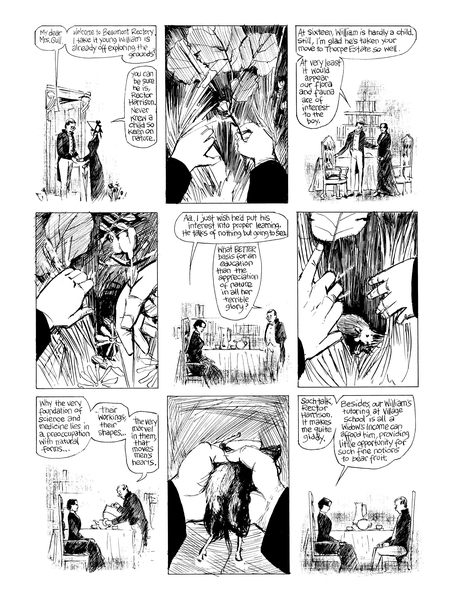
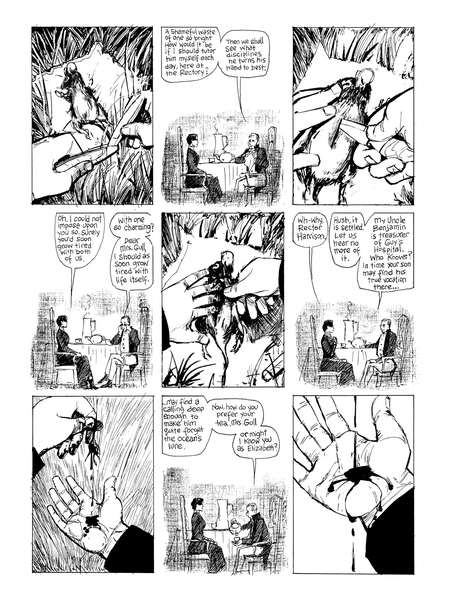
Jack the Ripper—a persona created much later. Initially, the comic narrates the life of a man (a killer?) fragmentarily—his hands and brushes are shown during meticulous autopsies, and he advances up the career ladder. One such episode is a frightening childhood memory involving the dissection of a dead mouse, and it then becomes clear that we are witnessing the formation of a killer. Later, William’s identity is revealed, but not his face.
Thanks to this meticulous narrative construction, the ultimate revelations about the character have a maximum psychological impact at the edge of horror, especially the moment his appearance is unveiled.
Alan Moore, Eddie Campbell. From Hell. Chapter 2
William Gale’s face is first revealed when he encounters a figure who signals the beginning of a dreadful tale—a young woman, the secret wife of the heir to the English throne, confined to a psychiatric clinic. This symbolic moment marks his transition from an anonymous doctor to a central figure in the narrative.
From this point on, his role becomes crucial to the plot of «From Hell,» and he cannot remain in the shadows. William’s identity becomes inextricably linked to the escalating horror.
Alan Moore, Eddie Campbell. From Hell. Chapter 2
The police are attempting to personalize the killer—creating a false persona named «Leather Apron.» This fabrication serves a single purpose: to redirect the residents' fear and anxiety toward a specific individual (even if that person is innocent), rather than toward the police department as a whole. Previously, the killer was depersonalized, representing a force threatening the entire city.
Fear has become a subject of manipulation, and through this false personalization, authorities can divert attention from their own ineffectiveness while maintaining public calm.
Alan Moore, Eddie Campbell. From Hell. Chapter 6
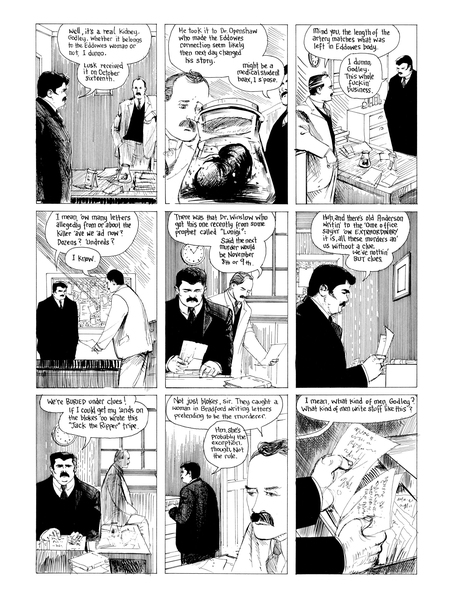
With the absence of real suspects and the police’s inability to track down the killer, a process of mythologizing begins, leading to the creation of a false persona—the «Jack the Ripper.» This name, first mentioned in one of the fabricated anonymous letters, becomes a symbol of evil and horror that extends beyond actual crimes.
It is worth noting that the victims are women of a different social class than the characters fabricating the killer’s identity. The [journalists] were initially safe, which allowed them to amplify fear among London’s low-income residents without fear for their own lives.
Alan Moore, Eddie Campbell. From Hell. Chapter 7
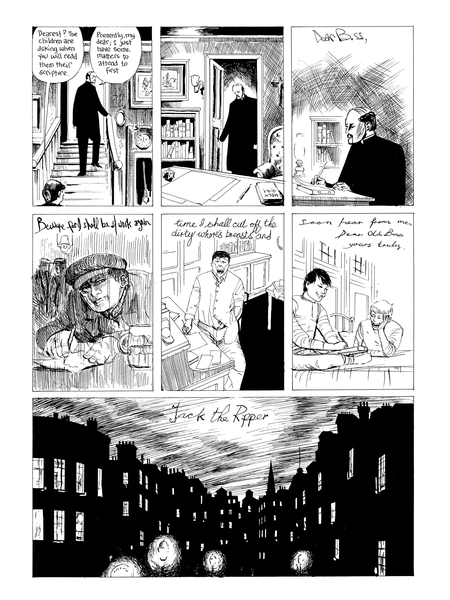
«Who are these people writing those terrifying letters?» Inspector Eberline asks in the comic strip. But it’s literally everyone around us—the ones we least suspect. This question is followed by panels where the hero’s conversation partner goes home to his family, and then sits down at his desk to write texts that seem to have come from a murderer. Colleagues, friends, loved ones—there is something dark within each of them that they carefully conceal.
The character who initially seems like an ordinary person turns out to be connected to the very actions the inspector is trying to investigate. He may not be the killer, but he becomes a part of the crime by creating the horrifying letters, thereby intensifying the atmosphere of fear gripping the city. Thus, «Jack the Ripper» is not only William Gall the murderer but also society itself, which becomes his accomplice by mythologizing his deeds.
«To glimpse the darkest moment of a soul, capture that moment and fill it with ink, ” — a review on Bookidote.
Alan Moore, Ed Brubaker. From Hell. Chapter 9
In Stephen Knight’s book, «Jack the Ripper: The Final Solution,» the theory is put forward that the five murdered women were victims of a meticulously planned conspiracy. According to this version, the murders were orchestrated by Freemasons aiming to conceal the existence of an illegitimate heir to the royal family, and the royal surgeon William Gall was the executor of this plan.
Alan Moore, inspired by Knight’s book, described his initial impressions: «As soon as I read the intricate and unbelievable claims in Knight’s book, I thought, 'There is something to this.' Then I read everything I could find on the subject and began putting it all together in this massive structure.» Over time, the comic evolved beyond Knight’s theory, transforming into a multi-layered narrative. «I incorporated all sorts of things into the story—London’s architecture, Masonry, Dionysian architects, patterns in time… and as the story expanded, so did my understanding of the murders.»
This theory, now entirely discredited, allowed the author not only to delve into the atmosphere of the Victorian era but also to expand the boundaries of contemporary paranoia, underscoring its influence on society and the perception of horror.
Alan Moore, Eddie Campbell. From Hell. Chapter 3
However, «From Hell» is a work of fiction, and because it is originally based on a flawed theory, the author took considerable liberties—adding context to heighten the sense of dread. Fiction grants the author the freedom to explore themes that might be inaccessible within a strictly documentary narrative.
Each murder becomes part of a larger design linked to the architecture of London and sacred geometry. Whitechapel, plagued by a series of brutal murders, symbolizes Victorian society, where real danger stems not from marginalized groups but from the system itself—a system that has legitimized its dominance through fear.
Alan Moore for What DVD: «Actually, I was dumbfounded and amazed by the number of confirming ‘evidence’ that emerged to support my ‘theory, ’ precisely because I knew it wasn’t a theory—it was fiction. I really didn’t want to dip my toe into the alluring pool of ‘truth, ’ because truth is a well-documented pathological liar. A self-proclaimed invention, on the other hand, is absolutely honest—it states, ‘I am a liar.’»
William Gall, consumed by Masonic ideas and immersed in his own madness, imbues his murders with the symbolism characteristic of secret doctrines. After yet another crime, he writes on the wall: «Iuva—not those unjustly blamed.»
In the book Magical Pantheons: Gods of Western Esoteric Teachings, by Shika Ciceron and Sandra Tabaty Ciceron, the symbolism of this name—Iuva—is discussed: it is elevated to the Latin verb iubere, which means «to command.» Similar names, Iuvelo, Iuvela, and Iuvelum, are mentioned in the comic during the ritual.
This symbolism can be interpreted in two ways. On one hand, Gall elevates himself to the role of a «master» within his madness—one capable of dictating destinies. On the other hand, his self-identification with Iuva might indicate an attempt to absolve himself of responsibility for the murders. By disowning his actions and placing them upon some higher power, he seems to be seeking justification within the framework of his manic ideology.
His acts, wrapped in philosophy, transform Jack the Ripper into something more than a man—an embodiment of the dark side.
Alan Moore, Eddie Campbell. From Hell. Chapter 2
Alan Moore, Eddie Campbell. From Hell. Chapter 8
Queen Victoria herself, within the mythology created by Mur, is depicted as a symbol of ultimate power that upholds Freemasonry—a secretive society endowed with limitless authority and concealment. If the head of state stands behind this, whom can one truly trust?
Mur uses this concept not only to reconstruct the Victorian era but also to demonstrate how mythology surrounding power and clandestine alliances transforms public consciousness, causing people to fear not only criminals but the system itself.
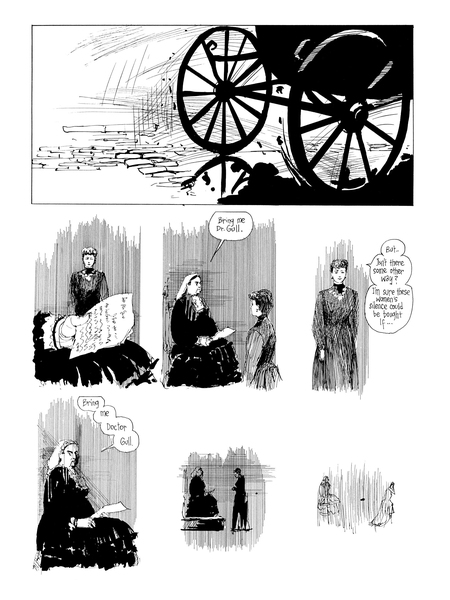
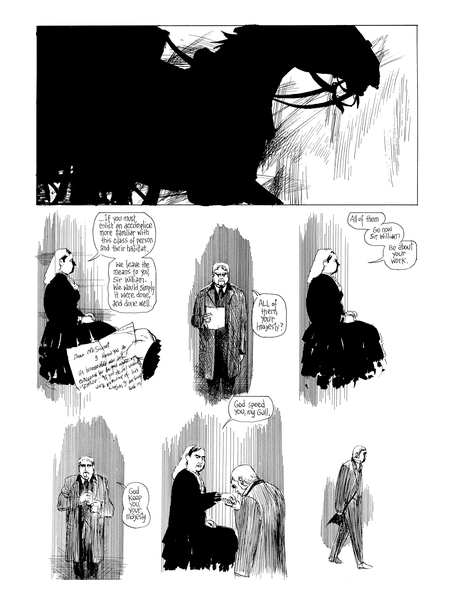
Alan Moore, Eddie Campbell. From Hell. Chapter 4
William led a tour, meticulously describing the city streets, which ultimately formed a «satanic» pattern—the architecture of London was intentionally imbued with ritual significance, a factor that explained the killer’s motives.
This concept implies that the violence committed by the Flayed Man was not an anomaly, but an inherent component of a larger structure—something inevitable.
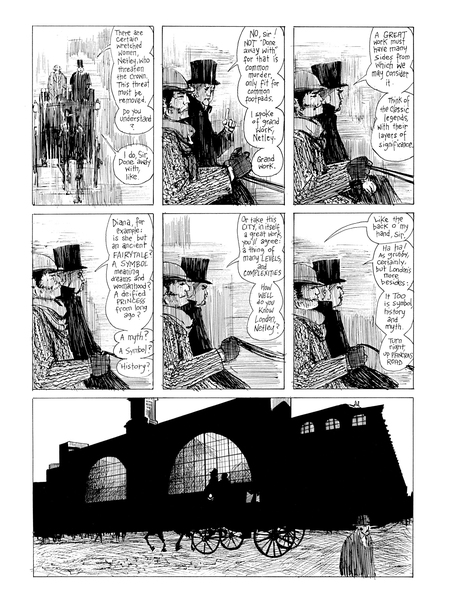
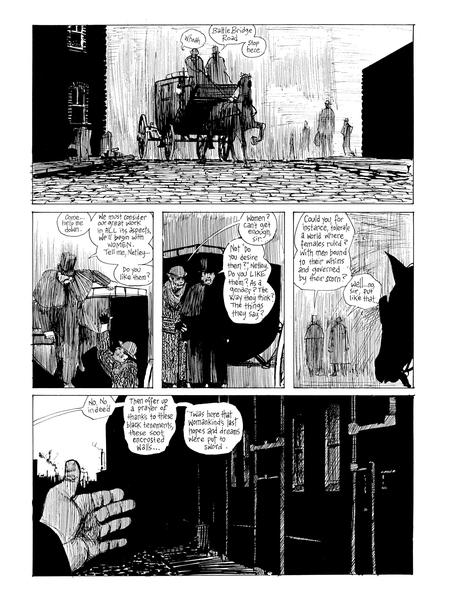
Alan Moore, Eddie Campbell. From Hell. Chapter 4
Alan Moore, Eddie Campbell. From Hell. Chapter 4