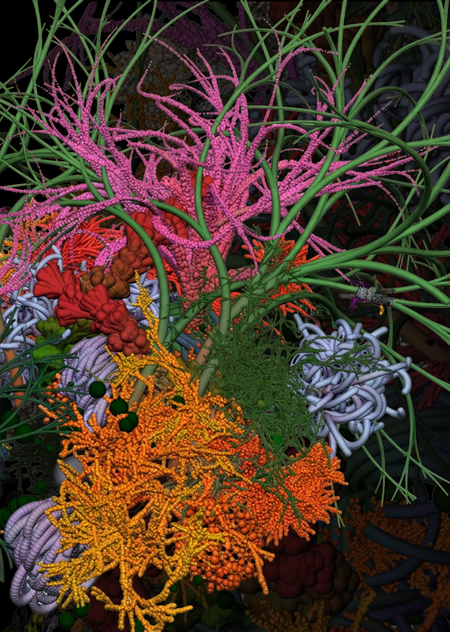
Concept
Typically, people perceive life as a natural biological process intrinsically tied to living beings—from birth to death. Throughout this process, an organism grows, develops, interacts with its environment, and reproduces. However, with the emergence and advancement of digital technologies, artists have gained the ability to experiment with creating a different form of life—an artificial one—attempting to endow these entities with unique characteristics, behavior, and the capacity for autonomous development.
Through the advent of net art, artists have been able to create diverse virtual spaces where digital organisms exist as images, interacting both with each other and with users. The internet has also allowed these artificial life forms to adapt to environmental conditions, reproduce, and form entire systems. Consequently, net art has become one of the platforms for such experiments. For instance, in some projects, the starting point for creating artificial life is a user’s textual description or drawing. In other works, it might be a set of predefined algorithms and rules that determine the organisms' subsequent behavior.
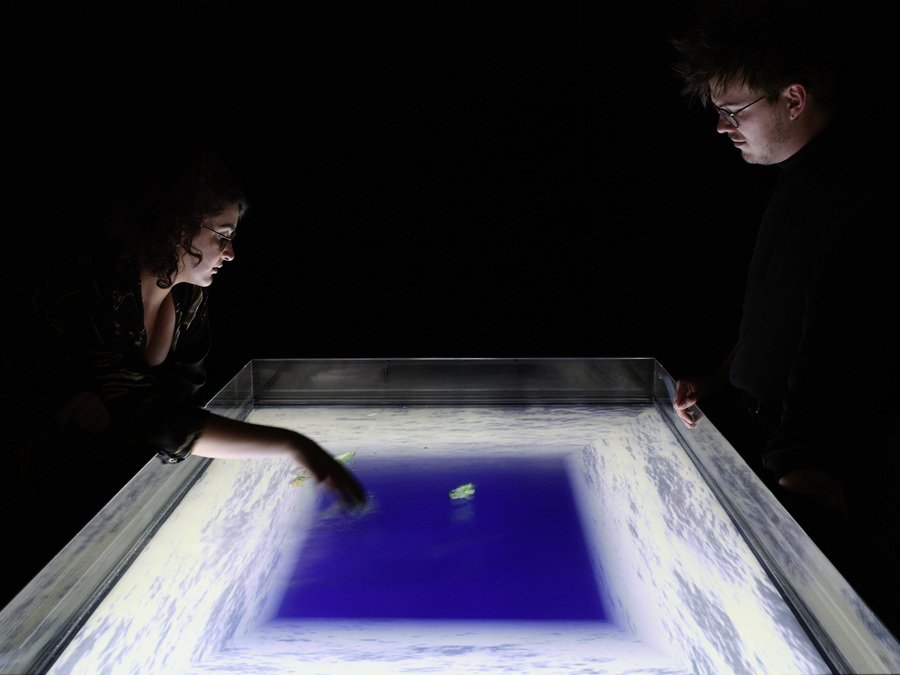
«A-Volve, ” Krista Zommerer and Laurent Minonne (1994)
In this research, I became interested in understanding how artists reimagine the concept of life within a digital environment and what properties of living organisms they translate into artificial space. I am particularly drawn to the opportunity to observe unfamiliar forms of existence—forms unlike those typically encountered in a living environment. Such projects allow one to view biological processes from a different perspective and ponder what precisely constitutes life in an object.
The research will examine artistic projects related to digital organisms and virtual ecosystems. The primary focus will be on how these organisms are created and the principles governing their existence. It will also be interesting to consider how they interact with one another and what role the surrounding environment plays in their existence. The study will cover works such as Life Spacies II and Verbarium by Krista Zommerer and Laurent Minonneau, TechnoSphere by Jane Prophet in collaboration with Gordon Selly, as well as SingleCell and DoubleCell by artist LIA.
Still ALife, Krista Zommerer, and Laurent Minonne (2005)
The research will be divided into three thematic blocks:I. The Genesis of Digital Organisms, where a key focus will be on exploring methods for creating digital organisms. This includes the process of transforming user text and imagery into elements of artificial life, employing algorithms and genetic principles, and examining the role of the human in the emergence of new forms.II. The Existence and Behavior of Digital Organisms. This section will investigate the structure and conduct of digital organisms—their anatomy, locomotion, sustenance, interactions, reproduction, competition, evolution, and adaptation. Particular attention will be given to the extent to which artificial entities can develop autonomously and which biological processes are replicated within the digital environment.III. Habitat and Virtual Ecosystems. This block explores the virtual spaces inhabited by digital organisms and the principles governing the formation of artificial ecosystems. The relationships between individual entities, the influence of the environment and the user on their existence, and the interaction between digital and biological life forms will be examined.
Life Spacies I & II, Krista Zommerer and Laurent Minonne (1997)
The visual component of the research will be built upon an analysis of the artworks themselves—the depictions of digital organisms, their structure and behavior, as well as images of virtual spaces.
The goal of this research is to study how artists create and present artificial life, what properties of living organisms they reproduce in a digital environment, and how individual virtual creatures coalesce into complete ecosystems.
I. The Birth of Digital Organisms
To begin, we want to understand what artificial life is, or as it is also known, Artificial Life or ALife. This is an interdisciplinary field that studies the principles of organization and behavior in living systems by creating artificial analogues of them. Unlike traditional biological methods that investigate existing life forms, ALife experiments with systems capable of reproducing individual characteristics of a living organism—that is, its movement, reproduction, adaptation, and interaction with its environment.One of the core principles of this field is the idea of studying life that has been artificially created. Artists develop their own systems to test what kinds of behaviors might arise within them.
Galapagos Islands, Carl Sims (1997)
In ALife research, three main directions are identified, differentiated by the materials and technologies used: Soft ALife refers to software models where life is reproduced through algorithms and computer simulations. Hard ALife encompasses hardware systems and robotics in which artificial organisms gain physical embodiment. Wet ALife involves experiments with biochemical processes, artificial cells, and biological materials. In net art, Soft ALife holds particular significance. Artists create virtual beings that exist within software systems and can interact with each other without physical embodiment.
Galapagos Islands, Carl Sims (1997)
A digital entity does not necessarily become artificial life simply because it resembles an animal, plant, or cell. What matters more is the processes occurring within the system. If an image merely reproduces the external appearance of an organism, it remains a visual model. However, if its form is linked to behavior, and the entity itself can react to its environment and interact with other elements, it acquires the properties of an artificial living system.
Therefore, in the ALife experiments, particular attention is paid not only to the appearance of the created creatures but also to the rules that govern their existence.
In 1999, artists Krista Sommer and Laurent Mignonne created Life Spacies II. This was an interactive artificial life system that brought together internet users and visitors to the ICC museum in Tokyo. The project allowed people from different parts of the world to create their own digital creatures using simple text messages.
To achieve this, the artists developed a special system for converting text into form. Every message became a kind of genetic code, based on which the computer generated a separate three-dimensional organism. In this way, human language was transformed into the source material for the emergence of artificial life.
Life Spacies I & II, Krista Zommerer and Laurent Minonne (1997)
At the core of Life Spacies II is the principle of transforming written text into a set of parameters that define the appearance of a digital being. Letters, their sequence, and the message’s syntactic structure influence the characteristics of the resulting organism.
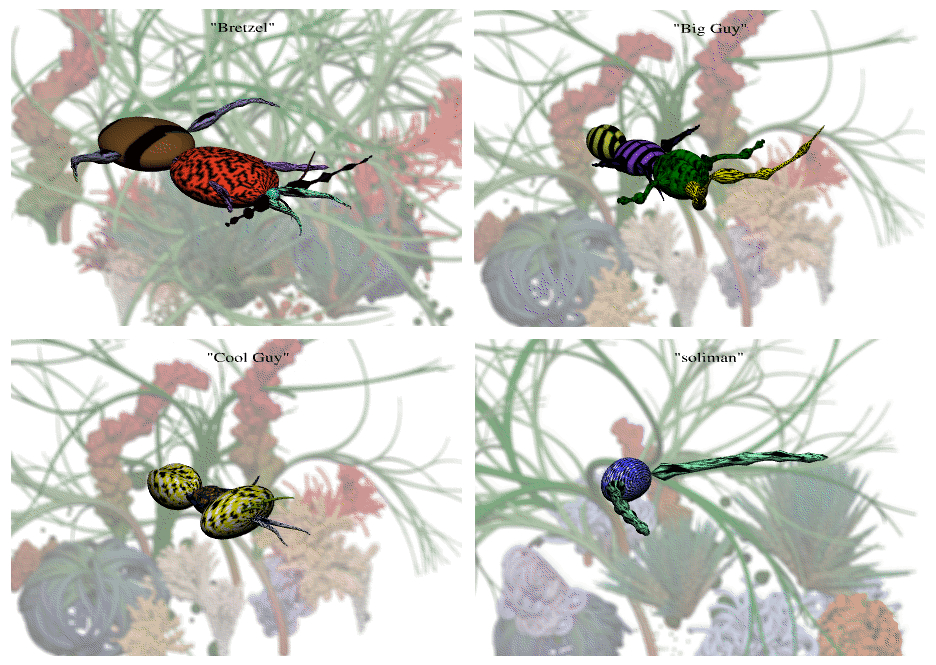
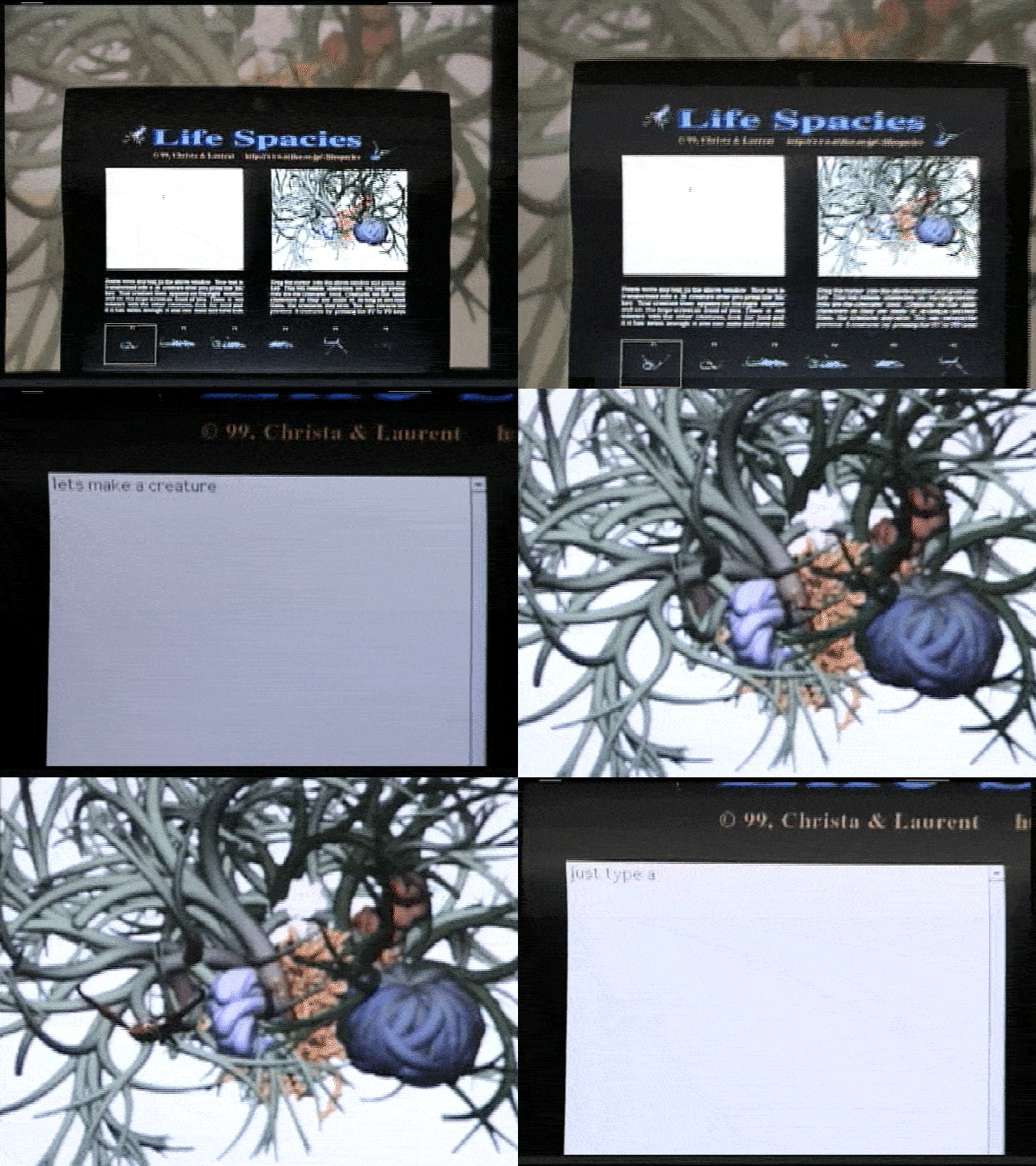
Life Spacies I & II, Krista Zommerer and Loran Minionno (1997)
Artists developed a specialized text-to-form algorithm that interprets text as a kind of genetic information.
Every message creates a unique combination of parameters, so even a minor change to the source text can result in an entirely different creature. The genetic code determines several characteristics of the organism. Its form, size, color, texture, number of body parts, and limbs depend on the source message. Furthermore, the complexity of the text influences the creature’s body structure and mobility.
Life Spacies I & II, Krista Zommerer and Laurent Minonne (1997)
Ultimately, different prompts generate distinct organisms with dissimilar characteristics—speed, form, color—all resulting from the interaction between language and algorithm.
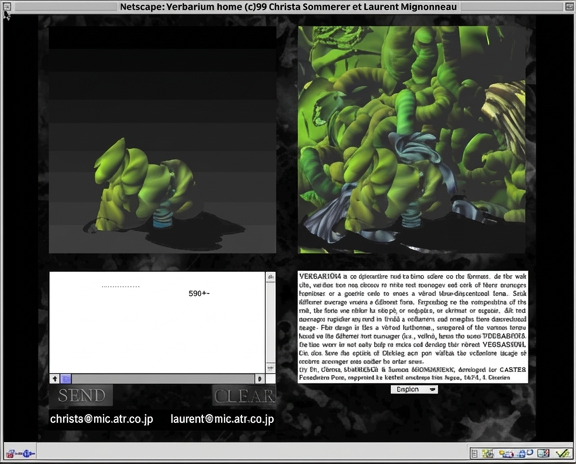
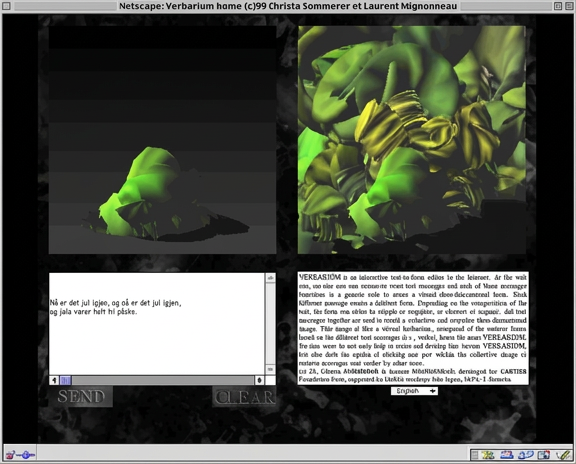
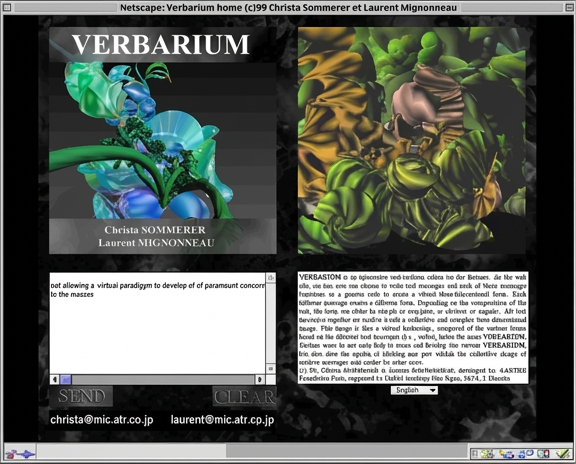
In the same year, the duo Krysta Sommerer and Laurent Minnone developed another interactive web project titled Verbarium. In this project, user text was also transformed into three-dimensional forms. The work was created for the Cartier Foundation in Paris and continued the artists' experiments with converting language into visual structures.The user would input a message into a text editor, after which the system generated a unique form. All the resulting structures gradually merged into a collective image resembling a virtual herbarium. This is how the project got its name—Verbarium.
Verbarium, Krista Zommerer and Laurent Minonne (1997)
At its core, Verbarium utilizes an algorithm that converts text characters into three-dimensional geometry parameters. The initial form is a ring with multiple vertices. The program then modifies its position, scale, rotation, and structure, gradually adding new segments and branches.Artists employed approximately fifty functions to govern the construction and manipulation of the form. Character values are determined via the ASCII table, and the resulting parameters drive subsequent geometric transformations. This process ensures that every message generates a unique structure—one that, evolving from abstraction to tangible form, can ultimately resemble a tree or a plant.
Verbarium, Krista Zommerer and Laurent Minonne (1997)
An interesting feature of the project is that every new structure created by the users is added to a collective composition that gradually becomes more complex and diverse. However, users can not only create their own forms but also select elements from the already formed image to revert to the messages on which they were based.
Verbarium, Kriszti Zommerer and Laurent Minonne (1997)