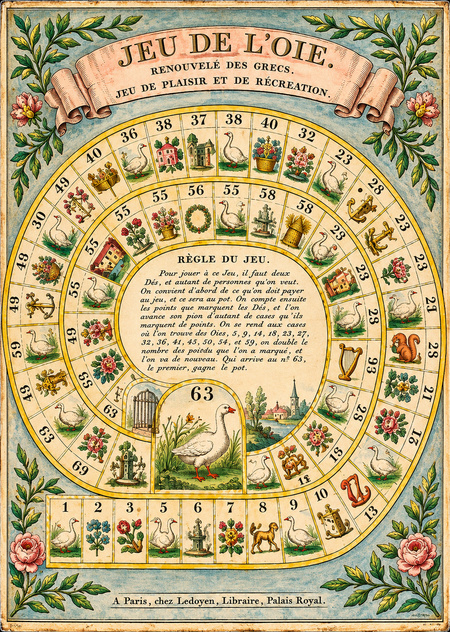
The History of Goose Game: The Evolution of European Travel Board Games
Research Concept
Board games are not just a form of entertainment but also an important part of cultural history. Their rules, design, and narratives reflect societal perceptions of the world, human life, luck, and social relationships. A prime example is the «Game of Goose”—a European board game that served as the basis for numerous travel games.The classic „Game of Goose“ features a board with 63 numbered spaces arranged in a spiral. Players move tokens according to the dice rolls, striving to reach the final space first. Along the way, symbolic obstacles are encountered: a bridge, a hotel, a well, a labyrinth, prison, and death. Some spaces allow for accelerated movement, while others force players to stop, move backward, or restart the game.At first glance, this mechanic appears simple. However, the arrangement of the spaces, the system of obstacles, and the fundamental principle of moving toward a center create a conceptual model of a journey where the outcome depends less on human decisions and more on chance.It is this very characteristic that makes the game interesting for historical study. Unlike chess, which necessitates strategic thinking, „Game of Goose“ revolves around unpredictable progress toward a goal. The player cannot fully control their own route. Therefore, the game board can be viewed as a conventional representation of life’s journey—complete with its fortunes, delays, and unexpected turns.The game was known in Italy before the 16th century, but the dissemination of printed game boards in the late 16th century marked a significant milestone in its European history. Thanks to the development of mass graphics, images of game tracks could be reproduced, sold, and distributed across countries. Gradually, the game gained popularity in France, the Netherlands, England, and other European nations.
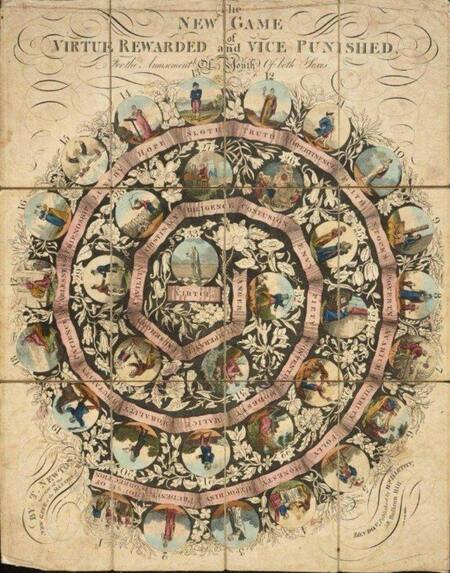
The spiral track gradually transformed into a distinct system of information organization. Instead of conventional obstacles on the squares, maps of countries, images of cities, architectural landmarks, characters, historical events, and moral examples could appear. The player embarked on a symbolic journey not just across the game board, but through a specific body of knowledge.Changes in European culture played a significant role in this development. The expansion of geographical knowledge, the proliferation of printed materials, the advancement of educational practices, and the growing interest in travel formed new demands for board games. The game could simultaneously serve both entertainment and educational functions, and its illustrations became a way to engage with the surrounding world.However, the evolution of board games was not linear. Educational, political, and moralistic variants did not replace the classic «Game of Goose.» Instead, they existed parallel to traditional game boards that retained their original symbols. This allows for a comparison of different developmental trajectories within a single gameplay principle.
Relevance of the Study
The relevance lies in examining the board game as a historical visual artifact. By studying the game board, one can gain insight not only into the history of recreation but also into the evolution of European printmaking, methods of visual storytelling, and the cultural values of different eras.
Research Subject
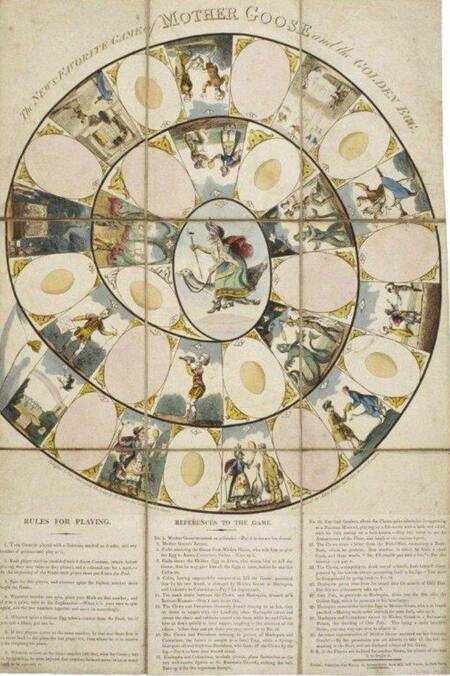
European tabletop journey games from the 16th to the 19th centuries, connected to the tradition of the «Game of the Goose.»
Subject of Study
Changes to the composition, illustrations, symbolism, and narrative content of the game boards.
Research Objective
Trace how the classic «Game of Goose» became the foundation for themed board games and how its visual language has evolved depending on historical and cultural context.
Research Question
How did the changes in the plots and the design of the game boards of «Goose Games» reflect the development of European culture from the 16th to the 19th century?
Research Hypothesis
While retaining the recognizable principle of following a route, the «Goose Game» gradually transformed from a primarily recreational game into a universal graphic form through which geographical knowledge, moral values, political events, and travel imagery could be represented. The primary method employed is comparative visual-historical analysis of surviving game boards. We compare their composition, color palette, illustration themes, and the relationship between the images and the game rules. The research material consists of dated printed copies from museum collections and historical archives.
The Emergence and Spread of «Game of Goose.» 16th Century
Origin of the Game and Its First Mentions
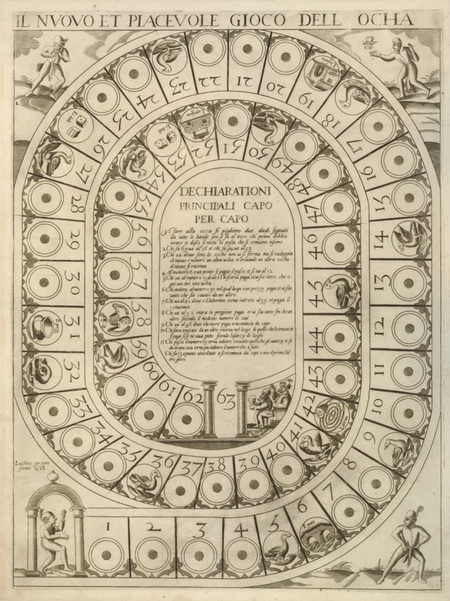
The history of «Game of Goose» dates back long before the advent of modern board games. The game originated in Italy and was known as early as the 15th century. One of the earliest documented references is from 1463, when the game was mentioned in connection with a ban on gambling in the Italian city of Argenta.In the 16th century, «Game of Goose» became known across various social strata. Its rules were quite simple, so no specialized knowledge or extensive preparation was required to play.Historians also link the spread of the game to Italian court circles. A later document is known that Duke Francesco I de’ Medici presented this game to the Spanish King Philip II.However, establishing the definitive place of the game’s invention is difficult. Earlier mentions suggest that by the end of the 16th century, it already had its own history.«One of the earliest surviving printed copies of the Game of Goose. The board consists of 63 spaces arranged in a spiral.»
The structure of a classical game board
The defining feature of «Game of the Goose» is the spiral arrangement of 63 spaces, along which movement progresses from the outer edge toward the center.
The game path forms a continuous journey. The dice roll determines the distance the piece advances. The objective is to reach the final space, and usually, winning requires rolling an exact number of points.
Goose figures are depicted on certain spaces. Landing on such a space allows the player to advance an additional distance. Conversely, other symbols slow down movement.
The composition of the board itself is particularly significant. The spiral allows the entire path to be viewed at once, yet the player traverses it incrementally. This organization creates a visual sense of movement toward the center while simultaneously emphasizing the journey’s unpredictability.
Symbolism of Obstacles and the Play Path
In the classic game, individual images represent not just objects, but situations that influence the player’s path.
The bridge allows for faster progress toward the goal. The hotel signifies a temporary stop. The well and the jail delay the participant until a certain event occurs. The labyrinth forces a retreat, and the death cell restarts the game.
These symbols can be interpreted as metaphors for life’s circumstances. A person is able to move toward a desired goal, but they cannot predict the obstacles that will arise beforehand.
The image of death, particularly positioned on the 58th space, is quite illustrative. It does not necessarily mean the end of the game; the player returns to the beginning and repeats the journey.
This creates a cyclical model of movement, which allows for a philosophical reading as a history of fortune, risk, and the repetition of life experiences.
It is important, however, to distinguish between the historical rules and modern interpretation: the symbolic meaning of individual spaces was not always explicitly stated by its creators.
The Appearance of Printed Game Boards
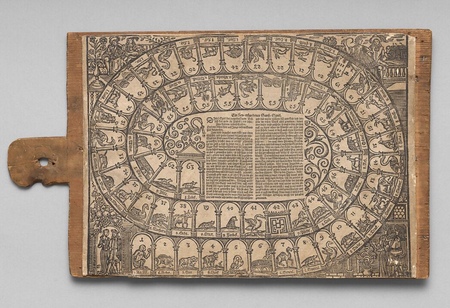
One of the earliest dated surviving printed game boards is the Il Nuovo et Piacevole Gioco dell’Ocha, created by Lucchino Gargano in Rome in 1598.
At the center of the engraving are the game rules, and around them unfolds a spiral track. The cells contain small illustrations that allow the player to recognize specific situations.
The visual design serves the function of the game. The black-and-white graphics, the clear cell outlines, and the repetition of small drawings ensure the route is easily understandable.
Printing technology made it possible to mass-produce identical game boards. Because of this, the game spread as an accessible graphic object, rather than just a set of verbal rules.
17th Century. Transforming Play into a Visual Journey
The Spread of Play in European Culture
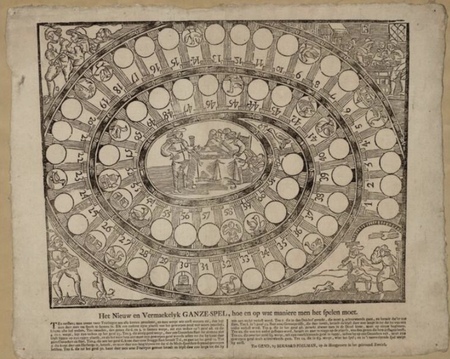
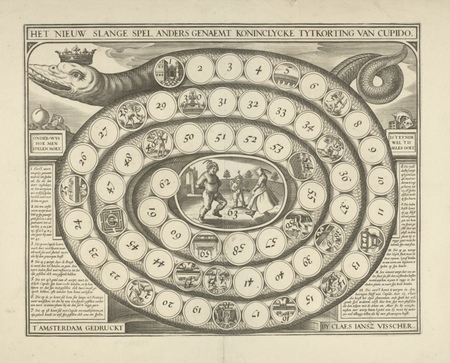
In the 17th century, «Game of Goose» gained widespread popularity in France, the Netherlands, and England.
Various European publishers utilized a similar grid system but often altered the artistic design of the board. This resulted in national variations distinguished by decorative elements and character imagery.
While retaining the core rules, the composition could become more intricate. The space surrounding the spiral was filled with ornaments, human figures, animals, and domestic scenes.
The game board transformed from merely an amusement tool into a self-contained work of printmaking.
The Emergence of Geographic Games