Concept
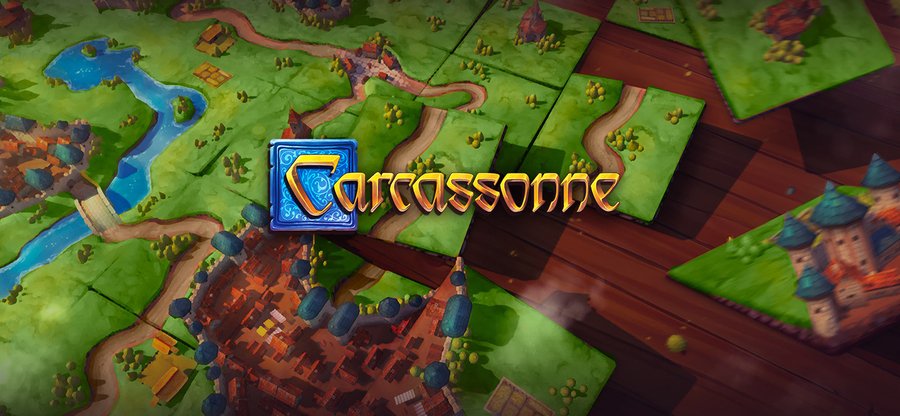
From the mobile version of the game «Carcassonne»
This research investigates the history of the board game «Carcassonne» and how its structure connects the construction of a shared space with individual competition. The focus will be on Klaus-Jürgen Wrede’s original game, the circumstances of its development, and the gameplay situations that arise when multiple players participate. Additions will be incorporated selectively if they help demonstrate the evolution of the core principles.
The choice of topic stems from the inherent tension between collaboratively creating a landscape and each participant’s personal objective. Players place cities, roads, monasteries, and fields on a single board, yet they strive to accumulate more points than their opponents. Consequently, a single move can simultaneously advance the collective construction, benefit a rival, and alter the possibilities for future contention. This material allows for an examination of the relationship between the game’s spatial design and the dynamics among the participants.
The core research question is: how does the construction of a shared landscape transform into a competition among players whose outcomes depend on the decisions of others? The working hypothesis is that the strategic tension in «Carcassonne» arises from the combination of individual scoring, random tile acquisition, and the ability to alter common elements.
The goal is to examine how these conditions create situations of conflicting interests, competition for the majority, and constraints on others' plans. Collaboration here will not be assumed as a permanent alliance, nor will rivalry be treated as inherent hostility.
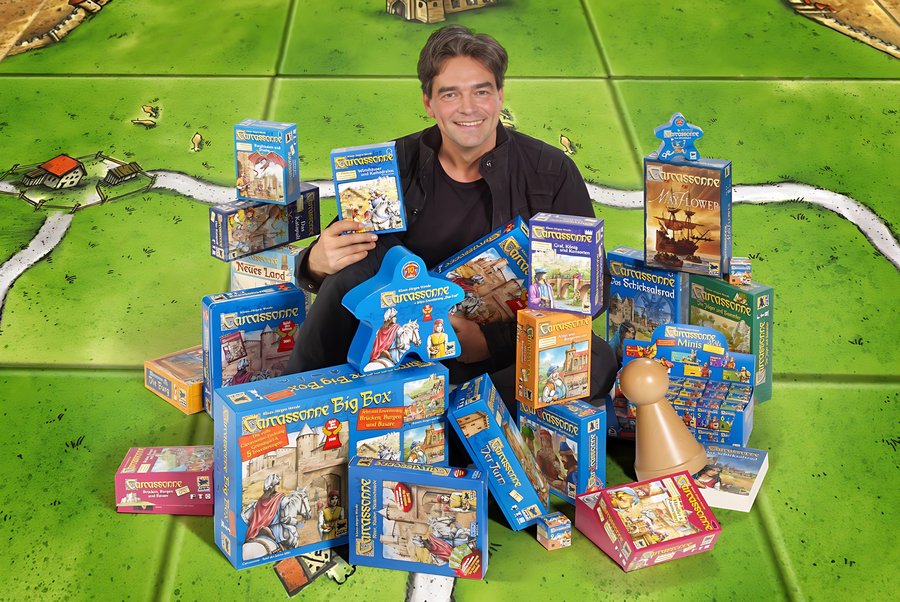
Game creator Klaus-Jürgen Wrede.
Navigation:
1. The Origins of «The Carcassonne.»
2. Visual Characteristics and Design Perception.
3. Game Mechanics and Social Dynamics.
4. Conclusion.
The historical foundation will be built upon publications regarding the game’s development and Spiel des Jahres materials. The rules of the specific edition will establish permissible actions, the scoring order, and constraints on piece placement. Roger Caureau’s work, «Games and People,» will be used to discuss the relationship between competition and chance after reviewing the relevant sections. Reviewers' statements about personal experience will be separated from the official rules and established psychological patterns.
The visual elements will combine early editions, components, and sequential diagrams of game scenarios. Different solutions will be compared from the same starting position: object completion, expansion, merging areas, and achieving a majority. The color of the pieces and the highlighting of the current turn will allow us to trace the consequences for each participant. The medieval landscape will be examined as a conceptual model of territorial development, rather than an accurate simulation of kingdom management.
The History of the Genesis of «Cartesian»
In the late 1990s, Klaus-Jürgen Wrede traveled to the South of France to collect material for a novel. He was drawn to the local castles and fortified towns, especially Carcassonne. During his travels, he conceived an idea for a game where players could gradually build their own medieval landscape. The real-life locations not only inspired the title but also the overall vision of the future game [4].
The walled city of Carcassonne, France.
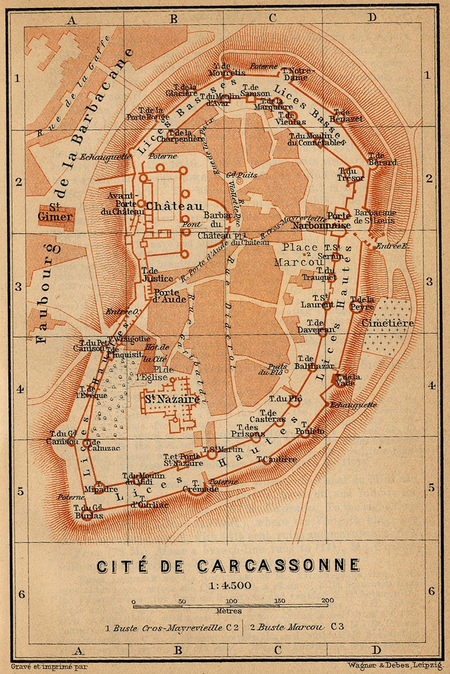
However, Vrede did not aim to precisely reproduce a city map. Instead of a ready-made territory, he proposed individual fragments that participants assemble into a space during the game. Therefore, Carcassonne became the starting point for a game world that unfolds differently each time.
After returning, Wrede began working on the prototype. The first versions were more complex than he had hoped. He aimed to create a game with clear rules that still allowed room for thoughtful decisions. Therefore, the work focused on the most essential elements. Wrede initially colored the tiles by hand with watercolor.
In the early 2000s, the author presented his designs to the Hans im Glück publishing house. The editor, Dirk Gahlenkzer, was interested in «Carcassonne, ” and the publisher requested a prototype. The game was then tested and refined. A decision was made to publish it in May, with the release being prepared for the fall of that same year.
2001 Awards Ceremony: Editor Dirk Geilenkaizer, Klaus-Jürgen Wede, and Publisher Director Bernd Brunnhofer
One of the most noticeable components was a small wooden human figure. According to the Spiel des Jahres materials, its shape was developed based on Brunnhofer’s sketches. These figures later came to be called meeples—derived from the English phrase «my people."[3; 4]
The tiles and the figures serve different functions. The former build a shared world, while the latter indicate a specific player’s presence. Within this structure, the foundation of future competition can already be seen: participants build a single board, yet each strives to gain personal advantage from it.
Mips on the game board. Mips up close
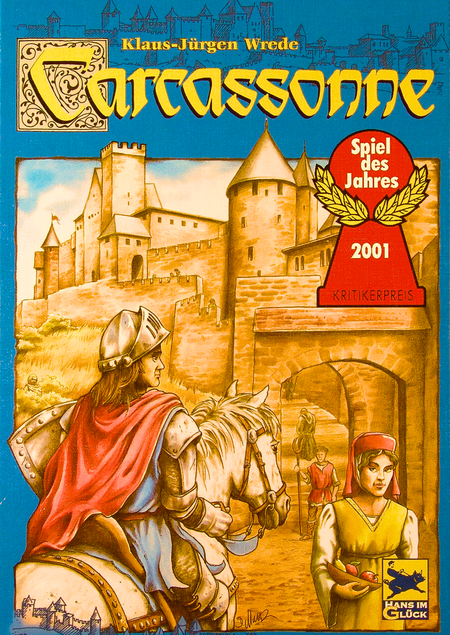
«Carcassonne» was released in the fall of 2000 and won the Spiel des Jahres award in 2001. It is important to distinguish between these events: first, the game went on sale, and later, it received jury recognition. The award materials cited its strengths as accessibility, party diversity, and the combination of randomness with tactical decisions [2; 3].
Thus, the impression of medieval cities evolved into a game about shared building and personal interests. Its final form was shaped by Wiedemann’s concept, the publisher’s work, and the artistic design. In the next chapter, we will compare editions from different years and the chosen expansions to understand how the appearance of this game world has changed.
The photo shows the first edition of the game «Carcassonne.»
Visual Characteristics and Design Perception
All editions, supplements, and spin-offs of «Carcassonne»
Unlike games with a pre-drawn map, Carcassonne allows participants to build the playing space themselves. Initially, each player has a separate tile, to which new ones are gradually added. Cities expand, roads connect, and fields remain between them. Therefore, the construction of the image by the players becomes an active part of the experience at the table. Every tile must extend the adjacent areas of the landscape.
The most popular edition of Carcassonne
Map Tiles
The road connects to the road, the city connects to the city, the field connects to the field. This principle allows individual cards to be perceived as parts of a single world.
Map tiles for the «River» supplement
However, the tile boundaries remain visible. We are presented with both a medieval landscape and the system of elements from which it is composed. This specific combination is important for our analysis. The player examines the drawing not just for its details, but also to understand where the next piece can be placed. The visual image and the rules work together—the image suggests which connections are permissible. The requirement to continue the landscape is explicitly stated in the instructions.
Field in the final stages of the game
The visual world of «Carcassonne» draws upon motifs of French medievalism: fortified cities, walls and towers, roads, monasteries, and the fields surrounding them. These elements do not form an exact historical map; rather, they create an archetypal image of the territory that participants gradually explore. Real Carcassonne served as the source of the name and inspiration, but the gameplay space is recreated anew each time [4; 5].
The base «Carcassonne» game has three main components: square landscape tiles, multi-colored meeples, and a scoring track. The tiles depict sections of cities, roads, monasteries, and fields. Players use these tiles to build the common space and use the meeples to mark features that can earn points. The scoring track is separate.
Score field