Introduction
In the modern world, provocation is one of the most common ways to capture an audience’s attention within the existing information landscape. Increasingly, brands emphasize ephemerality and engagement with controversial topics. However, in most cases, these are one-off stunts designed to attract attention and boost reach. Diesel is a rare example of a brand for which provocation has evolved from a temporary tactic into the foundation of its style. For over 30 years, the brand’s advertising campaigns have addressed the most provocative themes, simultaneously eliciting debate and delight. It is worth noting that different people have been responsible for creating these campaigns—from the Swedish agency Paradiset to Creative Director Glenn Martens—but despite these regular changes, Diesel’s advertising always remains recognizable and unique. The goal of this study was to determine how provocation became a complete system of the brand’s advertising language and to describe its visual and semantic techniques.
Research Hypothesis: Diesel’s provocation is not shock for attention’s sake, but rather a complete system that aligns with the slogan, «For Successful Living.» Despite constant changes in the world, shifts in leadership, and different creators, the mechanism of irony remains consistent.
The material for this study consists of 13 advertising campaigns and 39 advertising images, along with interviews with company personnel and the press.
Research Method: This visual study is based on a comparative analysis of all the advertising campaigns, which were selected according to specific criteria: taboo (which social norm the campaign violates), technique (how the provocation is constructed), visual component, slogan, and audience reaction.
Part 1. Violation of Standards. Introduction
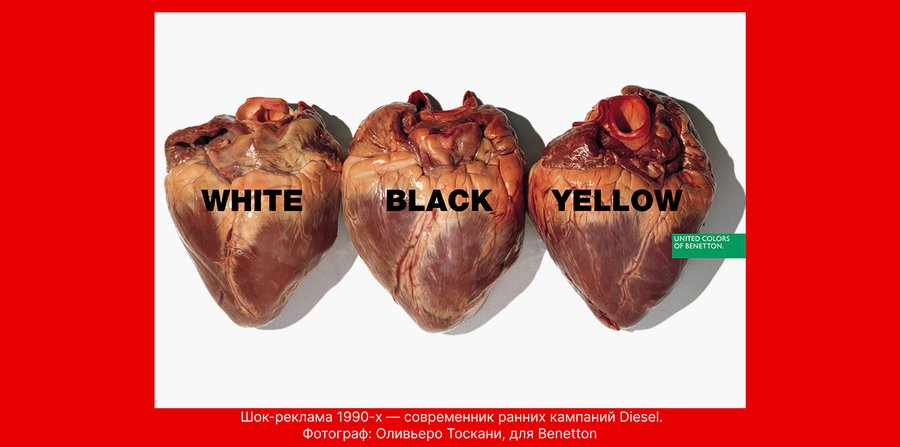
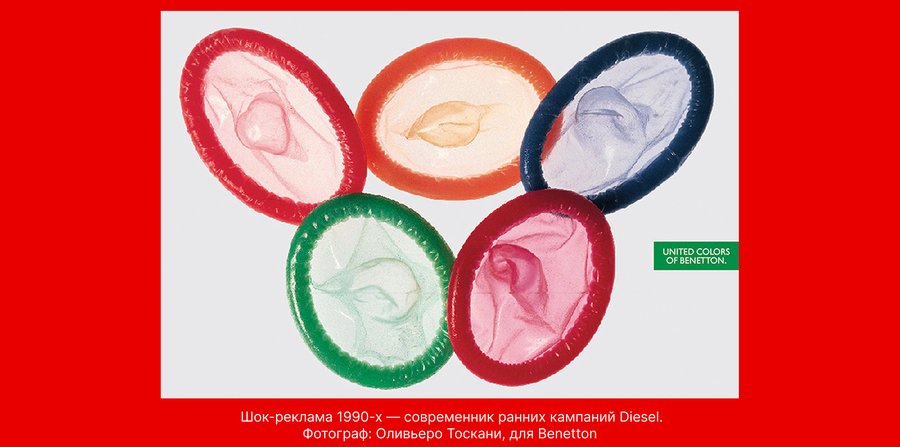
Darren U. Dale, Kristina D. Frankenberger, and Rajesh V. Manchanda characterized and defined shock advertising. They defined it as intentional violations of existing norms, and the authors highlighted several types of such violations: from repulsive imagery and sexualization and indecency to the violation of religious norms. Existing research has proven that shocking content captures the viewer’s attention and improves memorability more effectively than fear or simple information. In this study, this is a fundamental point because the target audience for diesel is primarily young. Marina Terskikh’s research on provocative video advertising suggests evaluating it based on several parameters: 1. Tone (mind share)—social media discussions, determining the ratio of positive to negative sentiment. 2. Engagement—the total number of reactions and audience involvement. 3. Reach. Advertising that breaks stereotypes attracts far more attention than classic, subdued advertising. Shock advertising has the potential to increase not only communication but also to stimulate economic impact. The key takeaway is that one must evaluate not just the «loudness» of the image presented, but also the subsequent reaction, which can be either positive or negative.
Identity Myth Douglas Holt, in his book «How Brands Become Icons,» explains why certain well-known brands become iconic. Coca-Cola or Nike are prime examples. Their core value lies in symbolism. They create an «identity myth”—specifically, stories that resonate with societal anxieties during various periods of change. Holt also emphasizes that creating an iconic brand through branding alone is nearly impossible; it requires a specific cultural stance. In the case of the Diesel brand, a successful life turned upside down served as such a myth. This myth addressed a fundamental problem of youth—specifically, disillusionment—and it succeeded precisely because of its engagement with the pain and new sensations experienced by young people.
Brand Criticism In Naomi Klein’s book, «No Logo,» the central idea was the anti-corporate movement of the 90s. One of the mechanisms described in the book was culture jamming—that is, a parody built upon the recognizability of a logo against the brand itself. Diesel made an incredible move; it independently utilized the language of anti-advertising and advertising parody from within. It was thanks to this mechanism and its resonance with the general mood that the brand became embraced by the audience. The brand’s identity began to be constructed precisely from its own contradictions.
Part 2. 1991–2001. Genesis
From 1978 to 1990, the brand slogan was «Only the Brave.» The advertising centered on rule-breaking and the desire for identity. In 1991, as the brand began its international expansion, the first global advertising campaign, titled «For Successful Living, ” was launched—a campaign that continues to this day. The first revolutionary decision was to deploy the exact same visual across all countries without any local adaptations, which is typically the standard practice. The company was built on parodying the 1950s and promised a better life without requiring a purchase, thereby satirizing corporations that claimed to champion social responsibility. The result of this advertising campaign, which lasted over six years, was the Diesel brand winning the „Ad of the Year“ award at the Cannes Lions. Their posters also became collectible items. This slogan, which originated in 1991, is still in use today.
Because of the brand’s provocative and unconventional nature, major agencies were hesitant to collaborate with them, as Diesel dictated all the terms. A small, independent Stockholm agency named «Paradiset,» led by Creative Director Jocke Jonason, agreed to partner with them. Jonason’s vision was to compel the viewer not just to look, but also to think. He rejected the conventional notion that youth only require interesting visuals, insisting instead on building provocation through the synergy of beauty and intelligent concept. Fictional historical moments were the key device in the collaborative advertising campaign. The campaign centered on the idea that the brand had been around for decades—and based on this provocative foundation, it constructed narratives on the most sensitive topics, such as race, religion, politics, or sexuality. The visual language of '93 was crafted by photographer Pierre Winther; in the advertisements, young models appeared in theatrical staging—it was pure grotesque.