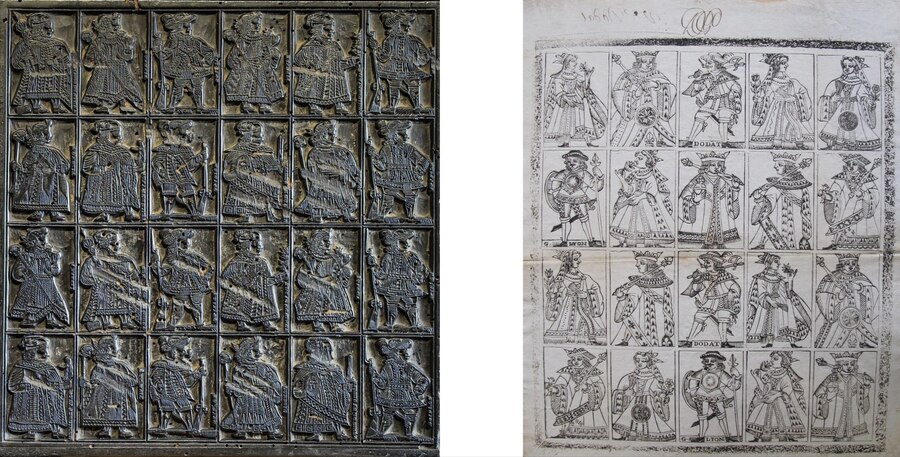
Revolutionary woodcut for printing facial card outlines (Gadan Museum, Lyon, Inventory Number 222) and a print taken from the woodcut by tax collectors for verification purposes (Municipal Archive, Lyon, HH 28 bis).
Concept
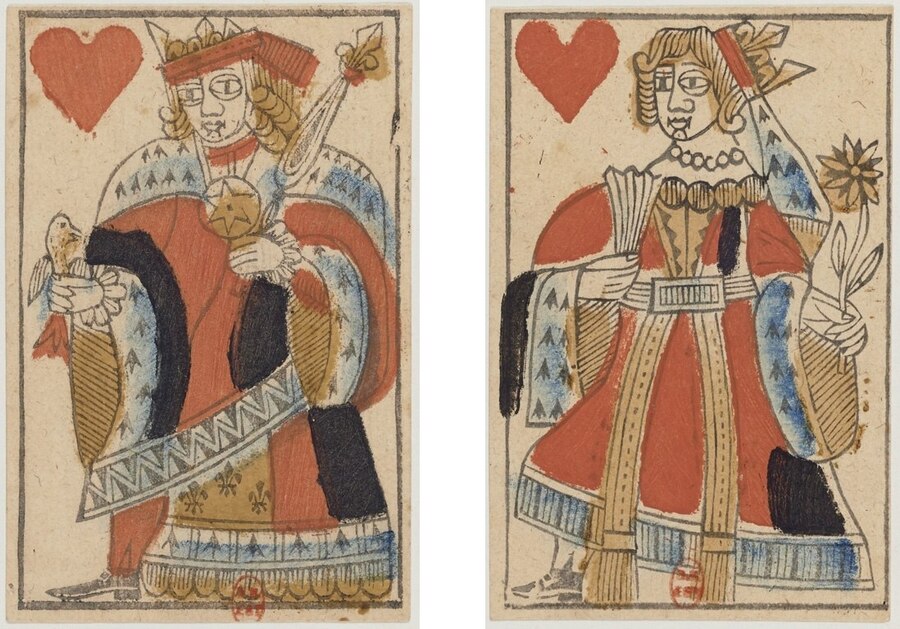
King and Queen of Hearts, printed at the Bibliothèque nationale de France in Lyon
What should happen to the King of Hearts when monarchical power ceases to be acceptable? One could erase the crown, change the name, or draw a different figure. But a more complex question remains: what should be done with the structure of the deck, in which cards are distinguished by rank?
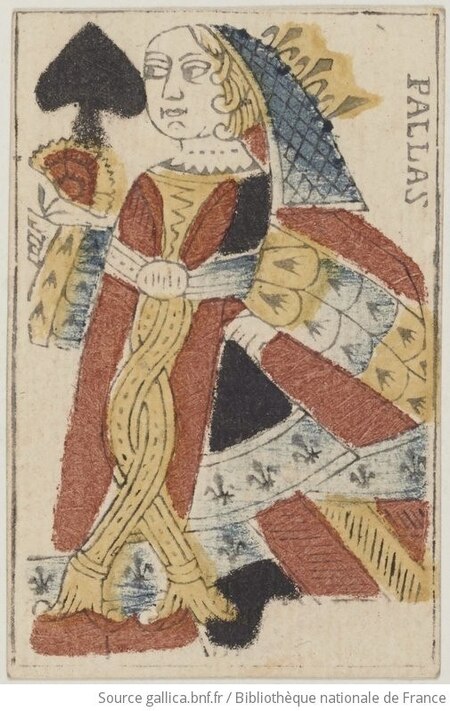
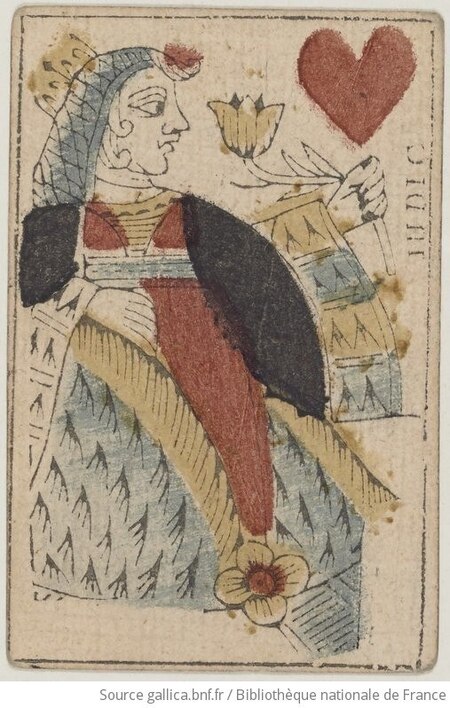
Queen of Hearts and Queen of Spades, Hygiene type circa 1750 Vidal.
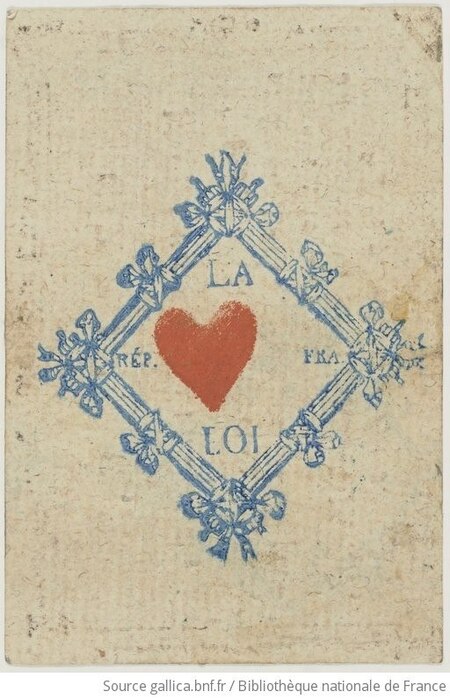
This study is dedicated to Jean-Demosphène Duguet’s and Urbain Jom’s «New Maps of the French Republic.» The work centers on the illustrations of Genius, Liberty, Equality, and Law, which replaced the figures of kings, ladies, valets, and aces. The patent for the new cards was issued on February 17, 1793; the Bibliothèque nationale de France describes the surviving deck as a set of 32 cards.
The primary visual source is the promotional sheet «New Maps of the French Republic, ” which features sixteen samples: four laws and twelve figures. It is examined alongside digitized copies of maps from the BnF. For comparison, French Old Regime maps, variants of revolutionary redesign, and imitations of the Jome and Duguet deck are used. The main chronological boundary is the 1790s; earlier images are used only to establish distinctions.
The methodology involves comparing names, poses, clothing, attributes, suits, and composition. The images are regarded as historical evidence, while the promotional text serves as evidence of the manufacturers' intentions. The assertions of the creators are not equivalent to proven impact on players. The theoretical foundation is Johannes Huizinga’s reasoning on play as an activity that creates its own order.
Power Before the Revolution: The Habit of Holding the King in Hand
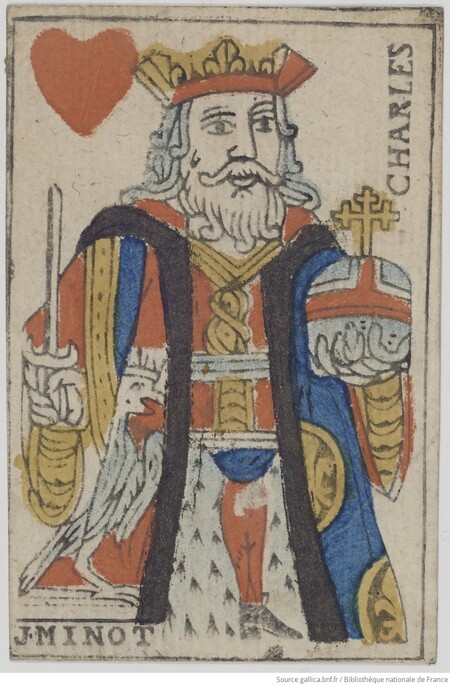
The King of Hearts occupies a unique position. It can be held in hand, passed to another player, discarded, or lost. At the gaming table, it becomes an object acted upon by an ordinary person. Yet, its name and image still denote a high status. The deck makes power familiar—encounters with its symbols repeat in every game.
This does not imply that any use of traditional cards expressed support for the monarchy. A player could see the court card of the desired rank first and foremost. It is this possibility of double reading that makes the object interesting: the political image can persist even where it is almost no longer noticed.
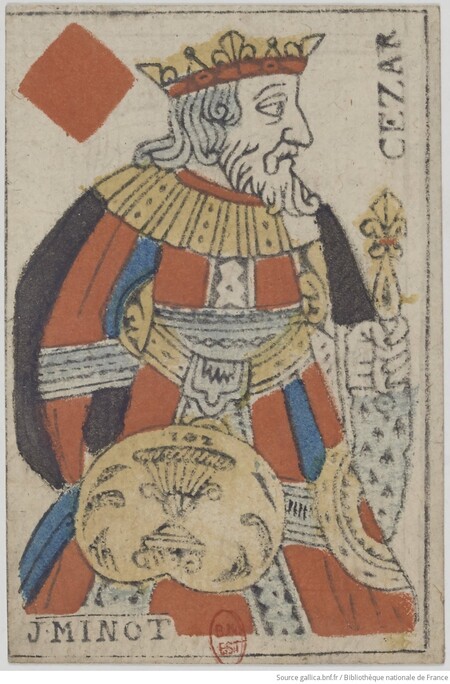
In 18th-century France, the connection between maps and the state was both practical. Geoffrey Revel shows that the design of figures was used to monitor production and tax collection. The established pattern helped distinguish authorized maps from products manufactured in violation of tax regulations. His publication includes kings and queens of hearts printed in Lyon, as well as materials related to verifying card prints.
It appears that authority was present in the card in two ways. On the front, it was represented by a character; in its production, it was represented by the order of manufacturing and control. Therefore, the revolutionary redesign affected an object already incorporated into the relationship among the maker, the state, and the player.
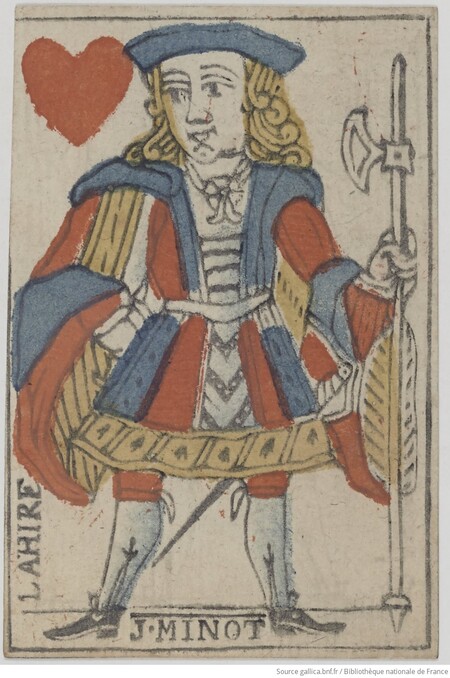
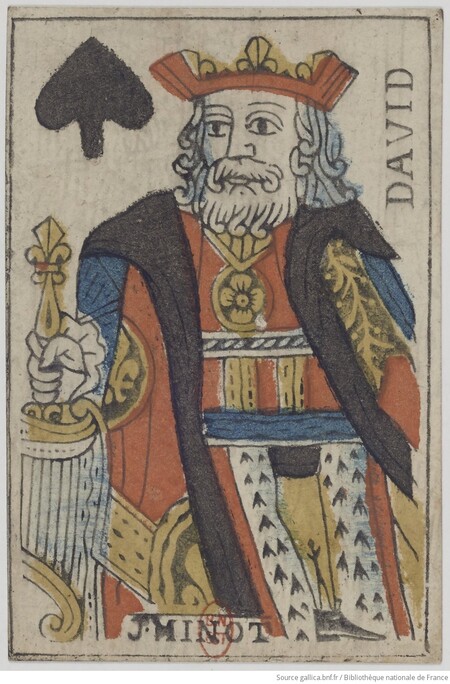
Visually, the traditional figure is identifiable by the combination of name, attire, headwear, and suit. An individual detail can change while the whole remains recognizable. For subsequent analysis, this property is crucial: political meaning can be altered without simultaneously dismantling all the card’s familiar characteristics.
Dugourc J.-D.; Jaume New Maps of the French Republic: More Queens and Knaves… Paris, [1793].
The Deck Declares the Republic
Dugourc J.-D.; Jaume U. Nouvelles cartes de la République française. Advertising sheet, 1793–1794. Victoria and Albert Museum. Reproduction published in: Moon I. Dugourc’s Playing Cards // Drawing Matter. 09.14.2022.
The promotional flyer by Jom and Duguрка begins with the title «New Maps of the French Republic.» This is followed by the program formula:
No more kings, queens, and knaves; they are replaced by Genius, Freedom, and Equality; only the Law stands above them.
This phrase offers the reader a ready-made framework for interpreting the image. Before them, these are not merely new costumes. The titles demand that the deck be perceived as a model of societal structure, one in which courtly roles have yielded to different foundations of authority.
Changing the names does not make all the cards equal. On the contrary, the image meticulously distributes functions. Some characters represent abilities, others—freedoms, and a third group represents equality. The law is singled out as a distinct group. Therefore, the advertising formula contains two operations: the removal of former figures and the establishment of a new order.
This is an important departure from simply erasing a crown. If the symbol of power is removed, the image is left with a void. Joam and Duguerc fill that vacant space—offering the viewer not only to discard the old name but also to embrace a new one.
Instead of Kings: Four Geniuses
The four kings are occupied by the Genius of War, the Genius of Peace, the Genius of Arts, and the Genius of Commerce. On the promotional flyer, they are represented as winged figures holding various attributes. Here, the word «genius» signifies the personification of a specific activity, not the portrait of a particular outstanding individual. Because of this, the ruler’s place becomes a symbol of ability: to defend, ensure peace, create works, and facilitate exchange. This interpretation is drawn from comparing the titles and the objects held by the characters.
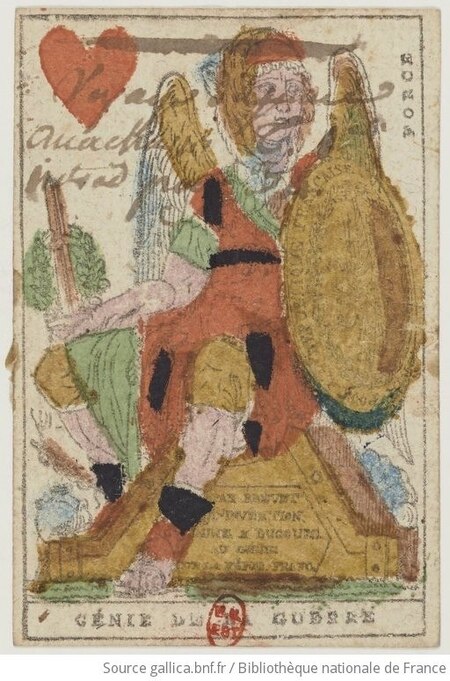
The genius of war belongs to the worms. Beside it, shields and military objects are visible; the vertical inscription connects the image to power. The genius of peace, related to the thistles, is surrounded by other symbols: botanical motifs, a horn of plenty, and a scroll. It is accompanied by an inscription about prosperity.
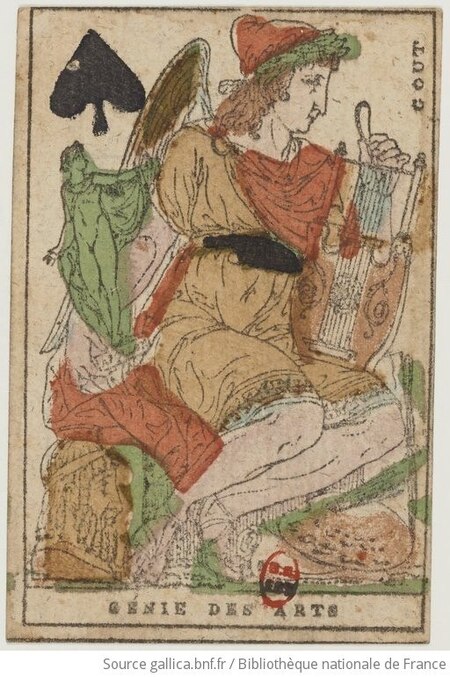
The comparison shows that war and peace are not reduced to a victor and a vanquished. They receive the same type of map and similar compositional weight. Within the depicted system, strength and well-being emerge as distinct societal challenges.
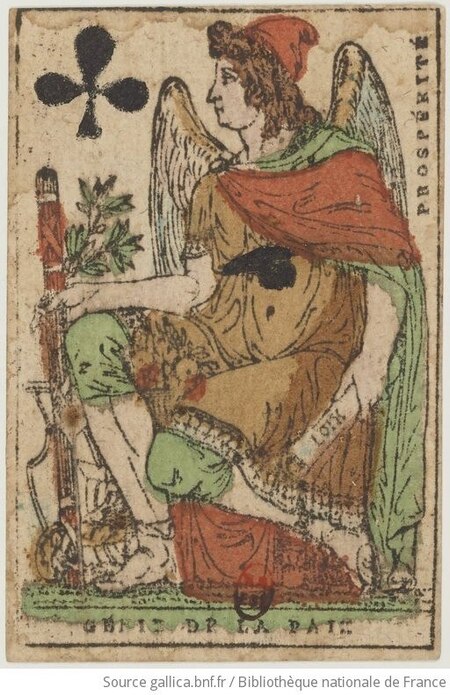
This visual array prevents the deck from being labeled either unequivocally militaristic or pacifist. It reveals something more specific: military strength is included in the set of recognized abilities, but it does not exhaust them. Alongside it are peace, art, and commerce.
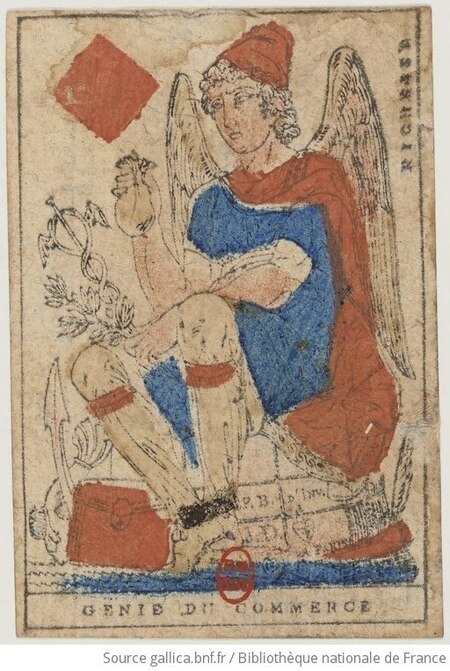
In the Genius of Arts, corresponding to the peaks, recognizable elements of artistic pursuits are gathered: lyre, sculpture, and palette. The Genius of Commerce, related to drums, is depicted with a caduceus and a pouch; nearby are goods and documents.
To understand the map, what is important is not a single object, but their totality. The palette points to painting, the lyre to music, and sculpture to plastic arts. Different activities are unified by one figure. Similarly, commerce is presented as an activity connecting the movement of goods, documents, and monetary exchange.
Instead of dams: four freedoms
The second row of figures is formed by freedom of religion, marriage, the press, and professions. Each concept is endowed with its own attributes. Because of this, freedom is not left as a single, undefined slogan—it unfolds through various areas of life. The compositions link an abstract idea to a tangible object that can be examined. Scrolls, books, headwear, or other objects serve the function of visual elucidation. The inscription sets the theme, and the attributes offer its interpretation.