How are 21st-century artists reinterpreting Viking-era art? This study compares the portal carving from Urnes and finds from Oseberg with five contemporary works. The comparison reveals what happens to line, rhythm, and motif scale as it transitions to skin, sculpture, or installation.
From Urnes Carving and the Oseberg Finds to 21st Century Art
Concept
The northern portal at Urnes features ribbons of varying thickness and the spaces between them that define the movement. On the Oseberg textile, the eye follows the rows of figures, and the repetition of diagonals highlights specific scenes. These artifacts allow us to examine the influence of Viking Age art through concrete forms. The same source material can be interpreted as an image, as an object of a specific scale, or as a result of material manipulation. This choice dictates what will appear in the contemporary work.
The key question is: what is retained when a historical form is transferred to a different medium? The hypothesis is that the artist transfers a chosen quality of the source. When working with ornamentation, the order of intersections and the pattern of open spaces may be preserved, even as the boundaries of the composition change. When translating an image into sculpture, recurring lines can become individual volumes. In the case of material, the surface structure is preserved, even if the modern work bears only a slight resemblance to the artifact as a whole.
The historical material is limited to Scandinavian art up to the 14th century. The main examples date from the 9th–11th centuries: these include items from the Oseberg burial and the carving on the northern portal of Urnes, dating to around 1070. The portal was reused in a church built around 1130. Examples from Borre, Elling, Mammen, and Ringe Rick help illustrate how the density of animal ornamentation, the thickness of the line, and its relationship to the object’s edge change. [1–5]
The contemporary works were selected based on two criteria. The connection to the artifact or style must be specified by the author, the museum, or the project organizers, and the nature of the transfer must be discernible from the images. The study includes reconstructions of the «Treets Meister» portal, Obban’s tattoos, Erik Fate’s chalice, Bart Lunnenburg’s sculpture «Passage, ” and the installations „Vessel“ by Beret Aksnes and Vegar Møen. [6–12]
The sections proceed from historical forms to contemporary works and final comparisons. Overview shots show the scale and placement of the object, while close-ups detail the flow of lines, relief, and intervals between elements. In comparative pairs, a single characteristic is tested—for example, how a line curves around an aperture and the rim of a vessel, or how a fabric diagonal becomes a wooden plank. This method allows each conclusion to be tied to a specific fragment.
UNESCO documentation supplements the museum materials. The article by Neil Price and the book by Marianne Wedeler assist in interpreting the Oseberg textiles. Scientific reconstructions are signed separately because their coloring is arbitrary. For contemporary works, we have utilized the artists’ portfolios, exhibition materials, and project documentation. These sources are used to verify the origin of references, while visual analysis is based on comparing the images themselves. [1–14]Historical Forms Scandinavia, 9th–12th Centuries
The Nose as an Extension of Ornament Unknown masters. The Oseberg ship, c. 820. Prow. [A] The tapering bow directs the gaze upward. The carving condenses toward the peak, where movement embraces the spiral.
Beast on a Three-Dimensional Surface Unknown Master. Carved pillar with a beast’s head from Osberger, 9th century. [B] The relief wraps around the neck of the carved pillar. As you turn it, the visible part of the design changes, while the head remains the reference point.
Borre. Ornament Holds the Center Unknown artist. Discoid brooch from Gotland, late 9th–10th century. Silver. [B] Repeating elements direct attention toward the center of the brooch. The rim encloses the composition, leaving almost no background space between the figures.
Elling. Body stretched into a band Unknown master. Elling bowl, 958/959 AD. Silver. [B] The animal’s body is elongated into a ribbon along the bowl’s wall. To trace the design, the bowl must be turned.
Mammoth. The line shifts with the material. Unknown artisan. Mammoth axe, 970/971 AD. Silver inlay. [B] A light silver line stands out against the dark metal. The lines converge toward the narrow part of the surface.
Ringrike. Scroll on a Stone Slab Unknown artist. Stone slab from the cemetery of St. Paul’s Cathedral in London, 11th century. [B] A broad contour isolates the beast among delicate shoots. The edge of the slab cuts off their movement.
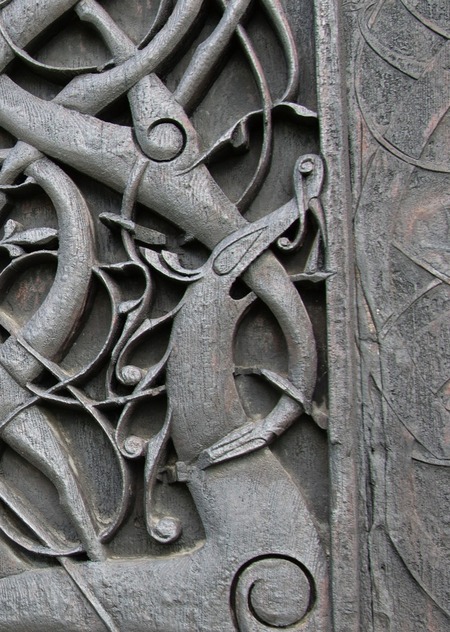
Urnes. Clearings between the knots Unknown master. Northern portal in Urnes, circa 1070. Wood. [C] Thin ribbons envelop the thickened bodies of animals. The clearings allow the knots to be discerned.
The Portal as a Carver’s Work. Church and North Portal Unknown Masters. Stavkirch in Urnes, circa 1130. Overall view and the north wall with carvings, circa 1070. [C] The roof steps are visible from a distance. The portal’s design is discernible upon approaching the wall.
Entry Border Unknown Master. North Portal in Urnes, c. 1070. General view and detail of the carving. [C, D] The shutter holds the vertical. The volutes frame the opening.
What Comprises Readability Unknown Master. Northern Portal in Urnes, c. 1070. Detail of carving. [D] The lower band at the intersection is interrupted. The shadow helps reveal what passes above.
How Masters Study the Original «Treets Meister» Project. Portal observation, 2020. Work on carving, 2020–2024. [E] The human figure provides scale for the portal. A close-up zooms in on the form of a single recess.
Before Joining Parts «Treets Meister» Project. Preparation, 2020–2024, and portal reconstruction, 2024. [E] On the horizontal base, the carver has access to the entire design. After assembling the boards, the entrance is framed.
Old and New Surface Unknown Master. Urnes Portal, c. 1070. [C] Treets Meister Project Masters. Reconstruction, 2024. [E] The placement of the hinges and the verticality of the door leaf match. The color of the wood and the shadows differ.
The Height of the Carving and Human Height Project Master: «Treets Meister.» Reconstruction of the Urnes Portal, 2024. View with project participants. [E] The figure in the opening provides scale. The viewer sees the upper and lower parts of the carving from different angles.
A finished portal in a different environment «Treets Meister» project masters. Showcase of the portal reconstruction, 2024. [E] In the exhibition space, the reconstruction is visible in its entirety. The historical framing is built into the wall. [6]
Body Ornament. The Shoulder as a Compositional Turn Obban. Urnes-style Tattoo, 21st Century. Shoulder and Forearm. [F] A large loop curves around the shoulder. Elongated bands follow the narrowing of the arm down to the forearm.
Relief and Black Contour Unknown master. Urnes Portal, c. 1070. [D] Obban. Urnes-style tattoo, 21st century. Fragment. [F] In the carving, the intersection is discernible by shadow; in the tattoo, by contour and the break in the lower line.
Dense lines and open loops Obban. Two Urnes-style tattoos from the 21st century. [F] Small whorls on the left fill almost the entire skin area. On the right, a large loop leaves a wide, open patch of skin.
How the sleeve is viewed from the side Obban. Urnes-style tattoo, 21st century. Side view. [F] The lines extend past the edge of the arm. When the arm is turned, the continuation of the design is revealed.
Local Composition Obban. Urnes-style tattoo, 21st century. Black and red outlines. [F] A black braid closes into an oval. Red lines form a separate accent in the center.
Two Types of Edge Unknown Master. Urnes Portal, c. 1070. [C] Obban. Urnes-style Tattoo, 21st Century. [F] In the portal, the edge is defined by the board and the opening. In the tattoo, the loops themselves form the boundary.
Forearm Intervals Obban. Urnes-style tattoos, 21st century. Cropped fragments. [F] In the first fragment, the light intervals are larger; in the second, they are fragmented by a dense interweaving pattern.
From Style to Multiple Compositions Obban. Four Urnes-style tattoos from the 21st century. [F] The connection and line thickness link the works to the Urnes style. The size and density of the pattern vary. [7]
Ornament along the rim of the object. Bowl Erik Fett. «Bowl with Dragon in Urnes Style, ” 21st century. Wood, overall view. [G] The horizontal body of the vessel is visible in the overall view. The raised ends reveal sections of carving.
Swirls on a narrow band Erik Fait. «Bowl with Dragon in Urnes Style, ” 21st Century. Carved edge detail. [G] Large loops occupy the width of the edge. Thin lines curve to follow them.
Two Framing Styles Unknown master. Urnes Portal, c. 1070. [C] Erik Feit. Chalice, 21st Century. Detail. [G] On the portal, the ornament runs along the entrance; on the chalice, it runs along the cavity. The vertical transitions into a curve.
Relief on light wood Unknown master. Urnes Portal, c. 1070. [D] Eric Fait. Bowl, 21st century. Detail. [G] Narrow shadows delineate the light relief on the bowl. The indentations are more pronounced on the darkened portal.