Categories
- Concept and Conclusions
- The Mausoleum of Galla Placidia
- The Basilica of San Vitale
- The Basilica of Sant’Apollinare in Classe
- The Basilica of Sant’Apollinare Nuovo
- Bibliography
- Image Sources
Concept and Conclusions
Topic: Christian Animal Symbolism in Byzantine Mosaics (Based on Ravennian Monuments of the 5th–6th Centuries)Byzantine mosaics are often perceived as merely decorative art, yet they constitute a rigorous visual system. Animals within these mosaics occupy an intermediate position: they simultaneously remain part of the earthly world and become carriers of theological ideas. This is particularly evident in the Ravennian monuments, where both scenes with animals and decorative patterns featuring them appear. In this work, I aim to investigate how specific visual techniques—such as posture, gaze, scale, color, and placement within the composition—cause the conventional depiction of a beast or bird to be interpreted differently, as a symbol.
For this analysis, four monuments in Ravenna were selected: the Mausoleum of Galla Placidia, the Basilica of San Vitale, the Basilica of Sant’Apollinare in Classe, and the Basilica of Sant’Apollinare Nuovo. These structures display both types of imagery: animals within religious scenes and animals within ornamental-landscape compositions. I examine both overall mosaic views and individual fragments—such as a close-up of a sheep’s head or a bird’s foot near a chalice—to illustrate how these techniques function.The work is divided into four sections based on a geographical principle—corresponding to the Ravenna monuments containing the material under investigation. The first section is dedicated to the Mausoleum of Galla Placidia, the second to the Basilica of San Vitale, the third to Sant’Apollinare in Classe, and the fourth to Sant’Apollinare Nuovo. This structure allows for a comparison, within each monument, of how the same medium (mosaic) utilizes animals differently, while maintaining a clear link to the specific location.When working with the material, I draw upon studies of Byzantine art as well as existing descriptions of the mosaics from academic databases. These sources are necessary to verify my visual observations and to understand the context in which the mosaics were created. I use these texts as a foundation for my own analysis.
The main question of this work is: through what visual means (pose, gaze, scale, color, placement in the composition) does the animal in Byzantine mosaics transform from a depiction of nature into a theological symbol? I hypothesize that the symbol is created not by the animal’s «species, ” but by the composition itself. In narrative scenes, this occurs through action and hierarchy (direction of movement toward the center, subordination to the scale of a sacred figure), while in ornamentation—through symmetry, repetition, and the golden background. Furthermore, analyzing individual monuments reveals that even across different basilicas, the same techniques function similarly—suggesting that the key lies not with a specific artist, but with the general Byzantine visual logic.
Mausoleum of Gallus Placidia
Mosaics from the Mausoleum of Galla Placidia
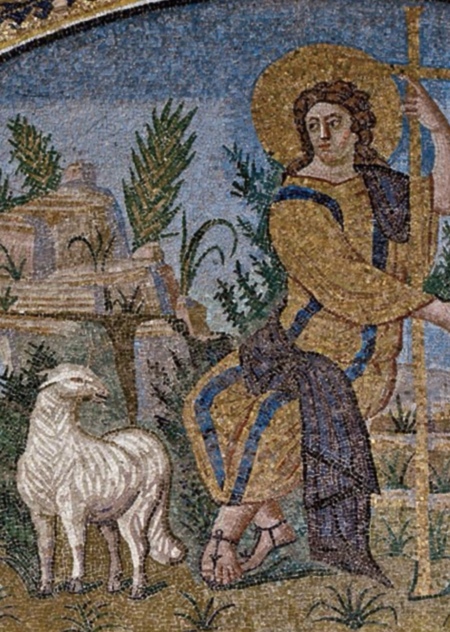
Mosaic «The Good Shepherd»
«Good Shepherd» / Mausoleum of Gallia Placidia / 5th Century
«Good Shepherd» / Mausoleum of Gallus Placidus / 5th Century
Christ turns his head and torso to the right, extending his arm to the left to touch the sheep. The sheep, in turn, is looking toward him. This gesture of touching and the direction of the gaze create a visual relationship of «shepherd—flock»: the animal is integrated into the relationship with the sacred figure.
«Good Shepherd» / Mausoleum of Gallus Placidia / 5th century
Christ’s gaze is directed to the opposite side of the hand gesture. This technique creates the sensation that the shepherd sees even those sheep who are outside his field of view. The animals in the mosaic are arranged so that each one is facing Christ, while Christ himself remains the central focus that holds the composition together.
Compendium, doves at the spring
Galla Placidia Mausoleum / 5th Century
Beneath the feet of the apostles are depicted two white doves, positioned on either side of a bowl of water. The birds are arranged with absolute symmetry: their postures, gaze direction, and head inclination mirror each other. This symmetry creates a sense of order and tranquility. The composition is structured so that the bowl becomes the focal point, with the doves framing it. The white color of the birds contrasts with the dark blue background, making them visually dominant. The symbolism here is established through symmetry and color contrast, which elevate ordinary birds to the realm of sacred imagery.
The «Paradise Garden» Collection
«Garden of Paradise» / Mausoleum of Galla Placidia / 5th Century
In this fragment, two deer bow toward a source located precisely in the center. The animals' poses create a sense of directed movement toward the middle of the composition. The gaze and bodies of the animals guide the viewer to the water, which in a Christian context is read as a source of salvation.
«Garden of Paradise» / Mausoleum of Galla Placidia / 5th Century
Two deer are positioned on either side of the light source; their bodies mirror each other, and the source is placed exactly in the center. This symmetry transforms them from «two deer» into a paired image of souls striving toward a single center.
Mosaic: «Doves Drinking from a Bowl»
«Doves Drinking from a Bowl» / Mausoleum of Galla Placidia / 5th Century
In the context of the mosaic, the upper bird’s posture is interpreted as a connection to the source: the bird is positioned on the border between the water and the surrounding space, and its pose captures the moment of touching the sacred object. The deep blue background on which the bird is depicted also plays a crucial role. Against such a backdrop, the light-colored bird appears particularly vivid. Within the mosaic, the bird’s gaze and the touch of its feet to the chalice, combined with the color contrast, read as participation in the source. Its posture freezes the moment of contact with the sacred object.
«Doves Drinking from a Bowl» / Mausoleum of Galla Placidia / 5th Century
The two lower birds are placed symmetrically on either side of the bowl, with their bodies and heads oriented toward the center. This symmetry transforms the birds into a pair. The white bodies contrast with the dark blue background, and it is this contrast, combined with the symmetry, that creates a sense of order. They are souls arranged around a source.
Basilica of San Vitale
San Vitale Mosaics