Research Concept
Museums are increasingly incorporating computer games, internet art, and interactive installations into their collections. However, such exhibits cannot always be preserved in the same manner as a painting or a piece of furniture. Their existence may depend on the operating system, browser, hardware, and user actions. Even if the original files are saved, the artwork may cease to function or alter its original appearance. This research topic was chosen because digital heritage compels a re-examination of the concept of a museum object. In traditional collecting, the preservation of the physical object is paramount. In digital art, software processes, system behavior, and viewer interaction can be equally significant. A conflict arises: preserving the original hardware does not always ensure the artwork’s accessibility, while migrating it to modern technologies may change its characteristics. The object of study is digital works and interactive design artifacts within museum collections. The subject is the methods of their preservation and exhibition, as well as the influence of these methods on the appearance, functionality, and perception of the exhibits. The chronological scope spans the late twentieth century through the first quarter of the twenty-first century, while referencing specific earlier examples of computer culture. Digitized copies of traditional works are not considered an independent object of analysis.
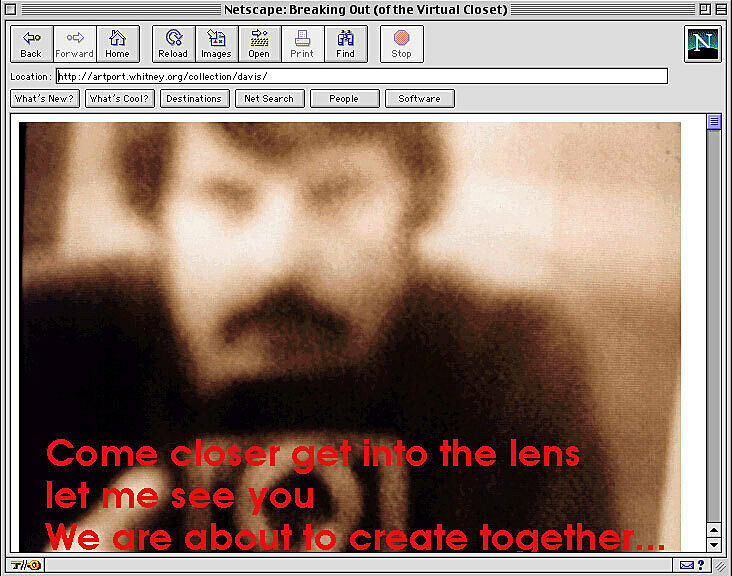
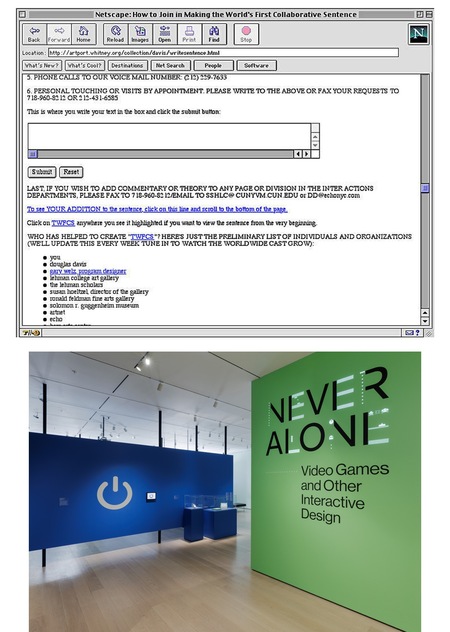
Douglas Davis. The World’s First Collaborative Sentence, 1994. A historic interface in the Netscape browser.
Research Question: How do practices for preserving and exhibiting digital objects affect their original appearance, functionality, and the possibility of recreating the historical viewer experience? The hypothesis is that the authenticity of a digital work is not always determined by the preservation of its original medium or the immutability of its software code. Depending on the object, significant roles can be played by the visuals, processing speed, interface, technical environment, and interactivity. Therefore, museums are compelled to decide which characteristics of a work must be prioritized for preservation. Different methods allow for the recreation of various aspects of an object, but none is universal. The research is based on a thematic and functional principle of categorization. The first chapter is dedicated to preservation practices: archiving, migration, and reconstruction of digital works. The second chapter covers exhibition practices: display on original hardware, emulation, and interactive and documentary presentation. This separation allows for a separate examination of the work’s long-term existence and the methods for granting access to it, while accounting for the overlap of some techniques. Visual materials are selected based on a principle of evidential documentation. The research is founded on archival screenshots, photographs of original and restored setups, equipment images, and documentary materials from museum projects. Particular attention is paid to comparing the original and contemporary versions of a single work. Each illustration must help reveal a specific challenge in preservation or exhibition, rather than merely demonstrating the object’s appearance. The textual source base includes official materials from MoMA, the Whitney Museum, the Guggenheim Museum, the Computer History Museum, ZKM, Rhizome, as well as publications by specialists in the preservation of digital art. The principle of source selection is documentary reliability and the ability to verify historical information, authorship, technical specifications, and the circumstances of the museum exhibition. The research is structured around historical-contextual and comparative visual analysis. Museum cases are examined according to five criteria: preservation of source data, visual form, technical environment, nature of interaction, and exhibition conditions.
Navigation
Chapter I. Practices for Preserving Digital Objects 1.1. Archiving: Preserving the Digital Original 1.2. Migration of Digital Works 1.3. Restoration and Reconstruction of Digital Works Chapter II. Practices for Exhibiting Digital Objects 2.1. Display on Original Equipment 2.2. Emulation of Digital Objects 2.3. Interactive Exhibitions 2.4. Documentary Exhibitions Conclusion · Bibliography · Image References
Never Alone: Video Games and Other Interactive Design, MoMA, New York, 2022–2023. Museum Exhibition, IN2500.6. Photography: Emile Askey.
Chapter I. Practices for Preserving Digital Objects
1.1. Archiving: Preserving the Digital Original
In traditional museum practice, the preservation of an object is primarily tied to its physical condition. In digital art, the situation is more complex: a museum must account not only for the files and software code but also for the conditions necessary for the artwork to function. A characteristic example is Oli Lyalina’s internet artwork, My Boyfriend Came Back from the War, created in 1996. It is a nonlinear narrative built upon black-and-white imagery, textual fragments, and the division of the browser window into multiple areas.
Olya Lyalina. My Boyfriend Came Back from the War, 1996. Start screen. Screenshot from the author’s website, 11/04/2026.
Unlike traditional illustration, the image here changes dynamically based on user interaction. By clicking on page elements, the viewer fragments the content and constructs the narrative sequence independently.
Olya Lyalina. My Boyfriend Came Back from the War, 1996. Historical interface after several navigations, rendered in Netscape. Publication material from 2016.
Comparing two screens reveals that the web page structure itself becomes artistic material. Saving only an individual image means losing the mechanism through which the viewer constructs a composition. A similar problem arises when curating video games. In 2012, MoMA acquired the first fourteen video games for its museum collection, including Pac-Man and Tetris.
Toru Iwata. Pac-Man, Namco, 1980. Gameplay screen.
Visually, Pac-Man presents itself as a maze with a limited set of colors and characters. However, merely capturing this screen is insufficient to preserve the game; one must recreate the controls, enemy movement, scoring rules, and the pace of the action.
Alexei Pazhitnov. Tetris, 1984. Historical Interface from the MoMA Collection.
In Tetris, the rules governing piece movement and placement are of critical importance. The same gameplay system can exist across various devices with differing visual presentations. Therefore, a museum must distinguish between the core software principles of the game and the specific historical forms of its implementation. MoMA emphasizes the necessity of acquiring original software formats, hardware, source code, and technical documentation whenever possible, as well as gathering information directly from the developers. Conclusion: a digital original is not always a single file or physical medium, but rather a collection of data and functional conditions. Archiving must preserve information not only about the work’s appearance but also about how it functions.
1.2. Migration of Digital Works
Over time, hardware and software become obsolete. One strategy for preserving digital artworks is migration—transferring a program or its components to a more modern technical platform. However, this transfer is not a neutral process. Even when the underlying programming logic is maintained, changes to the hardware environment can affect color, speed, and the character of image movement. A telling example is John F. Simon Jr.’s Color Panel, created in 1999.
John F. Simon Jr. Color Panel v1.0, 1999. Original version: modified Apple PowerBook 280c and acrylic.
The work is a shifting composition of colored rectangles. The software runs on a computer built into an acrylic enclosure, and the image gradually transforms over time. For the exhibition «Seeing Double: Emulation in Theory and Practice,» held at the Guggenheim Museum in 2004, the artist created a new version, Color Panel v1.0.1, based on an Apple PowerBook G3. Upon transfer, it was discovered that the more powerful computer executed the program too quickly. To preserve the original rhythm of the changes, the artist had to add slowing commands.
John F. Simon Jr. Color Panel, 1999; 2004. Left — v1.0.1 (2004), right — v1.0 (1999). Joint display at the Seeing Double exhibition, Guggenheim Museum, 2004.
The collaborative display allowed for a comparison not only of the external form of the devices but also of the behavior of the screen compositions. Because the work contained elements of randomness, the museum used an additional copy of the original version to control for differences between the systems.Conclusion: Migration extends the lifespan of a digital artwork but can alter its essential characteristics. In the case of Color Panel, preserving the artistic concept required changing the technical execution, which illustrates the distinction between the authenticity of the source code and the authenticity of the viewer’s experience.
1.3. Restoration and Reconstruction of Digital Works
In some cases, a digital artwork cannot be restored by simply transferring files to a modern computer. Its original technical system may be too complex or partially lost. In such instances, the museum must recreate the individual components necessary for the object to function. An example is the interactive video installation The Erl King by Graham Wainbrenner and Roberta Friedman, created between 1982 and 1985.
Graham Wynebrand, Robert Friedman. The Erl King, 1982–1985. Original installation at The Kitchen, New York, 1988.
The piece allowed the viewer to change the sequence of video clips via a touchscreen. Its operation relied on a Sony SMC-70 computer, laser videoprojectors, and custom-built software.
Graham Wynebrand, Robert Friedman. The Erl King, 1982–1985. Sony SMC-70 and components of the initial system. Documentation photography shows Seeing Double, 2004.
By the early 2000s, maintaining the original system had become difficult. For the Seeing Double exhibition, the specialists collaborated with artists to create an updated version that preserved the core interactive logic. Instead of fully emulating the computer, an interpreter of the original source code was developed to replace the functions of the obsolete hardware.