Navigation
1. Research Concept
2. Philosophical Framework
3. Genesis of Form: From Avant-Garde to the Thaw
4. Visual Analysis
5. Dynamics and Vector (The Dynamically Sublime)
6. Structure and Sign (Apollonian Order)
7. The Image of Humanity and the Moral Subject
8. Conclusion
9. Bibliography and Image Sources
Research Concept
The Problem of Visualizing Infinity in Soviet Art (1957–1967)
The period from 1957 to 1967—from the successful launch of Sputnik-1 to the celebration of the 50th anniversary of the October Revolution—became an era of radical reconstruction of the Soviet visual canon. The sending of humans beyond Earth presented artists, architects, and graphic designers with a fundamental plastic challenge: how to visualize that which fundamentally lacks form, boundaries, and human scale—the absolute infinity of Space? [1]
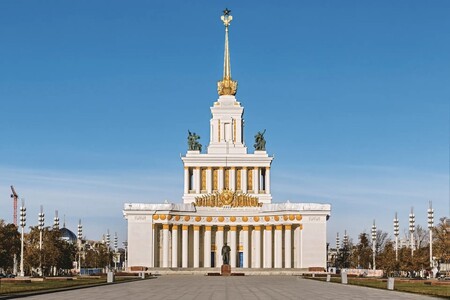
Left: Pavilion No. 1 «Central» (Main) — https://um.mos.ru/houses/vdnkh-pavilon-tsentralnyy/
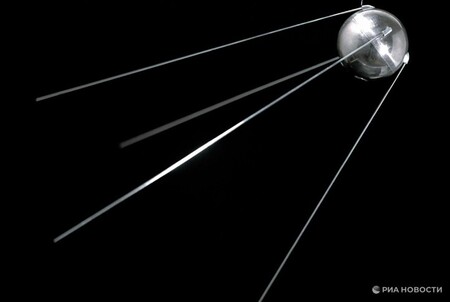
Right: The first Soviet artificial Earth satellite — https://riamediabank.ru/media/159275.html Author: Alexander Mokletsov RIA Novosti Medibank
Stalinist neoclassicism, with its heavy-handed historical ornamentation and Socialist Realist depiction of everyday life, proved entirely disproportionate to the grandiose scale of the event. A completely different visual language was required—one capable of uniting the state mandate, the scientific and technical optimism of the «Thaw,» and a profound sense of awe before the mysteries of the Universe. [1]
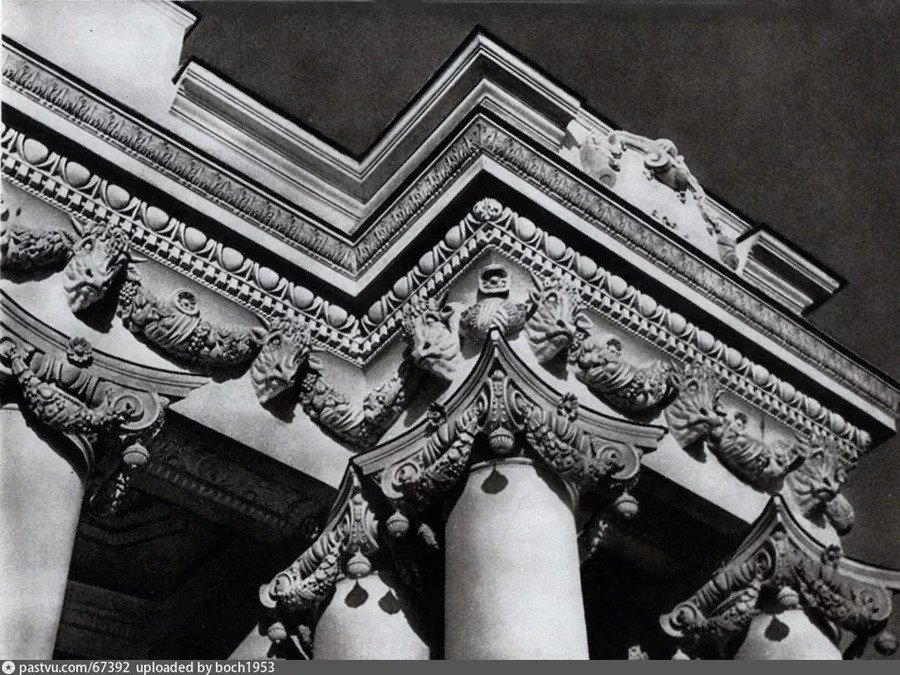
Detail of the portico of the «Animal Husbandry» pavilion. Photo from 1954.
In this brief historical period, Soviet artistic culture formed a cohesive aesthetic system. Space in this context is visualized not merely as a physical realm to be explored, but as a domain where absolute reason is embodied—a place where the boundless chaos of the universe submits to strict compositional and semantic order.
«To Distant Planets!» Author: B. Reshetnikov, 1974
Philosophical Framework
To grasp the stylistic complex of Soviet space culture, one must turn to two fundamental aesthetic categories of European philosophy: Immanuel Kant’s theory of the Sublime and Friedrich Nietzsche’s concepts of the Apollonian and Dionysian principles.
Immanuel Kant: The Mathematical and Dynamic SublimeIn the «Critique of Judgment, ” Immanuel Kant differentiates between the Beautiful and the Sublime. If the beautiful is related to the form of an object and its finite measure, the sublime arises when encountering something without limits that overwhelms sensory perception. [2, pp. 113–120]Immanuel Kant — The Mathematical SublimeThis occurs when contemplating an absolute magnitude that human imagination cannot grasp in a single, coherent act (for instance, the boundlessness of the universe). The encounter with this incommensurability initially provokes a sense of sensory impotence but subsequently awakens Reason—the faculty capable of conceiving the idea of infinity. [2, pp. 117–129]Immanuel Kant — The Dynamic SublimeThis emerges when contemplating overwhelming natural power (such as storms, abysses, or oceans). The individual recognizes their physical insignificance before the elements, yet simultaneously attains a sense of spiritual and moral superiority over them. [2, pp. 130–135]
Visual:
Peak dynamic load during fire tests of the RD-107 liquid rocket engine https://tvzvezda.ru/news/20201025921-9gqY7.html?ysclid=mvv0vhvdb690357882
«The sublime—that one possibility of thought which proves the soul’s capacity to transcend any scale of feeling.» — Immanuel Kant, «Critique of Judgment, ” [2, p. 120]
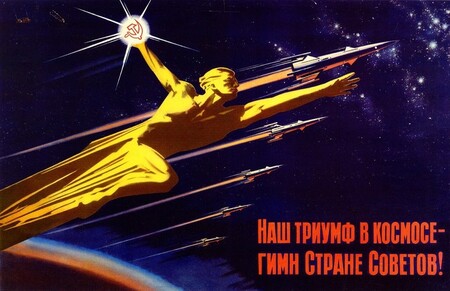
In Soviet space art, the abyss of Space (Kantian mathematically sublime) and the crushing energy of a rocket launch (dynamically sublime) are translated into the category of human genius triumph: reason conquers and masters frightening infinity.
Poster «Our Triumph in Space — Anthem of the Soviet State» (1963) Author: V.P. Viktorov
Friedrich Nietzsche — Dionysian Chaos In «The Birth of Tragedy Out of the Spirit of Music, ” Nietzsche describes the Dionysian impulse as boundless chaos—an undifferentiated element, intoxication, and the dissolution of form. The natural Cosmos is ultimately Dionysian—it is a cold, hostile, and destructive abyss. [4]
AI Boilerplate

Friedrich Nietzsche — The Apollonian PrincipleThe Apollonian principle is characterized by ordered structure, measure, geometry, clarity, plastic expressiveness, and the principle of individuation. The Soviet visual canon of 1957–1967 enforces a strict Apollonian taming of the Dionysian element, constraining it within a grid of orbits and pure typography.«Apollo appears before us as the sculptor of plastic forces… Upon him rests the seal of proportion, freedom from savage impulses, the wise tranquility of the creator god.» — Friedrich Nietzsche, «The Birth of Tragedy from the Spirit of Music.» [4]Cosmos in its natural state is ultimately Dionysian—it is an unfriendly, cold, and destructive abyss. However, the Soviet visual canon of 1957–1967 imposes a rigid Apollonian control over this element. Artists channeled cosmic chaos into an Apollonian grid composed of orbits, vector arrows, infographic schemes, and pure typography.Visuals: Infographic grid and typography. Author: V.P. Viktorov
Genesis of Form: From Avant-Garde to the Thaw
Continuity from the Russian Avant-Garde
Soviet space modernism of the 1960s directly drew upon the legacy of the Russian avant-garde of the 1920s in its visual aesthetics. Kazimir Malevich, in his treatise «Suprematism. 34 Drawings» (1920) and theoretical works, explicitly described Suprematist forms as cosmic structures floating in weightless white space. His architectural models—«Architectons» and «Planets of the Earthlings» (1923–1924)—represented futuristic projects for space stations and cities devoid of earthly gravitational ties. [3; 6]
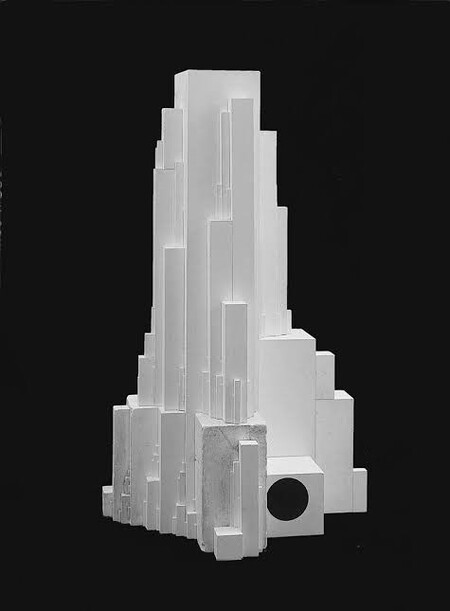
«Architectons»The concept of Kazimir Malevich’s architectons and his associates embodied the transition from planar painting to pure spatial construction. These volumetric Suprematist forms disregarded traditional laws of terrestrial gravity and architectural utilitarianism, anticipating future orbital stations and settlements.Visual: Kazimir Malevich’s Architecton. Source: Socks Studio
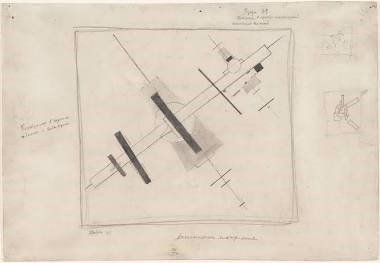
«Planes»The «Planes» series, created by Kazimir Malevich and his students in the 1920s, comprised radical designs for dynamic spatial structures. They were conceived not for static placement on Earth, but for free flight and orientation in vacuum space, serving as precursors to future orbital stations. In these sketches, rational geometry and vector axes entirely supersede terrestrial gravity, structuring a Suprematist order amidst cosmic infinity.Visual: Kazimir Malevich. Project from the «Planes» series. Source: MoMA.
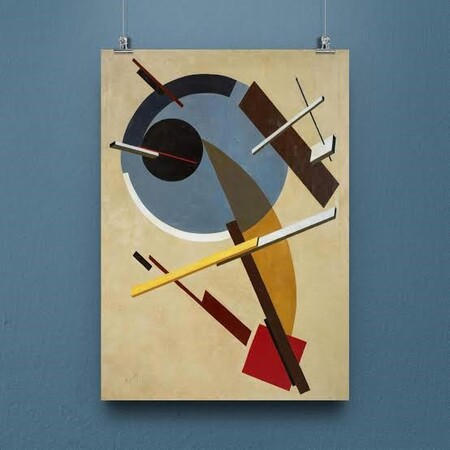
El Lissitzky, in the concept of «Prouns» (Projects for the Affirmation of the New), developed a system of axonometric representation for geometric bodies in zero gravity, creating a plastic foundation for future infographics and poster art. [3]
In the early 1920s, his work became a crucial link between the Suprematist plane and volumetric spatial construction in zero gravity. By using axonometry, El Lissitzky created a visual language that later formed the basis of Soviet infographics, aerospace schematics, and poster design. [3]
In this work, volumetric geometric elements and vector axes appear to float in an infinite, neutral space, demonstrating principles of form construction outside of terrestrial gravity.
**Visual: ** El Lissitzky. From the series «Prouns.» Source: Etsy.
The experience of Alexander Rodchenko and Varvara Stepanova in the 1920s established the fundamental principles of Soviet graphic constructivism. During the Thaw (1957–1967), this avant-garde toolkit was cleansed of the propagandistic aggression of the 1920s and reinterpreted by designers at the publishing houses Izogiz, Atomizdat, and the VTP bureau as an aesthetic foundation for visualizing scientific and technological breakthroughs and the exploration of space. [6]
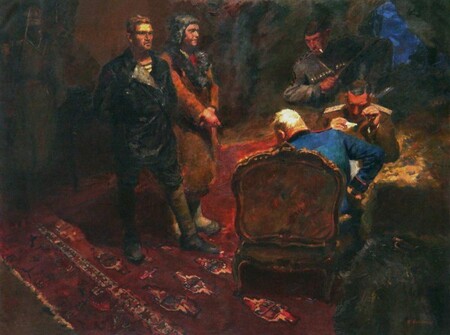
1. Rejection of Pictorial NarrativityThe Essence of the Transformation: In the Stalinist visual culture of the 1930s–1950s, illusionistic narrative painting predominated (academic drawing, complex multi-figure compositions, detailed rendering of the background). [1; 5]A classic example of the academic pictorial style in Socialist Realism. The composition is built upon the psychological and dramatic conflict between two groups of characters, where every background character and interior detail (from tablecloth folds to facial expressions in the background) is rendered with illusionistic precision.Visual: «Interrogation of Communists» (1933) Artist: Boris Vladimirovich Ioganson
«V. I. Lenin Proclaims Soviet Power at the Second All-Russian Congress of Soviets» (1947)
A sample of a complex, historical-revolutionary canvas. The painting is distinguished by its deep spatial perspective, meticulous rendering of the mass of workers, soldiers, and sailors in the Smolny Hall, as well as a detailed depiction of the fabric texture of the clothing and the architectural elements of the era.
«Meeting of the Presidium of the USSR Academy of Sciences» (1951)
An illusionistically realistic depiction of a grand state event. The painting demonstrates a strict adherence to the laws of classical academic perspective, where each of the dozens of attending academics bears a portrait likeness, and the interior is captured with meticulous painterly precision.
These canvases serve as a contrasting visual and plastic backdrop to the Thaw’s cosmo-modernism of the 1960s, which replaced weighty narrative with a concise Apollonian sign, vector, and Constructivist geometry.