Concept
The medieval church was perceived not merely as an architectural structure designed for religious rites and gatherings of the faithful. In the mind of the people of that era, it represented a distinct model of the cosmos, wherein every architectural detail held symbolic meaning. Domes and vaults embodied the celestial sphere; the altar became the point of contact between the earthly and the divine; and the walls, columns, and arches manifested the established order of the material world. Thus, the church space itself transformed into a reflection of the universe’s structure.
This worldview was also expressed in its decorative design. Images of planetary systems, zodiac constellations, celestial hierarchies, and biblical narratives became an inalienable part of the visual language of sacred architecture. Their presence was not mere incidental ornamentation; through symbols and images, the ecclesiastical space narrated the complex organization of the cosmos, linking religious beliefs with ancient astronomical knowledge and medieval philosophy. The imagery, in this instance, served as a kind of mediator between the invisible divine order and human perception.
The placement of these compositions was also particularly significant. Ceilings, vaults, walls, and floors offered different possibilities for the viewer’s interaction with the imagery. A gaze directed upward might encounter a depiction of the celestial sphere, whereas wall frescoes and mosaics unfolded entire systems of religious and cosmological ideas before the individual.
This study examines four examples of cosmological imagery in sacred and educational spaces: the crypt of St. Ann in Anagni (Italy, 13th century), the vault of the Salamanca University library (Spain, late 15th century), the fresco composition of Campo Santo in Pisa (Italy, late 14th century), and the Byzantine mosaic programs of the 9th–12th centuries.
Despite the common theme, each of these monuments demonstrates its own unique approach to depicting the structure of the universe.
Research Contents
- Introduction
— Ananias’s Crypt
— Salamanca Sky
— Campo Santo
— Byzantine Domes
— Conclusion
— Sources
Kripte Anani: Space as a Threshold
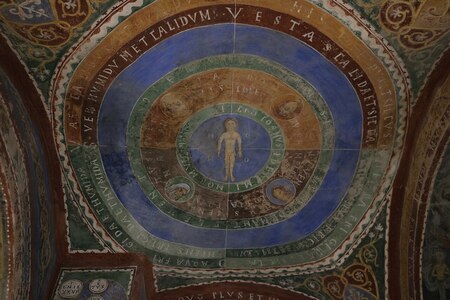
The crypt of the Basilica di San Mannone in Anania was painted between 1231 and 1255, during the pontificate of Pope Gregory IX. It represents one of the most large-scale and complex fresco ensembles of medieval Italy. The paintings cover the walls, vaults, apses, and column capitals, unifying biblical and hagiographical narratives with depictions dedicated to the organization of the cosmos.
A special place in the program is held by the cosmological diagrams located at the entrance to the crypt. Among these are a scheme of the microcosm, images of the zodiac and planets, as well as the «syzygy» diagram, which illustrates the interconnection of the four elements and their properties. Nearby are the ancient physicians Hippocrates and Galen and the figures of four astrologers. This juxtaposition of religious imagery, scientific diagrams, and ancient authorities reflects the desire to unify conceptions of human nature and the structure of the Universe within a single worldview.
Before encountering the sacred images and the altar, the visitor first met a visual representation of the cosmos.
Thus, entry into the crypt became a unique intellectual threshold: the viewer was first asked to comprehend the structure of the universe before moving on to perceiving the religious history. Humanity here is presented as a microcosm—a part of a single system connected to the planets, the elements, and the surrounding world.
Anania Cathedral (Cathedral of Santa Maria — Crypt of San Magno 1071–1105)
Cosmological imagery was not set against religious content, but prepared the viewer for its reception.
Cathedral of Annia (Santa Maria Cathedral — crypt of San Magno 1071–1105)
Martina Banyl, studying the diagram of the syzygy, notes the difference between the original scientific concept of the schema and its pictorial realization. In book tradition, such diagrams served as precise tools for knowledge systematization; however, when transferred to the walls of the church, they inevitably yielded to the characteristics of monumental painting and the overall narrative structure of the ensemble. This distinction is important not so much as a potential inaccuracy in the depiction, but as a testament to the interaction between science and art. Upon entering the sacred space, the scientific schema ceased to be solely a method of knowledge transmission—it became part of the visual and religious narrative. Its content was preserved, but its form adapted to the new environment and mode of perception. Thus, the presence of cosmological diagrams in the Crypt of Ananias testifies to the papal curia’s interest in medicine, astrology, and the era’s natural scientific concepts. This knowledge was incorporated into the religious program and helped present the Universe as an ordered whole, in which natural processes, the human body, and the divine plan are interrelated.
«Salamanca Sky»: Space Above the Library
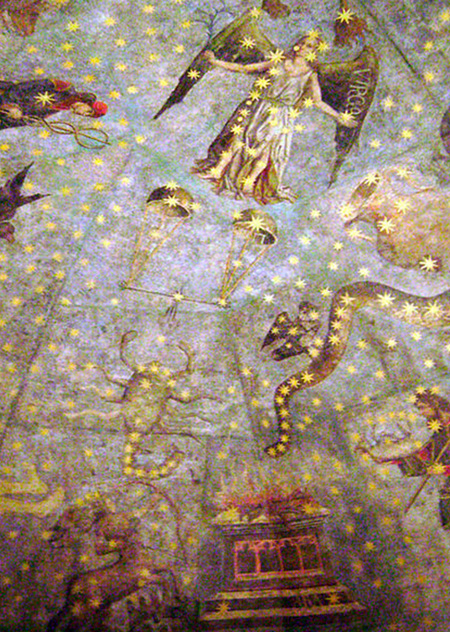
The vaulted ceiling of the University of Salamanca’s old library was decorated by the artist Fernando Gallego between 1483 and 1486. The surviving section of the fresco depicts a night sky with golden stars, constellations, and zodiac signs. Along the edges runs a Latin inscription from the eighth psalm, which speaks of the heavens, the Moon, and the stars as God’s creation. This example is interesting because the depiction of the cosmos appears not in a church, but in a university library. However, the library space itself was perceived as a special place—a peculiar temple of knowledge. The celestial vault above the readers served as a reminder that the study of the world and nature is connected to the knowledge of divine order. Moreover, the fresco itself combines various traditions: it uses zodiac signs and constellation images derived from ancient and Islamic astronomy.
Salamanca Sky (El Cielo de Salamanca 1483–1486)
Researcher Santiago Sebastián connected the painting with the teaching of astronomy. It could serve as a visual aid, helping students study constellations and the arrangement of celestial bodies. Jeannette Favro Peterson, in turn, noted that Gallego synthesized various artistic traditions—Islamic, Italian, and Northern European. Thus, the artist was not merely repeating existing patterns but was creating his own vision of cosmic space.
The biblical inscription along the edges of the vault plays a particularly important role. It links the astronomical imagery with the Christian worldview and reminds the viewer that the celestial order is considered part of divine creation.
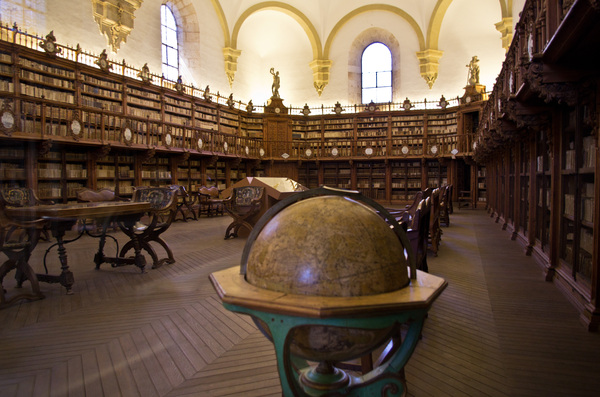
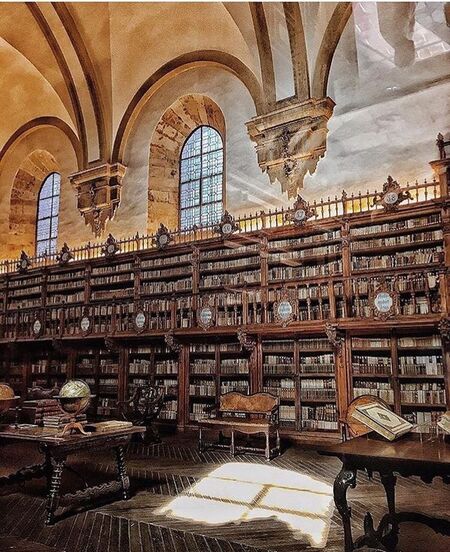
University of Salamanca, library in Spain
The development of university education and the interest in astronomy in the late 15th century led to the creation of murals that merged scientific knowledge with religious conceptions of the world. However, over time, the artwork went hidden—the vault was covered with a new structure in the 18th century. Only 20th-century restoration allowed the murals to be rediscovered. «The Salamanca Sky» demonstrates that the sacred image of the cosmos could exist beyond church architecture. Even the university library became a space where the study of the universe was perceived as a means of approaching the understanding of the divine plan.
Fragment from the «Salamanca Sky» mural
Salamanca University in Spain
Campo Santo: Space as Hierarchy and Memory of Death
The fresco by Piero della Francesca in Campo Santo was created between 1389 and 1391. At the center of the composition is the Earth, divided into three continents: Asia, Europe, and Africa. Around it are 21 concentric circles representing the structure of the cosmos: the four elements, the planets, the Sun and Moon, the starry sky with the zodiac, the crystalline sky, and the nine angelic hierarchies. God is positioned above the entire system, while Thomas Aquinas and Augustine are depicted in the lower section.
Campopanto Fresco (Piero di Puccio, 1389–1391)
Here, the cosmos is presented as a strict hierarchy, in which each sphere occupies a specific place and is subject to a divine order. The very space of Campo Santo—a cemetery connected to the memory of the deceased and reflections on the finitude of human life—lends special significance to this image. The cosmological scheme serves as a reminder of the scale of creation and humanity’s place within it: between the earthly world and the celestial hierarchy. Thus, the fresco represents the Universe not merely as a structure of the world, but as an expression of divine order, within which human existence is also included.
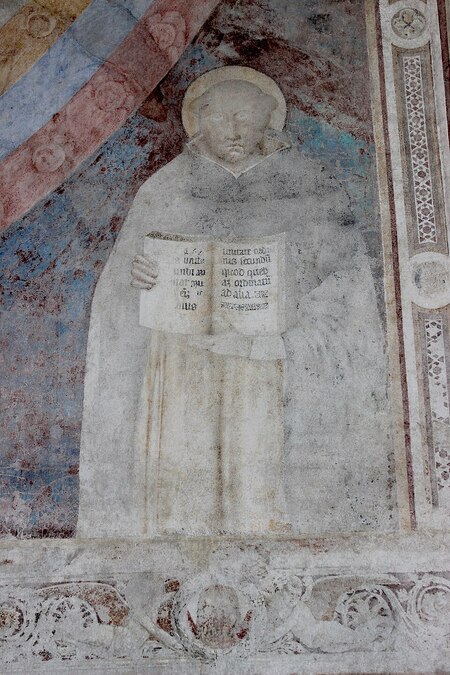
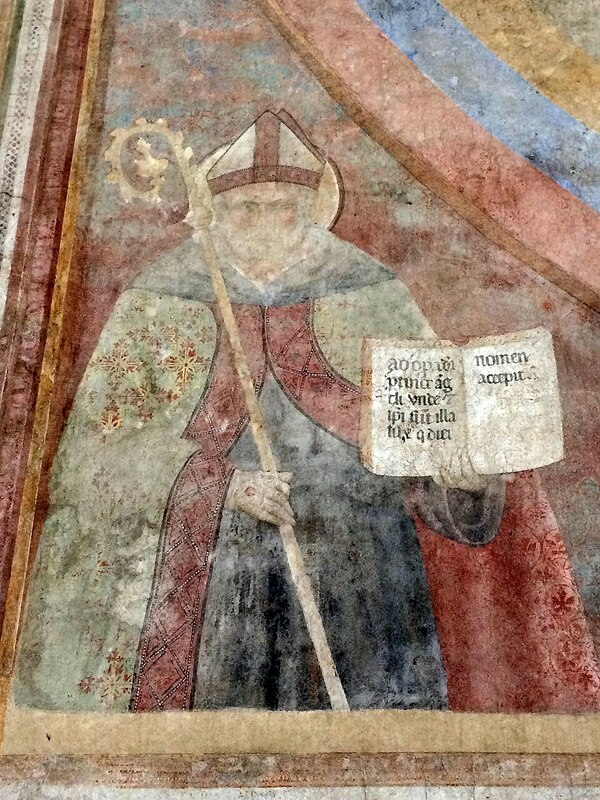
Fragments of the Campo Santo Fresco
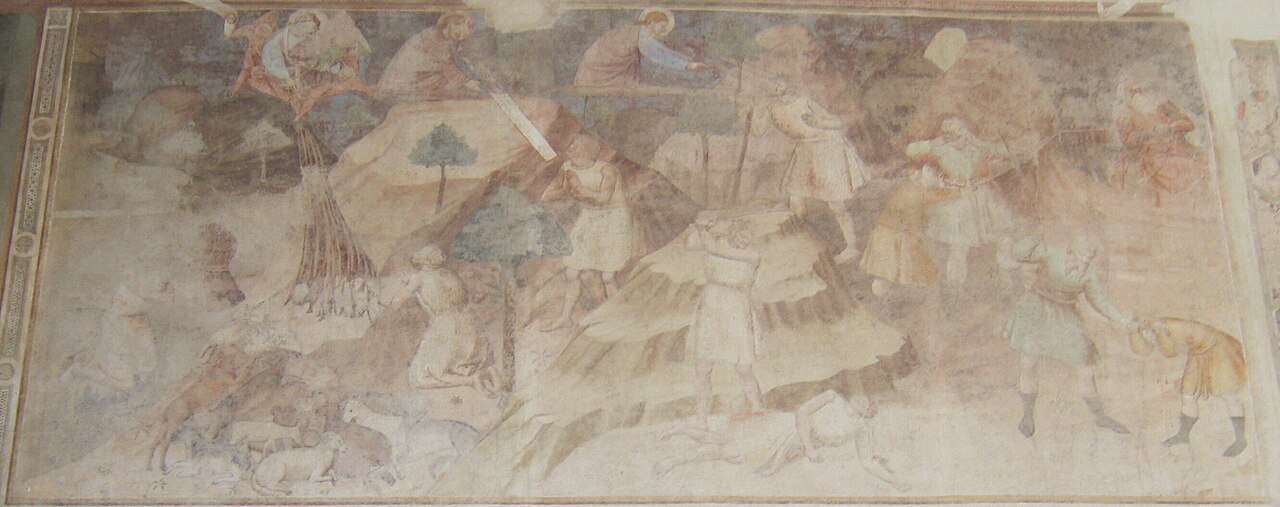
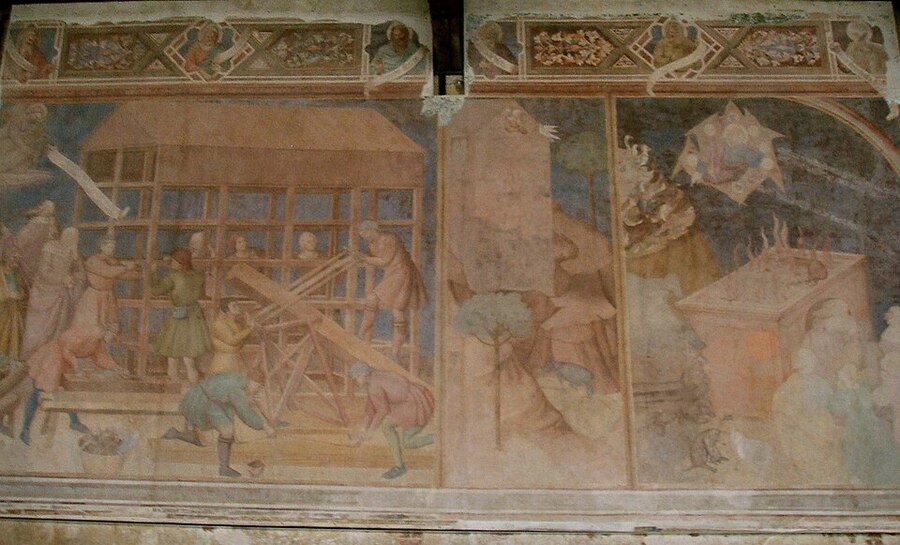
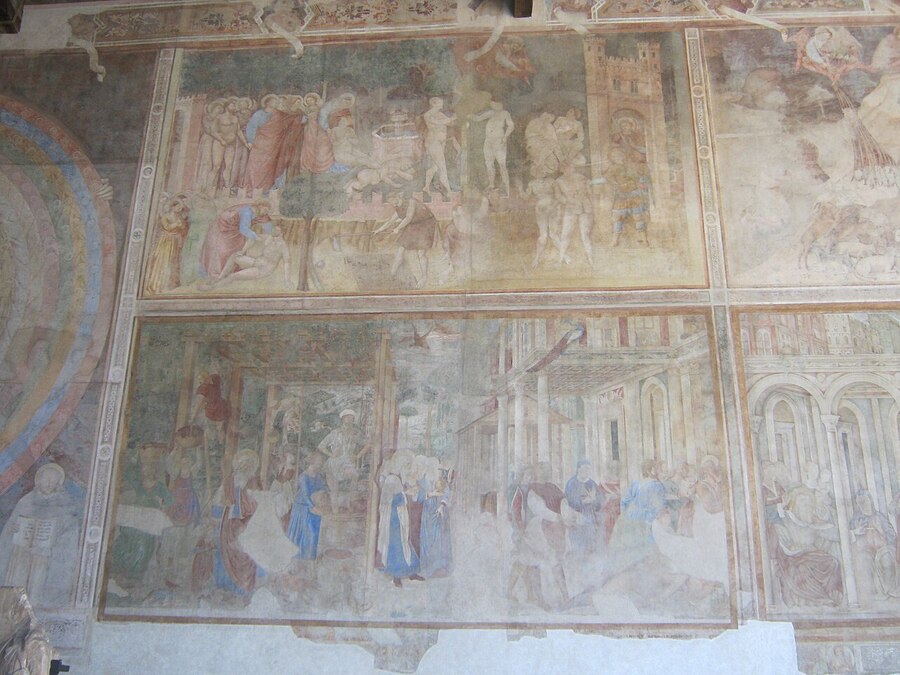
The placement of cosmography in the cemetery is tied to the function of this place: to remind us of the transience of earthly life and the grandeur of divine order. The hierarchical schema of the world visually reinforces this idea: everything in creation has its proper place, and a disruption of order is conceived as a violation of the cosmic hierarchy.
Byzantine Domes
The Byzantine church program proposes a fundamentally different approach to cosmos within sacred space. The cross-domed church was conceived as an image of the universe: the dome symbolized heaven, and Christ Pantocrator was placed at its center, gazing down. Below, on the vaults and walls, angels and saints were arranged according to their hierarchical rank, and even lower were scenes of the earthly life of Christ and the Virgin Mary. Upon entering the church, the viewer was meant first to lift their gaze toward the dome, and then gradually «descend» their view toward the earthly level.
Dome of the Savior Church in the Choir (Khachri-Jami)
Paracclesion of the Saviour Church in Khore (Khachkar-jami) 1315–1321