CONCEPT
Методы иконописи от ранней Византии до XIV века и в наши дни
In this project, I am investigating how icons were created from the early Byzantine period through the 14th century and what techniques contemporary iconographers employ. I compare the preparation of the ground and drawing, the composition of the pigments, the order of applying the paint layers, and the gilding process. To do this, I am consulting artifacts preserved on Sinai, Byzantine and Russian icons, and descriptions of the work of modern masters.
Подготовка основы.
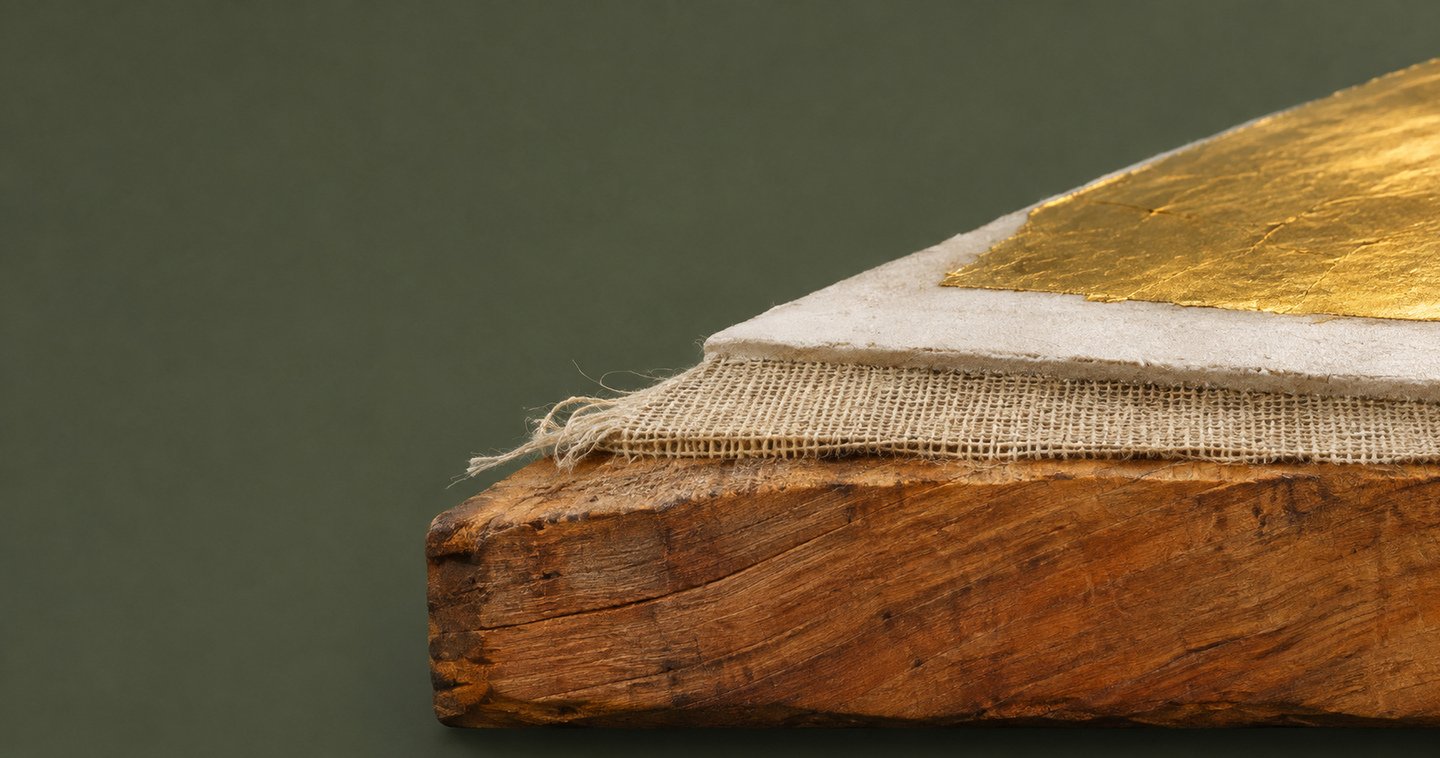
On a Constantinople icon of Saint Peter, dated around 1320, a coarse linen fabric coated with gesso rests on a cedar board. In contemporary traditional iconography, this fabric layer is called pavoloka, and gesso is applied using levkas, which can be made from chalk and animal glue. Some modern workshops create their supports from birch plywood, onto which linen fabric is also applied and gesso is added. In these examples, the material of the support itself changes, but the sequence of surface preparation remains the same.
Подготовка красок.
In early Sinai icons from the 6th–7th centuries, executed in encaustic, beeswax serves as the binder for the pigments. In egg tempera, the egg yolk binds the pigment. The wax also served another function. In the miniature mosaic icon «Eleousa» of the early 14th century, from the Metropoli Museum collection, individual elements of the image were fixed with wax. Contemporary artists continue to work in egg tempera, incorporating pigments into their palette that were new for the medieval period. For example, Peter Murphy added titanium white to the mixture used for faces. The choice of binder also depends on the intended purpose of the work. Dionysios Bulubasis paints individual icons in egg tempera on wood panels, while using acrylic on canvas for church interiors.
Методы письма.
In the application of sankir, the master sets the fundamental tone upon which light is gradually built up. In the Greek tradition, the underlayer serving a similar function is called proplasmos. In Russian icon painting, the modeling of the face using ochre layers with a gradual addition of white lead is called vokhreniye. An example of work in sankir is preserved on the icon «Boris and Gleb» from the mid-13th century. In the area of the artist’s painting depicting Boris’s left hand, researchers identified a subtle greenish sankir, ochre modeling, and soft, translucent highlights. This same principle—moving from the base tone to the light—is employed by contemporary masters.
Методы письма.
With the membrane method described by Aidan Hart, the master begins with a monochromatic tonal drawing using a brush. In the areas intended for highlights, he leaves the white primer exposed. He then applies several transparent layers of flesh tone and adds highlights. Peter Murphy demonstrated this sequence on an icon of Antony the Great. When painting with tempera, light is built up over the base tone. In the membrane method, the light areas are indicated in the drawing from the outset by using the white primer. Murphy documents the contemporary application of this technique, while Hart considers its ancient origins a hypothesis.
Подготовка рисунка и золочение.
The preliminary sketch is applied or transferred onto the ground. Individual contours can be scored to ensure they remain distinct throughout the process. When creating images of saints whose photographs are preserved, contemporary artists have an additional resource. Using his 1999 icon of Saint Elisaveta the Martyr as an example, Aidan Hart explains how photographs help convey the saint’s individual features.
The use of gold leaf in medieval icon painting is confirmed by the icon of Saint Peter, circa 1320. In modern descriptions of gold leaf application, the master first applies a gesso—a preparatory layer based on clay and glue. Then, they moisten it, lay down the gold leaf, and polish the gilded surface.
Визуальная часть.
In the visual component of the project, I will compare the layered schemes of medieval icons with photographs of contemporary masters' work. This will demonstrate how the foundation is structured, at what stage gold is applied, and how the light areas of the face are formed. The comparison shows that egg tempera and paint on gesso remain in modern practice, while the choice of support, pigments, and the sequence of paint layers depends on the technique and the artist’s objective.
Early Icons of Sinai and Egypt.
Christ Pantocrator (Sinai Christ) — 6th Century. Encaustic on wooden panel: pigments were mixed with wax. Monastery of St. Catherine, Sinai.
The Mother of God with the Child between Saints Theodore and George — 6th — early 7th century. Encaustic on wood. St. Catherine’s Monastery, Sinai.
Saint Peter with Medallions — 6th Century. Encaustic and gold on a wooden panel. Monastery of Saint Catherine, Sinai.
St. John the Baptist — presumably 6th century. Tempera on wooden panel. The binder for the paints, as described for the Sinai icon, is unspecified.
Christ and Abbot Mena (Aba Mena) — 8th century. Encaustic and tempera on a sycamore board. It originates from the Monastery of Bawit in Egypt and is held at the Louvre.
Mother of God with Child and Angels — 6th Century. Woven image from Egypt. The depiction is made with multi-colored woolen weaving. Cleveland Museum of Art.
Byzantine Icons. The Middle Ages.
Icon of Deesis — mid-10th century. Ivory relief carving. Presumably created in Constantinople, it is housed in the Metropolitan Museum.
Harbawi’s Triptych—c. 940–960. High relief ivory carving with traces of polychromy and gilding. Constantinople, Louvre.
The Theotokos Hodegetria among angels—c. 1000–1015. Relief plaque carved from ivory. Byzantium, Louvre.
Saint Demetrius—950–1000. Ivory relief carving. Byzantium, Metro Museum.
The Crucifixion and the Theotokos Hodegetria — a two-sided icon featuring layers of painting from the 9th–13th centuries. It was painted tempera on wood. X-ray analysis revealed several stages of painting application. Byzantine and Christian Museum, Athens.
Icons of Byzantium, Rus, and Sinai.
The Vladimir Mother of God—early thirteenth century. Tempera on a wooden board. Parts of the painting were restored later. Byzantine, Tretyakov Gallery.
The Annunciation of Ustyuzh — circa 1130–1140. Tempera on wood panel. Novgorod, Tretyakov Gallery.
Saint George from Yuriev Monastery—12th century, likely 1130s. Tempera on wooden panel. Novgorod, Tretyakov Gallery.
The Savior Not Made by Hands and Adoration of the Cross — second half of the 12th century. Two-sided icon: both images are painted in tempera on a single wooden panel. Novgorod, Tretyakov Gallery.
Archangel Gabriel («Angel with Golden Hair») — late 12th century. Tempera on wooden board. Some sections of the painting were restored in the 17th century. Russian Museum.
The Orans Mother of God («The Great Panagia») — 13th century. Tempera on wooden panel, gold background. Yaroslavl, Tretyakov Gallery.
The Mother of God Bodomlena — 12th century. Tempera on wooden panel, gold background. Vladimir-Suzdal Museum-Reserve.